Asset maintenance logbooks are vital tools for organizations that rely on machinery, equipment, or physical assets. These records document all maintenance activities, repairs, inspections, and adjustments, offering a clear history of an asset’s performance over time.
Maintenance logbooks provide critical insights for maintenance, reliability, and continuous improvement managers. These managers can leverage them to improve equipment reliability, reduce downtime, and optimize preventive maintenance schedules. Here’s how these logbooks benefit different roles within an organization.
How Technicians Can Use Maintenance Logbooks to Diagnose Equipment Failures
Maintenance logbooks are invaluable for maintenance technicians when diagnosing equipment failures. By maintaining detailed and accurate records of previous maintenance work, technicians can quickly identify patterns of recurring issues. When a piece of equipment fails, instead of starting from scratch, technicians can refer to the logbook to check for previous symptoms or malfunctions that may have occurred.
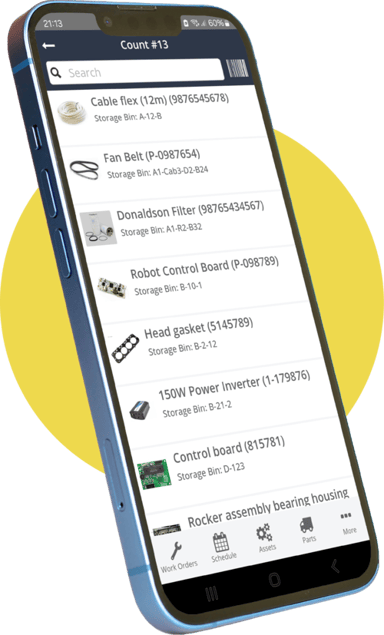
For example, suppose a machine has a history of a belt breaking on multiple occasions. In this case, the technician can see the solution that was implemented, the specific part that was replaced, and where that part is located in their parts room. This not only saves time but also ensures more accurate diagnostics. Logbooks also help avoid redundant repairs, where technicians might unknowingly repeat actions that have proven ineffective.
A detailed record enables maintenance personnel to use more data-driven approaches to troubleshooting and repair, speeding up and making the entire process more efficient.
How Reliability Engineers Can Use Maintenance Logbooks
Reliability engineers can leverage asset maintenance logbooks to conduct Failure Mode and Effects Analysis (FMEA), a crucial process in identifying asset failures and how to decrease or mitigate their impacts in the future. FMEA relies on detailed historical data to assess how and why specific components or systems fail.
Asset logbooks provide this historical insight by documenting when equipment failed, under what conditions, and how those failures were addressed.
By analyzing patterns in the maintenance logbook, reliability engineers can identify common failure modes and their effects. For example, if a particular type of pump has repeatedly required the same kind of repair, this could indicate a systemic design flaw or a misapplication of the asset.
Reliability engineers can use this data to assess the risk associated with continued operation and recommend design modifications, better preventive maintenance plans, or even equipment replacement.
Further, logbooks that include specific information on repairs, parts replaced, and timelines allow engineers to quantify the likelihood and severity of future failures—critical components of FMEA. This process enhances overall asset reliability and can help justify the need for capital investments or changes in maintenance strategy.
Continuous Improvement Through a CMMS
While paper-based logbooks have been a traditional method of recording maintenance activities, modern organizations are increasingly turning to Computerized Maintenance Management Systems (CMMS) to digitize and streamline this process.
CMMS software can store vast amounts of data, automate data entry, and generate reports in real-time. This digitization improves the accuracy of maintenance records, facilitates fast search, and enables better decision-making across the organization.
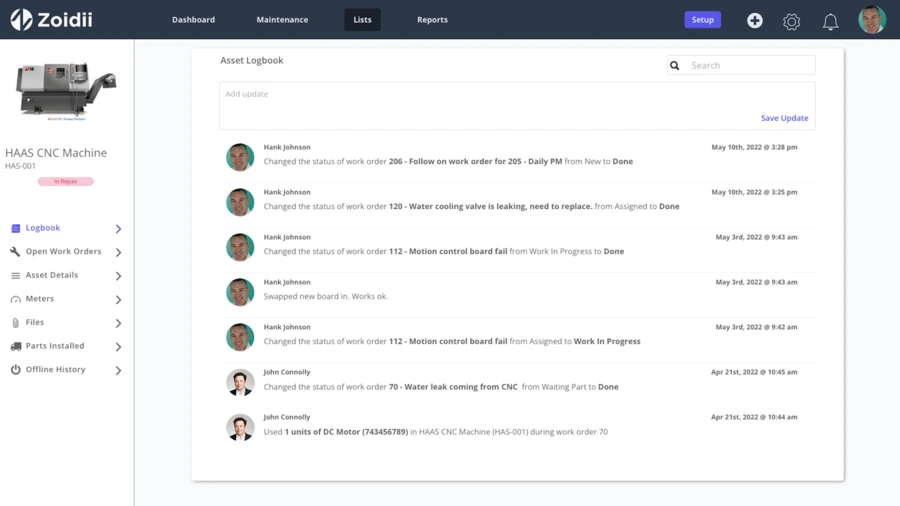
With a CMMS, maintenance logbooks become more powerful tools for reliability and continuous improvement managers. The data stored in a CMMS can be analyzed to track asset performance trends, identify inefficiencies, and inform predictive maintenance strategies.
For instance, continuous improvement managers can use historical maintenance data to determine which equipment consumes the most resources (in terms of time, parts, and labor) and develop strategies to optimize those assets’ performance.
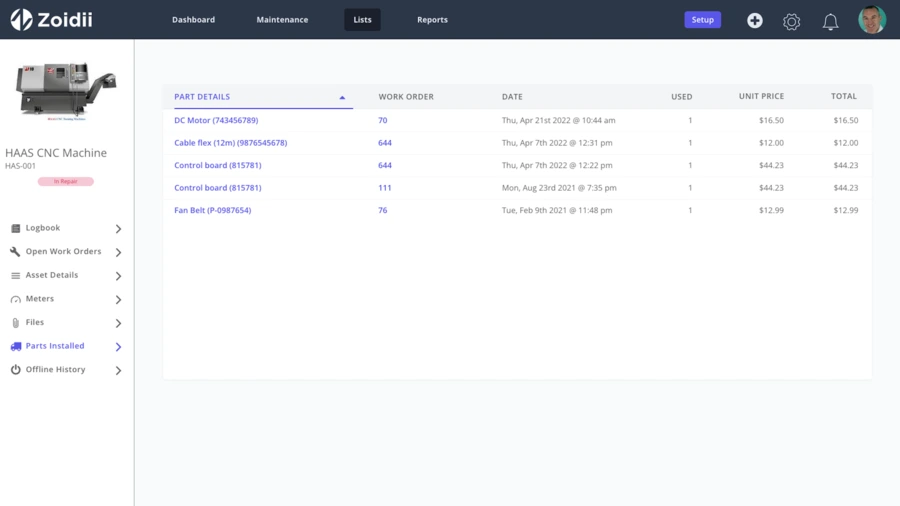
Furthermore, a CMMS can help in tracking key performance indicators (KPIs) such as Planned Maintenance Percentage, Mean Time Between Failures (MTBF), Mean Time To Repair (MTTR), and asset downtime.
This data-driven approach supports continuous improvement initiatives by helping managers focus on high-impact areas. For example, a CMMS can help uncover that certain assets are responsible for a disproportionate amount of downtime, prompting a targeted initiative to improve or replace those assets.
Conclusion
Asset maintenance logbooks are essential tools that bridge the gap between day-to-day operations and long-term asset management strategies. Technicians use them to simplify diagnosing equipment failures, saving time and reducing downtime. Reliability engineers use them to perform comprehensive analyses like FMEA, identifying patterns in failures and implementing strategies to prevent future issues.
With a CMMS, maintenance records become even more powerful, enabling reliability and continuous improvement managers to drive efficiency, optimize asset performance, and extend the lifecycle of critical equipment.
Incorporating detailed and accurate maintenance records into an organization’s maintenance culture can significantly improve reliability, safety, and overall operational efficiency. Logbooks, whether paper-based or digital within a CMMS, ensure that valuable data is retained and utilized to its full potential.