
Key Takeaways
- Most "do you need a CMMS" advice is a sales pitch wearing a question. The honest version names the exact point where paper and spreadsheets stop working, and it says out loud when they still do.
- A spreadsheet holds up until one of four lines is crossed. More than one person needs the same record, your history has to outlive one employee, leadership wants reports it can act on, or an auditor can walk in. Below those lines, keep it. Above them, manual has already quit on you.
- The real competitor is doing nothing. That feels free right up until the day you are paying its full cost by hand, and that day always comes.
Do you actually need a CMMS?
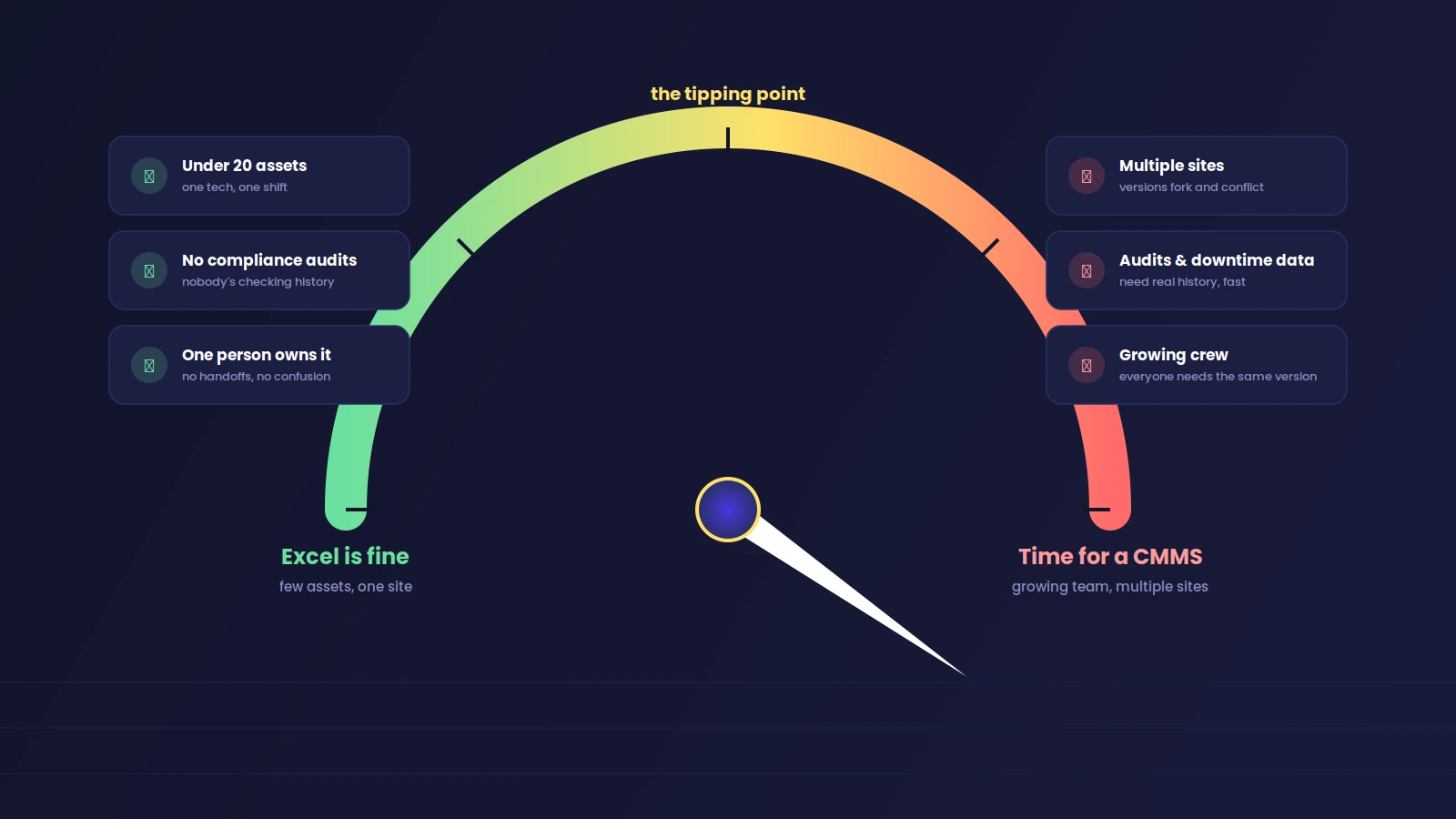
You need a CMMS when your operation crosses one of four lines. Below them you probably do not, and admitting that is the whole point of an honest answer. Above them, manual has already stopped working, and you just have not billed yourself for it yet. The four lines are simple to check:
- More than one person needs the same record. A spreadsheet has one real author. The moment a second person has to read or update it live, it starts to drift.
- The history has to outlive one employee. When the person who remembers every machine leaves, an undocumented operation leaves with them.
- Leadership wants reports it will act on. Once a budget or a headcount decision rests on maintenance data, that data has to be trustworthy and quick to pull.
- An audit can land. The day an inspector asks for records, "it is in a spreadsheet somewhere" is not an answer.
When is a spreadsheet still good enough?
A spreadsheet is genuinely fine when one person owns the records, the asset count is small, nobody else needs to read them in real time, and no regulator is going to ask. If that is you, a well-kept spreadsheet is organized memory, and you do not need to buy anything. We would rather tell you that than sell you a system you do not yet need.
There are two kinds of operations running without a CMMS. One is organized but inefficient, a proactive team that keeps everything in spreadsheets, updates them, and mostly stays on top of the work. The other is firefighting all day with almost nothing written down. Picture a two-person shop with a couple of dozen assets and nobody outside asking for reports. A spreadsheet is the right tool there, and adding software would only be friction for its own sake. So the honest test is simple. Does anyone other than you depend on that spreadsheet? A spreadsheet is a single-owner tool. It works right up to the moment the operation stops being a single-owner operation, and most growing teams cross that line long before they notice the day it happened.
What breaks first when you outgrow a spreadsheet?
Shared truth breaks first. A spreadsheet has one real author, so the moment two people need the same record at once, you start collecting versions, gaps, and quiet errors nobody catches until they matter. The tool does not fail loudly. It stops being trustworthy while still looking fine on the screen.
This is the failure people underestimate, because it is invisible. You email the sheet, someone edits an old copy, and now two versions disagree about when a pump was last serviced. Nobody decided to lose that record. It just happened. Field audits of real operational spreadsheets found that 84 to 91% of them contained errors, in the spreadsheet research of Raymond Panko at the University of Hawaii. A rate that high moves the question from whether your spreadsheet has mistakes to how many, and which decision one of them is about to inform. The job a CMMS actually does here is organization. It gets the work out of log books, phone calls, and one person's memory and into a single place everyone reads from, and analytics or AI are beside the point at this stage. One of our customers, a B&M Retail distribution center, had a maintenance planner spending four to six hours a day chasing colleagues for updates and keeping the record straight. That is most of a working day spent being a human database. At Grace Healthcare, the first change the team noticed was quieter and bigger. Everyone could finally see who did what, and when, without having to ask.
What happens to everything you know when someone leaves?
It walks out the door. In most manual operations the real maintenance system is one veteran's memory, and that memory has no backup. When they retire or quit, the next person starts from zero, with no history, no reasons, and no record of what tends to fail or what has already been tried.
This is the threshold that costs the most and shows up the latest. A spreadsheet captures what someone chose to type into it. It does not capture the twenty years of judgement about which machine runs hot in summer or which pump was rebuilt last spring. Put that knowledge into a system as work orders and asset history build up, and it stays with the business instead of the individual. Holistic Industries saw exactly that after moving off manual records. The information now lives in the system, where it stays put no matter who comes or goes. That is the real value, and it is the least glamorous thing a maintenance system does. It keeps institutional memory alive after the person who held it is gone. A whiteboard nobody updates and a spreadsheet only one person understands are the same risk wearing different clothes, one resignation away from being paper again.
What happens when leadership asks for numbers you don't have?
You lose the argument before you start it. When maintenance data lives in a spreadsheet only you can read, the rest of the business sees maintenance as a single yearly cost line with nothing underneath it. When the budget conversation comes, you bring instinct and they bring a number, and the number wins.
One head of engineering at a large manufacturer described maintenance as a black box to the wider organization. Its costs were known only as a yearly total, with no visibility into which assets drove them or what failed repeatedly. Operations like that live comfortably in the dark until someone above shines a light, and by then the questions are pointed. This is the threshold where a spreadsheet quietly caps your career, because you cannot make a case you cannot evidence. A CMMS changes that by turning daily work into a record you can pull on demand. At Grace Healthcare, the team can pull metrics or data for any facility in seconds, whether for an internal review or when an inspector asks. The value shows up in the budget meeting, where you arrive with the evidence already in hand and the decision goes on your terms instead of despite you. The dashboard is just where it lives.
What is the status quo actually costing you right now?
More than you have measured, because none of it lands on an invoice. Doing nothing feels free, so the spreadsheet survives long after it stopped working. The real bill shows up as lost records, a report leadership asked for that takes two weeks to assemble, and an audit that turns into a three-week scramble through filing cabinets and inboxes.
"I cannot afford the disruption" is the wrong objection, because the disruption is already here. You are absorbing it by hand, in overtime, in re-done work, and in the standing risk that the one record you need will not be there when it counts. You are not behind the curve, either. About half of maintenance teams still keep at least part of their asset register in spreadsheets rather than dedicated software, in SFG20's 2026 State of Facilities Management report. So the real question is about the specific day the gap catches up with you, and for a lot of teams that day is an audit. At Tricel, before they moved off paper, auditors walked from machine to machine checking the paperwork against the PM schedule by hand. Afterward, the same records came out of the system in seconds. The audit got easier for one reason. The record finally existed in one place.
So how do you know it's time?
Run your own operation against the four lines. If you have crossed even one, you do not need more convincing that you need a CMMS. You need to stop paying for the gap by hand. If you have crossed none of them, keep your spreadsheet and revisit the question when the operation grows into it. The decision really is that concrete.
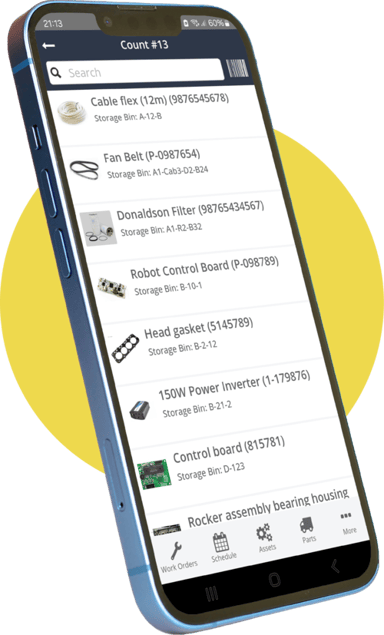
This is also how to weigh any system you look at, including ours. The question to put to a vendor is how fast a real team can be logging real work, and what the person holding the wrench actually sees on their phone. Feature count tells you almost nothing here. A system that cannot get a small team organized in its first days will not survive contact with a plant floor, whatever the demo looked like. Leaving paper behind is the moment the operation stops running on one person's memory and starts running on a record everyone can trust. That is a bigger decision than whether you can afford the software this quarter.
So, do you need a CMMS? You need one the day your operation outgrows a single person's memory and a single author's file, and you will usually feel that day before you can prove it on paper. Until then a spreadsheet is a fair answer, and anyone honest will tell you so. After it, the only thing doing nothing buys you is the cost of doing it all by hand, over and over, until it finally costs you the one record you could not afford to lose. The choice was never which CMMS. It is whether you are ready to stop absorbing that cost yourself.
References
- Raymond Panko, University of Hawaii. Spreadsheet Research, audits of operational spreadsheets (84–91% contained errors). https://panko.com/ssr/Audits.html
- SFG20. State of Facilities Management 2026 Report (about half of teams still keep asset registers in spreadsheets rather than dedicated software). https://fmuk-online.co.uk/less-than-2-in-5-fm-professionals-have-100-accurate-asset-registers-reveals-new-survey/
- Grace Healthcare case study (visibility into who did what and when; data pulled in seconds for review or inspectors). https://zoidii.com/case-study/grace-healthcare
- Holistic Industries case study (maintenance knowledge retained in the system). https://zoidii.com/case-study/holistic-industries
- Tricel case study (audit records pulled from the system in seconds). https://zoidii.com/case-study/tricel
- B&M Retail (maintenance planner time lost to manual chasing). Named customer, no public case study URL.