
Key Takeaways
- A spreadsheet and a CMMS are built for two different jobs. A spreadsheet is a private list one person keeps. A CMMS is a shared record the whole team writes to and reads from.
- Excel is genuinely the right call when one person tracks a handful of assets and nothing rides on the paperwork. Below that line, the spreadsheet still beats the software, and any honest comparison will say so.
- The switch earns its keep the day your record has to be shared, has to outlast the person who keeps it, or has to satisfy an auditor. Until then, a well-kept sheet beats a system nobody opens.
When is a spreadsheet genuinely the right tool?
A spreadsheet is the right tool when one person can hold the whole operation in their head and the file is a backup for their memory. Say you look after a couple of dozen assets. You are the only one updating the file, and no auditor will ever ask you for a maintenance record. In that case, Excel does the job at zero cost. You are in good company there. As of 2020, half of manufacturing plants still tracked maintenance on in-house spreadsheets, and plenty of them ran well [1].
We think of these teams as the organized camp. They run a tidy operation that happens to live in a spreadsheet, a world away from the reactive teams firefighting all day. If that describes you, keep the sheet until something forces the question. Buying software to replace a file that already does everything you need is a project you do not have time for. The discipline that keeps that sheet current is worth more than any feature you would be paying for. The trap is assuming the file will always stretch to fit. It stretches right up until the day it cannot, and that day rarely announces itself in advance.
CMMS vs spreadsheet: what actually separates them?
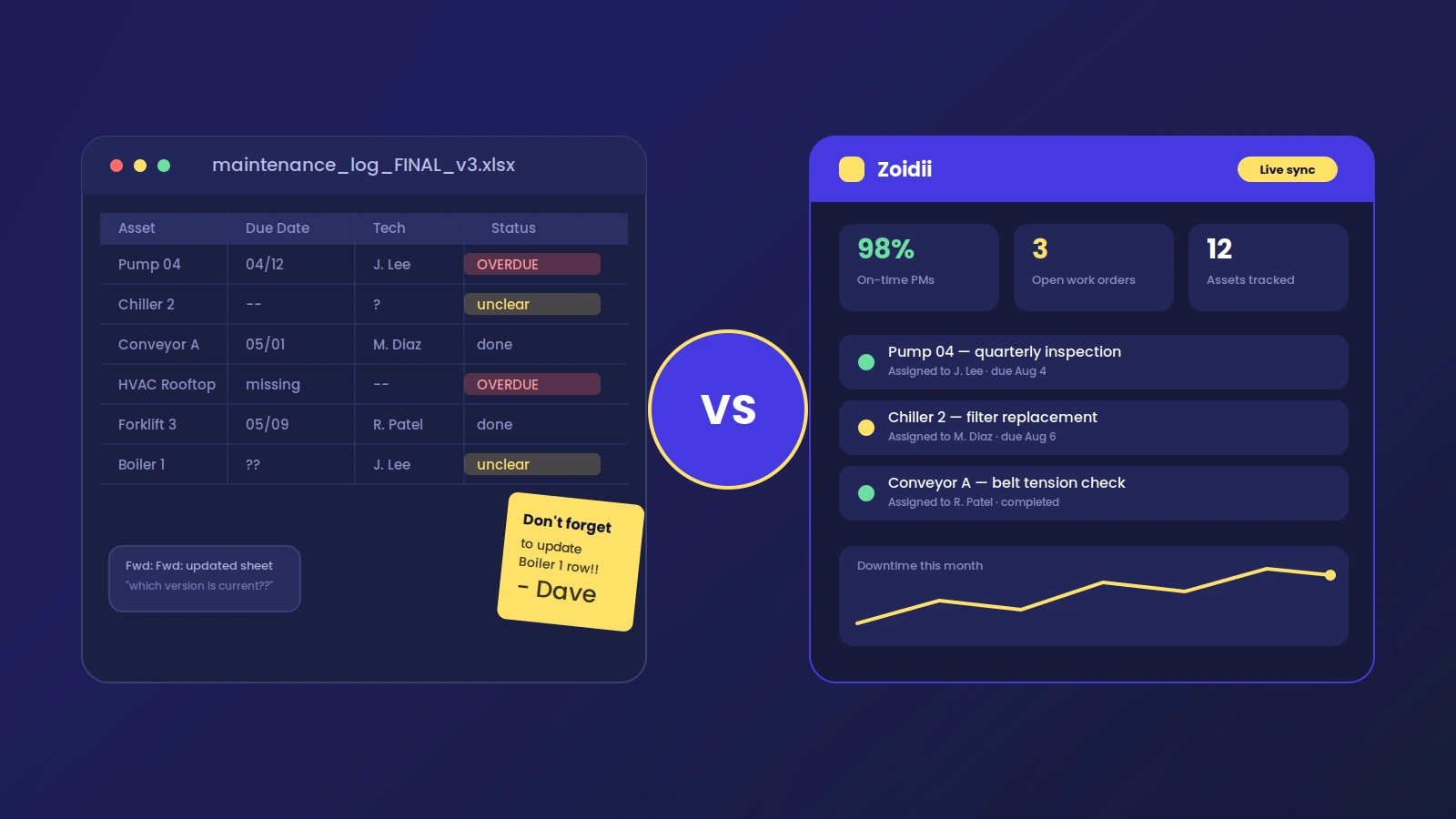
Forget the feature list for a moment. The difference that decides everything is who the record belongs to. A spreadsheet is a file one person owns and maintains. A CMMS is a shared record the whole team writes to and pulls from. Ask a maintenance manager what they actually need and the answer is organization, getting scattered information into one place the team can reach. Analytics and dashboards come later, if they come at all.
That one difference drives the rest. When the record is a private file, its accuracy rests entirely on one person keeping it current. When it is a shared system, the record updates itself as the work is logged. The gap shows up in the numbers. Teams running their asset register in dedicated software average about 70% accuracy. Spreadsheets and paper land closer to 60% [2]. Here is the same comparison across the things a maintenance manager feels day to day.
Where does a spreadsheet actually break?
A spreadsheet breaks at the second person. The moment two people update the same file, versions fork. One entry quietly overwrites another, and the record you trusted stops being true without anyone noticing. It breaks again when the person who keeps it leaves. Everything they knew about the machines goes with them. Which asset fails every winter, which bolt strips if you overtighten it, lived in their head. The sheet only ever held a fraction. A shared system keeps that history where the next person can find it. At the manufacturer Tricel, technicians began reviewing an asset's full work order history before starting a repair, so they understood its condition before they picked up a tool [3].
The break you cannot see coming is the one that lands from above. Someone asks for numbers. A head of engineering we work with described maintenance as a black box to the rest of the business, a yearly cost with no view of which assets drove it. With a spreadsheet, the report leadership wants is a weekend of manual assembly, and it is only as accurate as the memory of the person building it. With a shared record it is a filter and a few clicks. B&M Retail pull the reports that prove compliance in four clicks, and since leaving manual records behind they have passed every audit [4]. A spreadsheet was only ever built to hold a list, while an auditor wants the time-stamped trail that shows the work happened when you say it did.
Does moving off a spreadsheet just trade one problem for another?
It can, and this is the part a vendor rarely admits. A CMMS the team does not actually use is worse than a spreadsheet one person keeps well, because the record ends up both empty and expensive. The switch only pays off when the people holding the wrench genuinely adopt it. So before you migrate a single row, ask the harder question. Will your team update this every day, or will it become one more login nobody opens? The answer to that decides whether the move was worth it, far more than any side-by-side feature count.
That question is worth carrying into any vendor conversation, because it is the same one that separates a good CMMS from an expensive one. A system is only ever as good as the record the team is willing to keep in it. Push a demo past the dashboards and ask what the technician sees on their phone, and whether they can log a job in the time it takes to write it on a clipboard.
The choice in cmms vs spreadsheet comes down to one thing: whether your maintenance record still fits inside one person's file. While it does, the spreadsheet is a fair answer, and you should not let anyone shame you off it. When it stops fitting, when the record has to be shared, has to outlast the person keeping it, or has to satisfy someone who was not in the room, the spreadsheet hasn't done its job. The operation has simply grown past what a single file can hold.
References
- Plant Engineering / Advanced Technology Services, 2020 Maintenance Study. https://www.advancedtech.com/wp-content/uploads/2020/03/2020-ATS_Plant-Engineering-Maintenance-Study-Results.pdf
- SFG20, State of Facilities Management 2026 Report. https://fmuk-online.co.uk/less-than-2-in-5-fm-professionals-have-100-accurate-asset-registers-reveals-new-survey/
- Tricel, Zoidii case study. https://zoidii.com/case-study/tricel
- B&M Retail, named customer outcome (no public case study URL).