
Asset criticality is a crucial concept in asset management and maintenance strategy that focuses on determining the relative importance of various assets in an organization's operations. By understanding asset criticality, businesses can prioritize maintenance efforts, allocate resources more effectively, and ensure operational reliability.
It provides a systematic approach to identifying which assets are essential to the production process and how their failure could impact the organization in terms of safety, downtime, financial loss, and productivity. Determining asset criticality allows organizations to focus on equipment with the highest impact on safety, production, and operational efficiency.
In today's highly competitive and cost-conscious business environment, organizations must adopt effective asset management strategies to maximize efficiency and minimize risks. Asset criticality assessment plays a significant role in achieving these goals by helping organizations focus on the most critical assets that drive business success.
This article explores the concept of asset criticality, its importance, the methodology for conducting an asset criticality analysis, and how to use the results to improve overall operational efficiency.
What is Asset Criticality?
Asset criticality refers to the process of evaluating and ranking assets based on their importance to an organization's overall operation. This ranking helps identify which assets require the most attention regarding maintenance, monitoring, and resource allocation.
Critical assets are those whose failure could result in significant disruptions, safety hazards, financial losses, or regulatory violations. Less critical assets, while still important, pose a lower level of risk if they fail.
The core idea behind asset criticality is to ensure that maintenance and operational efforts focus on assets with the highest impact on business performance. It allows organizations to prioritize maintenance activities based on the potential consequences of asset failure rather than treating all assets equally.
Key Factors in Asset Criticality
Several factors contribute to determining the criticality of an asset, including:
- Impact on Production: How essential is the asset to the production process? Will its failure lead to significant downtime or reduced output?
- Safety and Environmental Risk: Does the asset pose any safety or environmental risks if it fails? For example, the failure of specific equipment in industries such as air travel, oil and gas, or chemicals could lead to catastrophic accidents.
- Financial Impact: What is the economic cost of the asset's failure? This includes repair costs, lost revenue, fines, or penalties.
- Compliance and Regulatory Requirements: Some assets are subject to regulatory compliance, and their failure could result in legal or regulatory penalties.
- Redundancy: Does the asset have backup systems in place? If an asset has backup redundancy, its failure may not have the same critical impact without a backup.
The Importance of Asset Criticality
Asset criticality is fundamental to optimizing maintenance and operational strategies. Prioritizing the most critical assets ensures that an organization's uses its resources effectively. Below are some key reasons why asset criticality is essential:
1. Optimized Maintenance Planning
Organizations often need more resources to maintain all assets simultaneously. Without understanding asset criticality, there is a risk of under-maintaining critical assets or over-maintaining non-critical ones. By focusing on critical assets, organizations can ensure that maintenance efforts are aligned with the importance of the asset, reducing the likelihood of catastrophic failures.For example, if an organization knows that a particular piece of machinery is critical to production, it can prioritize preventive maintenance for that asset, minimizing the risk of unplanned downtime.
2. Improved Resource Allocation
Efficient resource allocation is essential for businesses to remain competitive. Conducting an asset criticality analysis allows organizations to allocate their resources—such as labor, spare parts, and financial investments—more efficiently. Instead of spreading resources thinly across all assets, organizations can focus their efforts on the most critical assets of the operation.3. Enhanced Risk Management
Asset criticality plays a pivotal role in risk management by identifying which assets pose the most significant risk if they fail. Understanding the risks associated with critical assets allows organizations to develop appropriate mitigation strategies. This could involve increasing the frequency of inspections, implementing condition-monitoring technologies, or creating contingency plans for critical assets.4. Cost Reduction
One of the most significant benefits of conducting an asset criticality assessment is the potential for cost reduction. By focusing on critical assets, organizations can avoid unnecessary maintenance on non-critical assets, reducing operational costs. Moreover, the timely maintenance of critical assets prevents unexpected breakdowns and costly emergency repairs, further reducing maintenance expenses.5. Increased Equipment Reliability
Improved focus on critical assets results in increased equipment reliability. When well-maintained, critical assets are less likely to fail unexpectedly, leading to a more stable and efficient production process. High equipment reliability reduces the likelihood of production delays, enhances product quality, and contributes to a safer working environment.6. Regulatory Compliance
Asset failure can result in legal or regulatory penalties in industries with stringent regulatory requirements, such as pharmaceuticals, energy, and aviation. Identifying critical assets subject to compliance ensures they are properly maintained and meet all regulatory standards.Steps for Conducting an Asset Criticality Assessment
An asset criticality analysis involves a structured approach that evaluates assets based on their potential impact on operations. Below are the critical steps involved in conducting a successful analysis:
Step 1: Asset Identification
The first step in an asset criticality analysis is identifying all the assets within the organization. Create a comprehensive asset registry or inventory that includes every piece of equipment, tool, and infrastructure. Asset identification should also cover production and support assets, as failures in support systems (such as HVAC or electrical systems) can also impact operations.Step 2: Define Criticality Criteria
Once asset identification is complete, the next step is to define the criteria used to evaluate their criticality. As mentioned earlier, typical criteria include:- Safety risk: Impact of asset failure on employee and public safety.
- Production impact: The degree to which failure disrupts operations.
- Downtime costs: Financial losses incurred due to equipment failure.
- Regulatory compliance: Whether failure leads to legal or compliance issues.
- Maintainability: Ease of performing repairs and maintenance.
- Redundancy: Availability of backup systems to mitigate failures.
- Safety Risk: 30%
- Production Impact: 25%
- Downtime Cost: 20%
- Regulatory Compliance: 15%
- Maintainability & Redundancy: 10%
Step 3: Score and Rank Assets
After defining the criteria, each asset is scored based on how well it meets each criterion. Scoring can be done using a numerical scale (e.g., 1-5) or a qualitative assessment (e.g., low, medium, high). For instance, an asset that poses a high safety risk if it fails may receive a score of 5 in the "safety risk" category.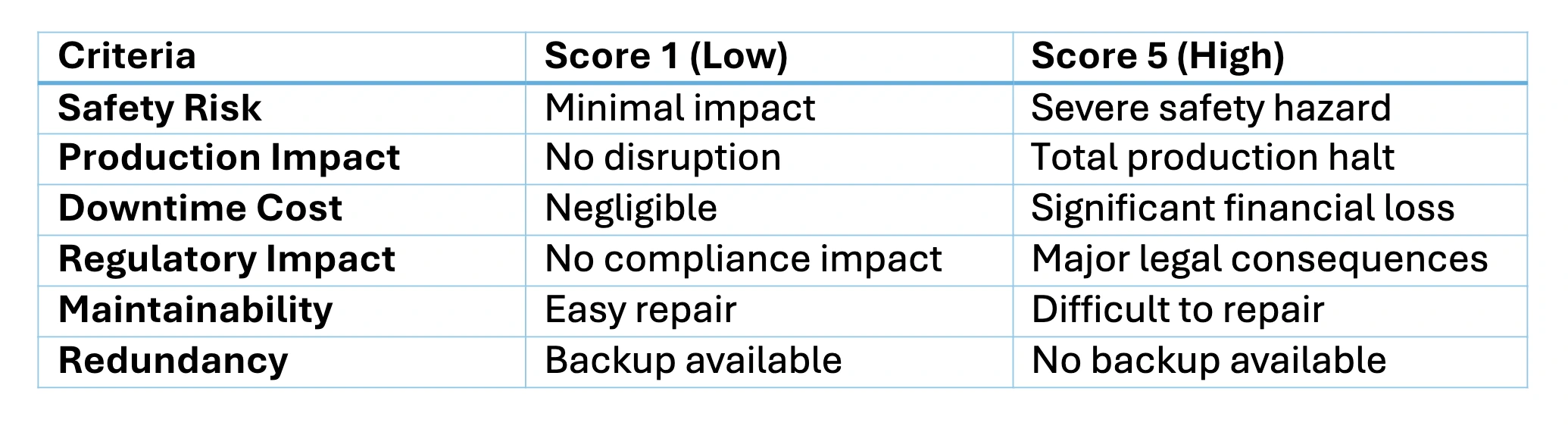
Multiply each asset’s score by the corresponding weight and sum the values to obtain the total criticality score.
Once scored, assets are then ranked in order of criticality. This ranking allows organizations to identify the most critical and least critical assets. Step 4: Assign Maintenance Priorities With the criticality ranking, organizations can assign maintenance priorities based on each asset's relative importance. Critical assets should be prioritized for preventive maintenance, condition monitoring, and inspections, while less critical assets may require less frequent attention.
Step 5: Implement Maintenance Strategies
The next step is to implement tailored maintenance strategies for each criticality level. Organizations may implement advanced maintenance strategies for highly critical assets, such as predictive maintenance, which uses real-time data to predict potential failures. They may adopt a more reactive or preventive maintenance approach for less critical assets.Step 6: Monitor and Review
Asset criticality is not a one-time analysis. Over time, factors such as equipment age, changes in production processes, or shifts in organizational priorities may alter the criticality of assets. Therefore, it is essential to monitor asset performance and periodically review the criticality assessment to ensure it remains relevant.What Tools Can You Use for Calculating Asset Criticality?
Organizations can use different tools and software solutions to streamline asset criticality analysis, including:
- Computerized Maintenance Management Systems (CMMS): Automates asset tracking, failure history, and maintenance schedules.
- Failure Mode and Effects Analysis (FMEA): Identifies potential failure modes and their impact.
- Risk Matrix and Decision Matrices: Helps visualize and prioritize risks based on likelihood and severity.
Using Asset Criticality Data for Operational Improvement
Maintenance, reliability, and operations leaders can use the insights gained from an asset criticality analysis to improve various aspects of organizational operations:
1. Predictive Maintenance
By focusing on critical assets, organizations can implement predictive maintenance strategies on the equipment that really needs it. Predictive maintenance uses sensors and data analytics to monitor equipment conditions in real time and predict when maintenance is needed. Predictive maintenance helps avoid failures before they occur, ensuring critical assets remain operational.2. Resource Optimization
Organizations can use asset criticality data to optimize resources such as spare parts, maintenance personnel, and financial investments. By focusing resources on critical assets, organizations can reduce overall maintenance costs while ensuring that essential equipment receives the attention it needs.3. Risk Mitigation Plans
Criticality assessments help organizations identify high-risk assets and develop risk mitigation plans. For example, an organization might invest in redundancy or backup systems for assets critical to production but with a high risk of failure.4. Capital Planning and Asset Replacement
Criticality data can also inform capital planning decisions. By identifying aging or underperforming critical assets, organizations can prioritize replacing or upgrading them to avoid future risks. This ensures that organizations direct capital expenditures toward the assets with the most significant impact on business performance.Five Steps to Implement an Asset Criticality Program
1. Engage Cross-Functional Teams: Involve maintenance, operations, and safety teams in the assessment process.
2. Review and Update Periodically: Reevaluate asset criticality periodically as operational conditions change.
3. Integrate with Maintenance Strategies: Align asset criticality scores with preventive, predictive, and condition-based maintenance programs.
4. Leverage Data Analytics: Use historical failure data and predictive analytics to refine criticality scoring.
5. Communicate Findings: Ensure stakeholders understand criticality rankings and resource allocation priorities.
Challenges in Implementing Asset Criticality
While asset criticality offers significant benefits, organizations may face challenges when implementing this approach:
- Data Availability: Accurate criticality assessments require comprehensive data on asset performance, failure history, and maintenance needs. Organizations that lack detailed asset data may find it challenging to conduct a precise criticality analysis.
- Resistance to Change: Implementing asset criticality involves shifting resources and priorities, which can meet resistance from stakeholders accustomed to traditional maintenance practices.
- Complexity of Multi-Asset Environments: In large organizations with diverse assets, conducting a criticality analysis across different systems, locations, and departments can be complex and time-consuming.
Asset Criticality to Improve Maintenance Efficiency
Asset criticality is a powerful tool for optimizing maintenance strategies, improving resource allocation, and minimizing risks. By focusing on the most critical assets in an organization, businesses can increase equipment reliability, reduce costs, and enhance overall operational efficiency.
With a structured approach to asset criticality analysis, organizations can make informed decisions about maintenance, asset replacement, and risk mitigation, ultimately driving long-term success.