Background
How well can you answer the following questions regarding your equipment, buildings, or vehicles?
- Which piece of equipment has experienced the most chronic (low-cost, high-frequency) failures in the last six months?
- What kind of equipment has experienced the most significant failures between planned preventive maintenance (PMs) in the last two years?
- What are the most common issues?
What exactly are failure codes?
Failure codes are alphanumeric or text identifiers that specify why an asset failed. Classifying an issue or work order with failure codes eliminates the need for human effort when mining maintenance data for patterns and recurring issues. Failure codes are essential for tracking and diagnosing problems in maintenance management.
These codes help identify the root cause of problems, streamline maintenance processes, and improve overall equipment reliability. Here is a list of some of the top failure codes commonly used in various industries
Example failure codes
In the past, maintenance applications used abbreviated failure codes, such as "OPER" for operator error, due to limitations on database size. Most maintenance applications do not have such restrictions today, so most modern applications utilize full-text failure codes. Some examples include:
- Bearing problem
- Calibration
- Contamination
- Corrosion
- Equipment jams
- Excessive Vibration
- Leaking
- Operator Error
- Overheating
Types of failure codes
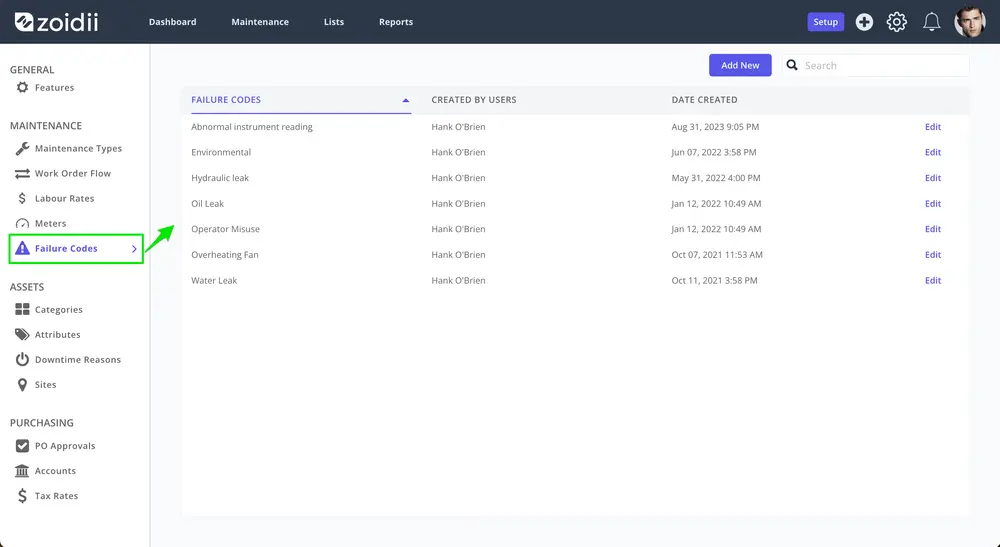
There are many methods for creating and deploying failure codes, but asset and inspection-based failure codes are the most common.
1. Failure Codes Based on Assets An asset-based approach assigns failure codes to each asset, which may be common to many assets or unique to a specific asset, covering all possible causes for failure. Failure codes "follow" assets to work orders, allowing technicians to choose from a smaller range of codes unique to the asset.
2. Failure Codes Based on Inspection Inspection-based failure codes account for the various types of failures that may occur during visual inspections. Failure codes, for example, are created for generic situations such as noise, apparent damage, fluid levels, and vibrations. Inspection-based failure codes are broader than asset-based failure codes, making the collection of codes more manageable and efficient.
Why Use Failure Codes
Failure codes are a valuable tool for optimizing maintenance. They provide an easy way to quickly tag equipment failures, problems, and faults. The failure code data can then be analyzed to help identify trends.
Failure codes help maintenance departments become more efficient by highlighting undesirable patterns. Using failure codes in your CMMS software is crucial for several reasons:
1. Root Cause Analysis: Identifying and documenting specific reasons for equipment failures helps understand underlying issues, enabling better diagnosis and prevention. Let's say a particular code appears consistently, such as "Part failed on install." It may indicate issues with how the parts are handled or installed. The organization could implement new guidelines for parts handling or parts installation training to reduce similar problems in the future.
2. Improved Maintenance Planning: Failure codes provide valuable data that can be used to plan and prioritize maintenance tasks more effectively. Additional proactive tasks can be added to preventive maintenance schedules to reduce the likelihood of similar failures recurring.
3. Cost Reduction: By analyzing failure trends, organizations can implement strategies to reduce repetitive failures, thereby lowering repair costs and downtime. For example, let's say the failure code data in your CMMS indicates that overheating is the primary issue with your equipment. You could consider measures to reduce overheating, such as installing cooling fans or adding vents to equipment enclosures.
4. Regulatory Compliance: Accurate failure reporting helps ensure compliance with industry standards and regulations, supporting audits and safety protocols.
5. Equipment design issues: Failure codes may indicate issues with equipment design or raw materials. This data can indicate design flaws or weaknesses in the equipment, leading to targeted improvements in future designs or modifications to existing equipment.
Failure codes implementation best practices
1. Standardization across the business
Ensure that failure codes are standardized across the organization to maintain consistency in reporting and analysis.2. Training is key
Train maintenance personnel on the proper use of failure codes to ensure accurate and effective reporting.3. Integration within your CMMS
Integrate failure codes into your CMMS to automate data collection and analysis, making it easier to track and address recurring issues.4. Analyze on a regular basis
Analyze failure code data regularly to identify trends and root causes, which can help improve preventive maintenance strategies and reduce downtime.5. Effective documentation
Maintain detailed records of failure codes and their associated corrective actions to build a comprehensive knowledge base for future reference.6. Strike the right balance
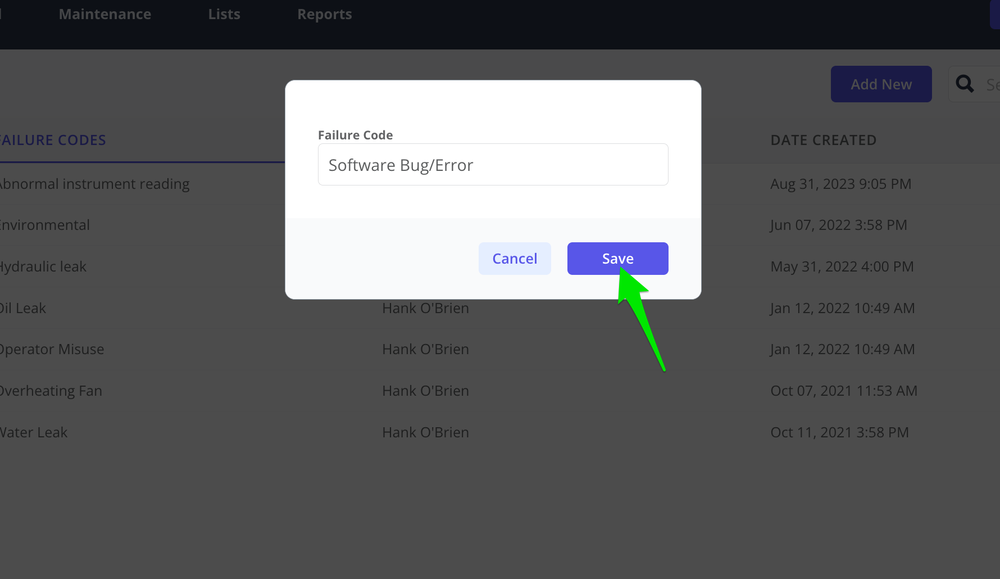
It is critical to strike the right balance between too few and too many failure codes. Insufficient failure codes lead to incorrect work orders and incomplete data. Too many failure codes are confusing, causing technicians to use catch-all terms such as "other" or "miscellaneous."As a general rule, aim for approximately 25 codes.
7. Assign ownership to the correct group
The technician completing the work has first-hand knowledge of the issue, so they are best suited to assign the failure code to the work order.8. Implement failure codes naming convention
Codes, like assets in a CMMS, need a consistent tagging scheme. Filtering or running reports will provide incorrect insights if multiple operators describe the same failure as "leak," "leaking," or "leaks." CMMS applications with user-configurable dropdowns help ensure consistency, making the data easier to interpret.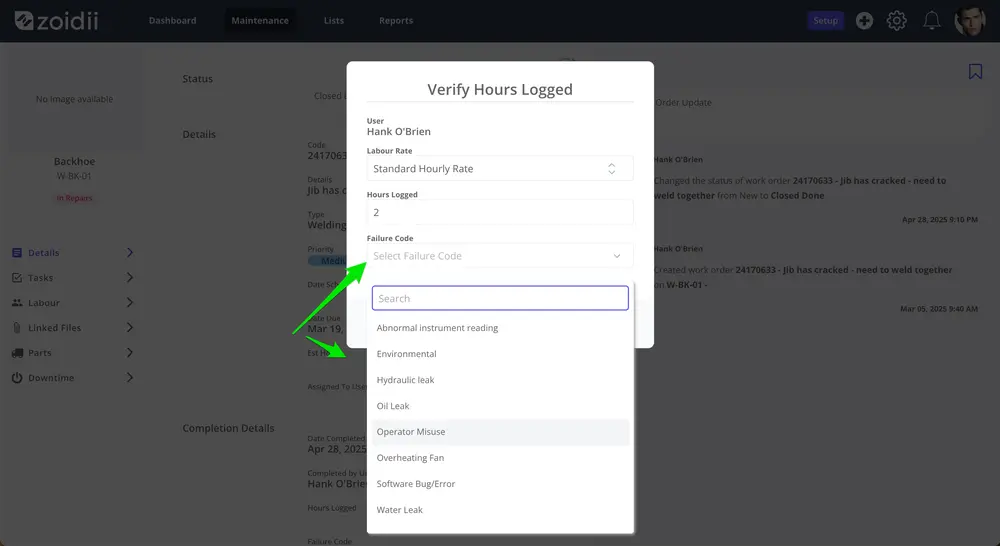
Sample failure codes implementation
1. Mechanical Failures
- M-001: Bearing Failure
- M-002: Gearbox Failure
- M-003: Shaft Misalignment
- M-004: Seal Leakage
- M-005: Lubrication Failure
2. Electrical Failures
- E-001: Motor Failure
- E-002: Circuit Breaker Trip
- E-003: Wiring Short Circuit
- E-004: Power Supply Failure
- E-005: Control System Failure
3. Hydraulic Failures
- H-001: Hydraulic Pump Failure
- H-002: Hose or Pipe Leakage
- H-003: Hydraulic Cylinder Failure
- H-004: Valve Malfunction
- H-005: Hydraulic Fluid Contamination
4. Pneumatic Failures
- P-001: Compressor Failure
- P-002: Air Leak
- P-003: Actuator Failure
- P-004: Pressure Regulator Malfunction
- P-005: Pneumatic Control System Failure
5. Structural Failures
- S-001: Cracked Welds
- S-002: Structural Fatigue
- S-003: Corrosion Damage
- S-004: Material Deformation
- S-005: Fastener Failure
6. Process Failures
- PR-001: Temperature Control Failure
- PR-002: Pressure Control Failure
- PR-003: Flow Control Failure
- PR-004: Chemical Contamination
- PR-005: Process Sequence Error
7. Software and Control System Failures
- SC-001: PLC (Programmable Logic Controller) Failure
- SC-002: Software Bug/Error
- SC-003: Network Communication Failure
- SC-004: Sensor Malfunction
- SC-005: Data Corruption
8. Human Error
- HE-001: Incorrect Installation
- HE-002: Improper Operation
- HE-003: Insufficient Maintenance
- HE-004: Poor Quality Workmanship
- HE-005: Inadequate Training
9. Environmental Factors
- EF-001: Temperature Extremes
- EF-002: Humidity/Moisture Damage
- EF-003: Dust and Dirt Contamination
- EF-004: Vibration and Shock
- EF-005: Chemical Exposure
10. Other Common Failures
- O-001: Wear and Tear
- O-002: Obsolescence
- O-003: Overload
- O-004: Misuse
- O-005: Lack of Spare Parts
Maximize the impact of failure codes during troubleshooting
Failure codes simplify the analysis of repair data. Ultimately, this proactive approach enhances reliability, reduces downtime, and lowers maintenance costs. By systematically recording and analyzing failure codes in your CMMS software, patterns of recurrent failures or specific types of malfunctions can be detected.
The consistent use of failure codes provides a convenient method for gathering statistics about equipment failures or breakdowns. Analysis, in turn, provides knowledge of equipment failure behavior patterns concerning other external and internal factors such as "working" age, PM frequency, EHM parameters and decision models, operational tradeoffs, etc.
While each company will decide which codes are most useful for asset management, standardized failure codes are vital in a CMMS system. Subsequently addressing the repeat issues identified will ultimately lead to a more profitable organization.
By utilizing these failure codes and implementing best practices for their effective use, organizations can significantly enhance their maintenance management processes, resulting in improved equipment reliability, reduced downtime, and lower maintenance costs.