Your maintenance budget is likely leaking 15% of its total value on the cost of poor quality, and most of that money is spent fixing the exact same problems you thought you solved last month.
It's exhausting to play the hero in a never-ending cycle of equipment failures while the C-suite breathes down your neck about uptime. You already know that band-aid fixes are a waste of time, but when the work order backlog is growing, digging deeper feels like a luxury you can't afford. It's time to stop the bleeding.
This guide is your no-nonsense roadmap to mastering root cause analysis without the over-engineered corporate fluff. You'll learn how to stop treating symptoms and start killing the core problems that wreck your maintenance schedule.
We'll show you how to use a "stupid simple" process to identify the real issues, leverage your CMMS data for asset replacement justifications, and adopt a 72-hour rhythm to resolve failures for good. By the end of this article, you'll have a clear path to reduced downtime and a more predictable workday.
Key Takeaways
- Learn to distinguish between surface-level symptoms and the "original sin" of equipment failure to stop wasting your maintenance budget on band-aid fixes.
- Use the 5 Whys technique as a "stupid simple" way to uncover the truth behind recurring breakdowns without slowing down your busy team.
- Master the Fishbone Diagram and the "6 Ms" framework to systematically solve complex, multi-variable asset failures.
- Follow a direct 5-step root cause analysis process to turn messy work order history into data-backed justifications for asset replacement.
- Leverage a Kanban maintenance board to make recurring issues visible and store permanent solutions directly on asset records for future reference.
What is Root Cause Analysis (and Why Maintenance Teams Fail Without It)
Root Cause Analysis (RCA) is a systematic troubleshooting process for identifying the underlying causes of problems or failures in various fields, including maintenance management, manufacturing, healthcare, and IT.
By targeting the underlying root cause of the issue rather than just the symptoms, RCA helps prevent recurrence, leading to long-term solutions and improved performance.
Think of Root-cause analysis as the systematic process of hunting down the "original sin" of a machine failure. It is the difference between mopping up a puddle every morning and actually fixing the loose seal that caused it. Most maintenance teams stay stuck in a loop because they treat the symptom (the leak) as the problem.
When you ignore the root cause, you're just volunteering for more work later. You're stuck on the "Maintenance Hamster Wheel," running as fast as you can just to stay in the same place.
At Zoidii, we believe in keeping things "stupid simple." If your process involves fifty pages of academic theory or complex spreadsheets, your technicians won't do it. They'll just close the work order and move to the next fire.
Effective root cause analysis happens when it's built into the daily workflow, not when it's treated as a separate, painful chore for the engineering department.
Why Root Cause Analysis is Important
- Prevents Recurrence: By identifying and addressing the root cause, you prevent the problem from happening again.
- Improves Processes: RCA leads to a better understanding of processes and helps improve them to avoid future issues.
- Reduces Costs: By solving the core issue, organizations can avoid repetitive failures, which reduces operational costs.
- Enhances Safety: RCA can prevent accidents and ensure a safer work environment, particularly in industries like manufacturing and healthcare.
- Increases Efficiency: Addressing the root cause of inefficiencies leads to smoother operations and better resource utilization.
Steps in Root Cause Analysis
1. Define the Problem
The first step in RCA is to define the problem clearly. This process involves gathering detailed information about the issue, including what happened, when, where, and who was involved. A well-defined problem statement is crucial for the success of the RCA process.2. Collect Data
Collect all relevant data related to the problem, including data from logs, maintenance records, interviews with personnel, and any other documentation that provides insight into the issue. Accurate data collection is essential for identifying the true root cause.3. Identify Possible Causes
Brainstorm all possible causes that could have contributed to the problem. Use problem-solving methods and tools like the Fishbone Diagram (Ishikawa Diagram) or the 5 Whys technique to explore potential causes. This step involves collaboration from various stakeholders to ensure all possibilities are considered.4. Analyze the Causes
Once the team identifies potential causes, analyze them to determine the most likely root cause. This analysis often involves narrowing down the list of causes through data examination, testing hypotheses, and validating findings. The primary goal is to pinpoint the underlying root cause that, if eliminated, would prevent the problem from recurring.5. Implement Solutions
After identifying the root cause, develop and implement solutions to eliminate it. Solutions should be practical, cost-effective, and sustainable. The resolution often involves changes to processes, systems, or behaviors.6. Monitor and Review
After implementing the solution, monitor the situation to ensure the problem does not recur. Review the solution's effectiveness and make adjustments if necessary. Continuous monitoring is crucial to verifying the team successfully addressed the root cause.Steps 1 & 2: Gathering the Blunt Truth
Most maintenance teams fail because they jump to conclusions before they have the facts. You need data from the people who were there when the machine screamed. Using guest work orders is a "stupid simple" way to get better data from floor operators. They can submit a report with photos and timestamps directly from their phones without needing a full CMMS seat.This provides a digital breadcrumb trail that doesn't rely on someone's memory from three days ago. Industry data suggests that 40% of repairs are repeat failures simply because the initial data collection was ignored.
Steps 4 & 5: Closing the Loop
There's a massive difference between a "Corrective Action" and a "Preventive Action." Replacing a seized bearing is a corrective action; it fixes the immediate damage. Updating your PM schedule in the CMMS to include a specific lubrication task is a preventive action; it fixes the future.Once you've implemented the change, you must verify the results. Set a hard "verification date" in your calendar. If the asset hasn't had a repeat failure within 30 to 60 days, you can confidently close the case.
If you're tired of solving the same problems every week, book a demo to see how Zoidii makes this entire loop automatic.
Tools and Techniques for Root Cause Analysis
1. Fishbone Diagram (Ishikawa Diagram)
Fishbone diagrams relate the "what happened" to the "why did this happen." This tool helps identify potential causes of a problem by categorizing them into groups such as People, Processes, Materials, and Environment. It's a visual representation that aids in understanding the problem's complexity.2. 5 Whys Technique
The 5 Whys approach is a simple yet effective problem-solving technique for drilling down to the root cause of a problem. Just like a toddler, it involves asking "Why?" multiple times (usually five). Each answer forms the basis for the next deeper Why question.3. Failure Mode and Effects Analysis (FMEA)
FMEA is a systematic technique for evaluating systems, products, or processes to identify where and how they might fail and assessing the relative impact of different failures to prioritize the most critical areas.4. Pareto Analysis
Pareto Analysis is a powerful decision-making tool for identifying and prioritizing the most significant factors contributing to a problem or outcome. Based on the Pareto Principle, the 80/20 rule suggests that 80% of problems are typically caused by 20% of the causes.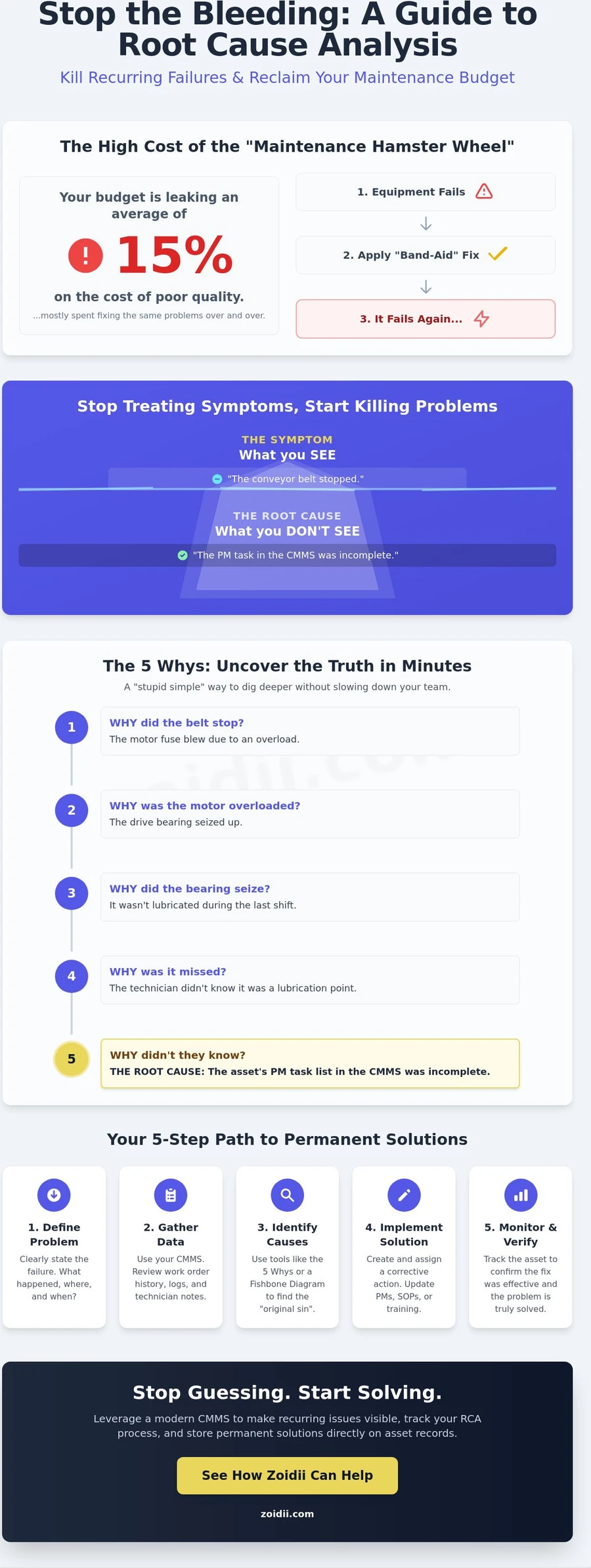
8 Tips for performing effective root cause analysis
Follow these eight tips to conduct a thorough and effective Root Cause Analysis, which can lead to lasting improvements and prevent future issues.
1. Clearly Define the Problem
Start with a precise and detailed problem statement. Ensure that everyone involved understands the issue in the same way, covering the what, when, where, and who aspects. A well-defined problem is more straightforward to analyze and solve.2. Gather Comprehensive Data
Collect all relevant data, including records, logs, eyewitness accounts, and any other information that provides insight into the issue. Accurate data collection is critical for identifying the true root cause and avoiding misdiagnosis.3. Use the Right Tools
Utilize appropriate RCA tools such as Fishbone Diagrams, 5 Whys, Pareto, or Failure Mode and Effects Analysis (FMEA). These tools help structure the analysis process, making it easier to explore all potential causes systematically.4. Involve the Right People
Assemble a cross-functional team with diverse expertise and perspectives. Including people directly involved with the issue and those with a broader view ensures that all angles are considered.5. Avoid Blame and Focus on the Process
RCA should focus on identifying process failures rather than assigning blame. A blame-free environment encourages open communication and honest input, which is essential for uncovering the root cause.6. Prioritize and Validate Causes
Once the team identifies potential causes, prioritize them based on their likelihood and impact. Validate the most likely causes through testing or further analysis to ensure they are the root cause before proceeding to solutions.7. Implement Effective and Sustainable Solutions
Develop solutions that address the root cause and are practical to implement. Consider long-term sustainability, ensuring the team can maintain the solution over time without requiring excessive resources.8. Monitor and Review Outcomes
After implementing solutions, continuously monitor the situation to ensure the problem does not recur. Review the effectiveness of the solutions regularly and make adjustments as needed.Common Pitfalls in Root Cause Analysis
- Jumping to Conclusions: Do not assume the first identified cause is the root cause. A thorough analysis is necessary.
- Lack of Data: Incomplete or inaccurate data can lead to incorrect conclusions.
- Failure to Implement: Identifying the root cause is only useful if the solution is properly implemented and followed up.
- Not Involving the Right People: RCA should involve a team with diverse knowledge and perspectives to discover and assess all possible causes.
Maximize its impact during troubleshooting
Root Cause Analysis (RCA) is an excellent tool for solving problems at their source, leading to lasting improvements in processes and systems. Organizations can effectively prevent issues from recurring and enhance overall performance by following a structured approach, using appropriate tools, and avoiding common pitfalls.
Effective root cause analysis isn't a complex academic exercise; it's a practical habit that turns every breakdown into a permanent fix. When you document these wins directly in your asset records, you build a library of reliability that protects your team and your bottom line.
It's time to trade the chaos for operational order. Zoidii is the #1 cloud-based CMMS for ease of use, designed to help you realize your management goals without the over-engineered fluff. We're trusted by maintenance experts worldwide because we prioritize the results that matter to your facility. When you reach out, you'll get direct access to product experts who understand your industry, not just sales reps trying to hit a quota.
Zoidii’s comprehensive CMMS software helps with the Root Cause Analysis process by capturing equipment issues and classifying recurring problems through failure codes. Contact our team today to learn more about how we can support your maintenance needs.
Frequently Asked Questions
What is the difference between root cause and contributing factor?
A root cause is the fundamental reason a failure occurred, which, if removed, prevents the event from happening again. A contributing factor is a condition that influenced the outcome but didn't cause it directly. For example, high humidity might be a contributing factor that accelerates wear; however, the root cause is the lack of a proper protective seal on the motor. You must fix the root cause to kill the problem for good.How long should a typical root cause analysis take?
A simple 5 Whys session should take 15 to 30 minutes on the shop floor while the details are fresh. For complex asset failures requiring a fishbone diagram, expect a 60-minute brainstorming session with your key stakeholders. Many high-performing enterprises now aim for a 72-hour operating rhythm to contain, analyze, and resolve issues. This speed ensures the trail of evidence is still warm, and the team stays focused on a permanent fix.Can I perform an RCA without CMMS software?
You can perform a root cause analysis using paper forms or whiteboards, but you'll struggle to find the blunt truth in a pile of paperwork. Without a digital record, 40% of maintenance data is typically lost or misfiled within a week. Using software allows you to link findings directly to asset history. This makes it stupid simple to see if a specific repair actually stopped the recurring failure or if you're still wasting money.What is a "Bad Actor" in maintenance terms?
A "Bad Actor" is a specific asset that accounts for a disproportionate amount of your downtime or maintenance budget. In most facilities, the Pareto Principle applies: 20% of your assets usually cause 80% of your headaches. Identifying these machines through reporting allows you to prioritize your RCA efforts where they'll have the biggest impact. Focusing on these high-cost assets is the fastest way to realize significant budget savings.How do I get my technicians to participate in RCA?
Build a blameless culture where the focus is on fixing the system rather than punishing the person. If technicians feel safe, they'll share the honest details you need to find the truth. Use mobile tools that make data entry stupid simple, so they don't feel like they're doing extra paperwork. When they see that their input leads to fewer repeat failures and a lighter workload, their participation usually increases by 50% or more.Is root cause analysis required for OSHA compliance?
OSHA doesn't mandate a root cause analysis for every mechanical breakdown, but it is required for incidents involving a fatality or the hospitalization of employees. Even for minor near misses, OSHA's Process Safety Management standard expects a thorough investigation.Performing regular RCA on mechanical failures helps you stay ahead of these risks. It prevents the kind of serious citations that can cost your company thousands in penalties.
What happens if we can’t find the root cause?
If a clear root cause remains hidden, implement a temporary containment action to prevent further damage. Increase your inspection frequency for that asset and start collecting more granular data, such as vibration analysis or sensor logs.Sometimes the truth only emerges after a second failure provides a more complete data set. Don't guess; wait for the evidence to point toward a systemic change that actually works.
How often should we review our RCA findings?
Review your findings during monthly reliability meetings to ensure that corrective actions were actually implemented. Checking the status of these fixes every 30 days helps you verify if the problem is gone. If you notice the same root causes appearing across different departments, it's a signal that you have a larger organizational gap.This requires a change in your standard operating procedures to ensure long-term order.