Maintenance expenditures are a critical component of asset management in industries such as manufacturing, energy, transportation, and facilities management. Given budget constraints and the need to maximize asset performance, organizations often prioritize maintenance activities based on their importance and impact.
A Ranking Index for Maintenance Expenditures (RIME) is a systematic approach to prioritizing maintenance tasks to ensure optimal resource allocation. This article provides an in-depth understanding of RIME, including its components, methodology, benefits, and implementation.
Introduction to RIME
RIME is a decision-making tool designed to prioritize maintenance tasks based on their relative importance. It helps organizations allocate maintenance budgets effectively, ensuring critical assets receive the required attention while minimizing unnecessary expenditures. The index considers multiple factors, including asset criticality, failure consequences, repair costs, and operational impact.
RIME aims to strike a balance between cost efficiency and operational reliability. Without a structured ranking system, organizations may face issues such as over-maintaining non-critical assets or under-maintaining critical ones, leading to suboptimal outcomes.
Key Components of RIME
A robust RIME framework incorporates several key factors to assess and rank maintenance activities:
1. Asset Criticality
- Asset criticality is the importance of the asset to the organization's operations.
- Evaluated based on factors such as production dependency, safety implications, and compliance requirements.
2. Failure Probability
- Likelihood of an asset failing within a given timeframe.
- Determined through historical failure data, condition monitoring, and predictive analytics.
3. Consequence of Failure
- Impact of asset failure on operations, including downtime, safety risks, environmental consequences, and financial losses.
- Higher consequence ratings result in higher priority.
4. Repair and Replacement Costs
- Costs associated with fixing or replacing the asset.
- Direct costs (labor, materials) and indirect costs (lost productivity, penalties).
5. Remaining Useful Life (RUL)
- Remaining Useful Life is the estimate of the time remaining before the asset requires replacement or fails.
- Influences urgency of maintenance interventions.
6. Operational Impact
- Disruption caused by maintenance activities themselves, such as downtime during repairs.
- The maintenance team should prioritize tasks with minimal operational disruption over those with significant impacts.
7. Budget Constraints
- Availability of funds to execute maintenance tasks.
- Helps in balancing maintenance needs with financial limitations.
Methodology of RIME
The RIME process involves several steps to calculate and rank maintenance tasks effectively:
1. Data Collection
Gather relevant asset data, including historical maintenance records, operational metrics, failure statistics, and financial information.2. Criteria Weighting
Assign weights to each criterion (e.g., criticality, failure consequence) based on organizational priorities. For instance, a safety-critical asset might have a higher weight for the consequences of failure.3. Scoring System
Decide a scoring system, such as a scale from 1 (low importance) to 10 (high importance), and assign a score for each criterion. Normalize scores to ensure consistency across criteria.4. Index Calculation
Calculate the RIME score for each maintenance task using a weighted sum formula: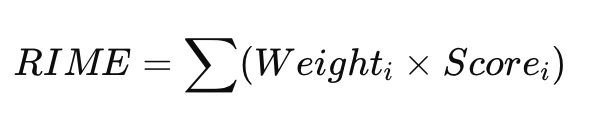
Where Weighti is the weight of criterion i and Scorei is the score for that criterion
5. Ranking and Prioritization
Rank tasks based on their RIME scores. Higher scores indicate higher priority for maintenance.6. Review and Validation
Review the rankings with stakeholders to ensure they align with operational goals and adjust weights or scores if necessary.7. Implementation
Execute maintenance activities based on the prioritized list, starting with the highest-ranked tasks.Benefits of RIME
Implementing a RIME framework offers numerous benefits to organizations:
1. Efficient Resource Allocation
Ensures limited maintenance budgets are spent on the most critical tasks, reducing waste and enhancing ROI.2. Improved Asset Reliability
RIME minimizes unplanned downtime and enhances operational continuity by prioritizing high-risk and high-impact assets.3. Enhanced Safety and Compliance
Proactively addresses safety-critical maintenance tasks, reducing the risk of accidents and ensuring regulatory compliance.4. Data-Driven Decision Making
Provides a structured, objective approach to maintenance prioritization, reducing reliance on subjective judgment.5. Transparency and Accountability
Creates a clear rationale for maintenance decisions, which can be communicated to stakeholders.6. Cost Savings
Optimizes maintenance schedules, preventing over-maintenance or deferred maintenance that could lead to expensive repairs.Challenges in Implementing RIME
Despite its benefits, organizations may face challenges when adopting RIME:
1. Data Availability and Quality
Data that is incomplete or inaccurate can compromise the reliability of RIME scores. Establishing robust data collection processes is essential.2. Subjectivity in Weighting and Scoring
Assigning weights and scores involves judgment, which can introduce bias. Engaging a diverse team of stakeholders helps mitigate this risk.3. Complexity of Integration
Integrating RIME with existing maintenance management systems (e.g., CMMS, EAM software) may require significant effort and resources.4. Resistance to Change
Employees accustomed to traditional maintenance practices may resist adopting a new prioritization framework.5. Dynamic Asset Conditions
Asset conditions and operational priorities change over time, requiring periodic review and adjustment of the RIME framework.Best Practices for Effective RIME Implementation
To maximize the effectiveness of RIME, consider the following best practices:
1. Leverage Technology
Use advanced tools such as predictive maintenance software, IoT sensors, and machine learning algorithms to enhance data collection and analysis.2. Engage Cross-Functional Teams
Involve stakeholders from operations, finance, safety, and maintenance departments to ensure a holistic approach to prioritization.3. Regular Updates
Review and update RIME scores periodically to reflect changes in asset conditions, operational priorities, and budget constraints.4. Training and Change Management
Provide employees with training on the RIME framework and its benefits. Address resistance by highlighting success stories and involving staff in the implementation process.5. Pilot Programs
Start with a pilot project to test the RIME framework on a subset of assets. Use the lessons learned to refine the approach before full-scale implementation.6. Integration with Maintenance Software
Integrate RIME with existing Computerized Maintenance Management Systems (CMMS) or Enterprise Asset Management (EAM) systems to streamline execution and tracking.Case Study: RIME in Action
Background: A manufacturing company with a fleet of production equipment faced frequent breakdowns and escalating maintenance costs. To prioritize its maintenance activities, the company implemented a RIME framework.
Process:
- The team collected data on asset performance, repair costs, and downtime impacts from the CMMS
- Criteria such as asset criticality, failure consequences, and operational impact were weighted and scored.
- RIME scores were calculated, and tasks were ranked accordingly.
- The team reduced maintenance expenditures by 20% as non-critical tasks were deferred.
- Asset reliability improved, with a 15% reduction in unplanned downtime.
- The company achieved better compliance with safety standards, reducing accident risks.
Optimize Maintenance Strategies with RIME
The Ranking Index for Maintenance Expenditures is a powerful tool for optimizing maintenance strategies in asset-intensive industries. By systematically evaluating and ranking maintenance tasks, organizations can ensure effective resource use, improving reliability, cost savings, and operational efficiency.
While challenges exist, following best practices and leveraging modern technology can help organizations successfully implement and sustain a RIME framework. As businesses strive for greater competitiveness and sustainability, RIME stands out as an essential element of strategic maintenance management.