What is a Remote Terminal Unit (RTU)?
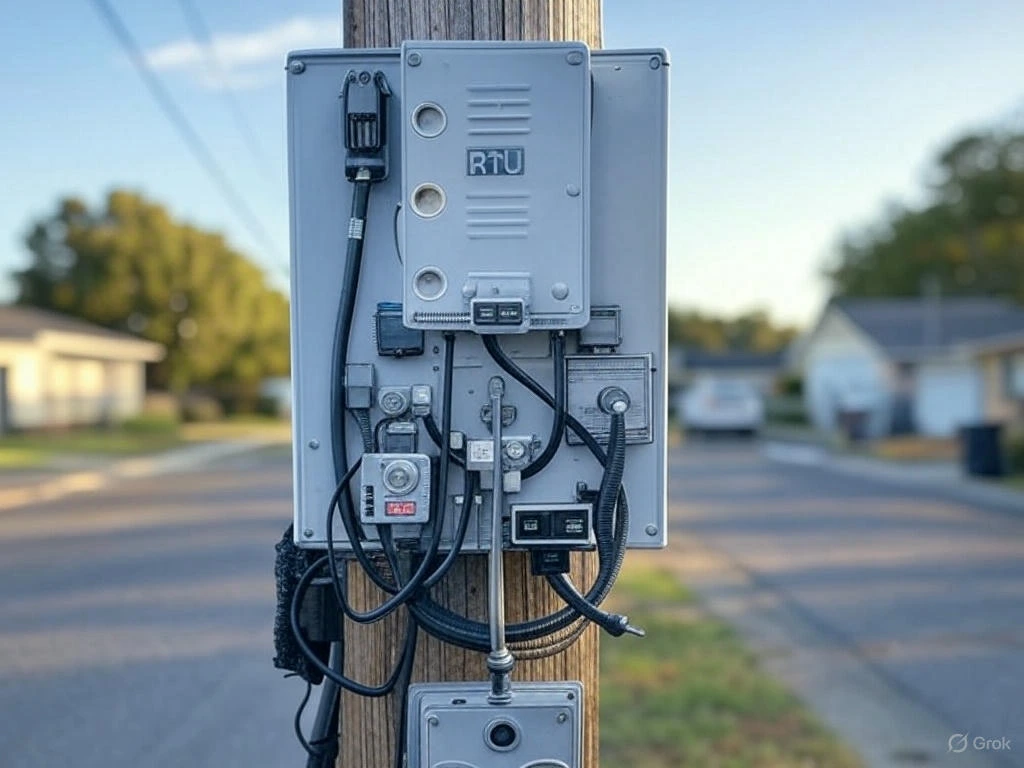
A Remote Terminal Unit (RTU) is a microprocessor-based industrial device that monitors, collects, and transmits data from remote locations to a central control system.
RTUs serve as critical components in automation systems, enabling communication between field devices (such as sensors and actuators) and a central supervisory system, typically a SCADA (Supervisory Control and Data Acquisition) system or a distributed control system (DCS).
RTUs play a critical role in industries such as oil and gas, manufacturing, water treatment, power generation, and telecommunications, where real-time monitoring and control are essential for operational efficiency and safety.
How Does a Remote Terminal Unit Work?
A Remote Terminal Unit acts as a bridge between field sensors and actuators and a central control system or SCADA network. It collects data from field devices, processes it, and transmits it to a control center via wired or wireless communication networks.
This data is processed locally (if required) and then transmitted to a central control system via a communication link. The central system analyzes the data and sends back control instructions, which the RTU executes. In some cases, RTUs can operate autonomously, relying on pre-programmed logic to respond to specific conditions—such as shutting down a pump if pressure exceeds a threshold.
For example, in a water treatment plant, an RTU might monitor tank water levels, report the data to a SCADA system, and open a valve to release excess water if instructed—or do so automatically if programmed to act independently.
Key Functions of a Remote Terminal Unit
An RTU performs several essential tasks that make it indispensable in remote monitoring and control:
- Data Acquisition: RTUs interface with sensors, meters, and other field devices to gather real-time data such as temperature, pressure, flow rates, or voltage levels.
- Control Execution: They can send commands to field devices, such as turning pumps on or off, opening valves, or adjusting settings based on predefined logic or instructions from a central system.
- Communication: RTUs transmit collected data to a central control system and receive commands via communication protocols, ensuring seamless integration into larger networks.
- Local Processing: Many RTUs have built-in logic capabilities, allowing them to process data and make decisions independently of the central system, which is useful in case of communication failures.
- Data Logging: They often store data locally, providing a historical record that engineers can retrieve later for analysis or troubleshooting.
Components of an RTU
An RTU consists of several key components that enable it to function effectively:
1. Microprocessor/Controller
- The brain of the RTU processes data and executes control commands.
- Runs firmware that manages communication, data acquisition, and automation tasks.
2. Input/Output (I/O) Modules
These connect the RTU to field devices:- Analog Inputs (AI): Receive signals from temperature sensors, pressure transducers, etc.
- Digital Inputs (DI): Detect on/off states, such as valve open/closed.
- Analog Outputs (AO): Send control signals to actuators.
- Digital Outputs (DO): Control relays, pumps, or switches.
3. Communication Interfaces
- Ethernet, RS-232, RS-485 for wired connectivity.
- Cellular, radio, satellite, or fiber-optic for wireless communication.
- Protocols: Supports Modbus, DNP3, IEC 60870-5, MQTT, and more.
4. Power Supply
- RTUs are often deployed in remote areas, so they may include battery backups or solar power support to ensure continuous operation.
- RTUs are typically powered by AC/DC sources and may include a battery backup for reliability in case of power failures.
5. Memory & Data Storage
- Stores firmware, configuration settings, and operational data such as logs and alarm history for retrieval and analysis.
6. Enclosure
- Rugged housing protects the RTU from harsh environmental conditions like extreme temperatures, dust, or moisture.
Applications of RTUs
RTUs are widely used in various industries for automation and control. Some key applications include:
1. Power Generation & Distribution
- Monitor and control transformers, circuit breakers, and substations.
- Collect data on voltage, current, and power quality.
- Enable remote shutdown and fault isolation in case of failures.
2. Oil & Gas Industry
- Track pipeline pressure, flow rates, and leak detection.
- Control pump stations and valve actuators remotely.
- Ensure compliance with safety and environmental regulations.
3. Water & Wastewater Treatment
- Monitor water levels, chemical dosing, and pump operations.
- Detect leaks and overflows in water distribution networks.
- Support automation in sewage treatment plants.
4. Transportation & Traffic Management
- Monitor railway crossings, highway lighting, and traffic signals.
- Enable remote control of tunnel ventilation and toll collection systems.
5. Manufacturing & Industrial Automation
- Automate production lines by controlling robotic arms, conveyor belts, and temperature sensors.
- Improve efficiency in chemical processing and material handling.
Difference Between RTU and PLC
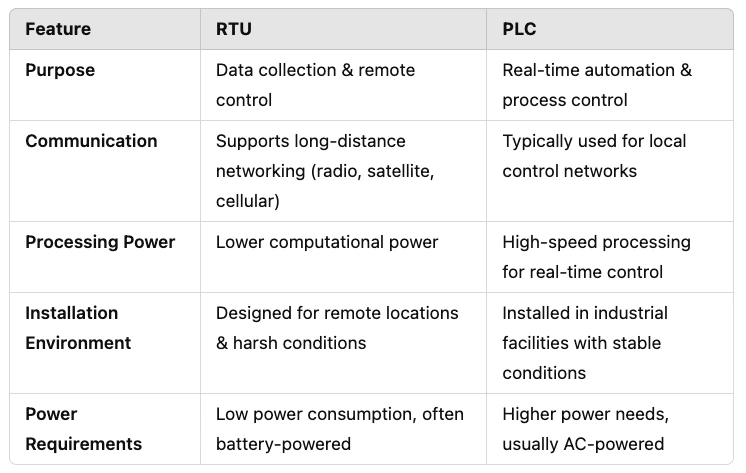
RTUs are often compared to Programmable Logic Controllers (PLCs), another common device in industrial automation. While both RTUs and PLCs are used for industrial automation, they serve different purposes:
- Purpose: RTUs are designed for data collection and remote control, while PLCs are designed for real-time automation and process control.
- Location: RTUs are designed for remote, distributed environments and harsh conditions, while PLCs are typically used in centralized, local control settings like factories.
- Communication: RTUs prioritize long-distance communication with central systems, whereas PLCs focus on local control and may not have extensive communication capabilities.
- Autonomy: RTUs often include local decision-making capabilities for standalone operation, while PLCs rely more on continuous interaction with a control system.
- Power: RTUs are often battery-powered and consume little power, whereas PLCs are mains-powered and require more power.
Advantages of Using RTUs
Implementing RTUs in industrial systems provides several benefits:
1. Real-Time Monitoring & Control
- RTUs continuously monitor critical infrastructure and provide real-time data to operators.
- They provide immediate insights into system performance, enabling quick responses to anomalies.
- Enables fast response to emergencies and system anomalies.
2. Remote Access & Reduced On-Site Visits
- RTUs eliminate the need for personnel to be physically present at distant sites, reducing operational costs and improving safety.
- Reduces operational costs and response time.
3. Integration with SCADA & IoT Systems
- RTUs seamlessly integrate with SCADA, IoT, and cloud-based platforms.
- Allows predictive maintenance and AI-driven automation.
4. Reliable Performance in Harsh Environments
- RTUs are designed to withstand extreme temperatures, humidity, and electrical noise.
- Operate effectively in offshore platforms, power plants, and remote industrial sites.
5. Improved Operational Efficiency & Safety
- Automates repetitive monitoring tasks, freeing up human resources.
- Enhances workplace health and safety by reducing human intervention in hazardous areas.
6. Scalability
- RTUs can be integrated into large networks, making them suitable for both small installations and expansive systems.
Challenges in RTU Implementation
While RTUs offer significant advantages, there are some challenges associated with their deployment:
1. High Initial Costs
- RTUs with advanced features require an investment in hardware, software, and integration.
- Solution: Use modular RTUs that allow scalability as needs grow.
2. Installation Complexity
- Setting up an RTU in a remote area requires careful planning for power, communication, and environmental protection.
2. Cybersecurity Risks
- RTUs connected to SCADA and IoT systems are vulnerable to cyber threats.
- Solution: Implement firewalls, encryption, and regular security audits.
3. Communication Reliability
- Remote areas may have poor cellular or satellite connectivity.
- Solution: Use redundant communication channels to ensure data transmission reliability.
4. Maintenance & Technical Expertise
- RTUs require skilled personnel for setup, troubleshooting, and maintenance.
- RTUs in isolated locations can be challenging to service.
- Solution: Provide training programs for staff and use vendor support services.
Future of RTUs
As the Industrial Internet of Things (IIoT), Artificial Intelligence (AI), and cloud computing evolve, RTUs are becoming more intelligent, connected, and efficient. The future trends in RTU technology include:
- IoT Integration: Modern RTUs support Internet of Things (IoT) protocols, allowing them to connect to cloud-based platforms for advanced analytics.
- Edge Computing: RTUs with built-in AI capabilities for on-site data processing, reducing bandwidth usage and improving response times.
- Wireless Connectivity: Advanced 5G and LPWAN (Low Power Wide Area Networks) for improved communication.
- Enhanced Security Features: With increased connectivity, RTUs now include encryption and authentication features to protect against cyber threats.
- Energy-Efficient RTUs: Low-power designs make RTUs suitable for off-grid installations powered by renewable energy sources.
Modernize Industrial Automation with RTUs
Remote Terminal Units (RTUs) are essential in industrial automation, SCADA systems, and remote monitoring applications. Their ability to collect, process, and transmit data from remote locations makes them invaluable in the energy, water management, oil and gas, and manufacturing industries.
With advancements in IIoT and AI, RTUs are becoming more sophisticated, paving the way for greater efficiency, reliability, and real-time decision-making in industrial operations.
Whether managing a pipeline in the desert or a wind farm on a mountaintop, RTUs ensure that critical systems remain under control—no matter the distance.