
If you've spent any real time working on or managing a farm, keeping equipment running is a full-time job in itself. Tractors break down at the worst possible moment - usually right before harvest. Irrigation systems fail when you can't afford downtime. Combine harvesters develop mysterious rattles two days before you need them most. The list goes on.
That's where a Computerized Maintenance Management System (CMMS) comes in. A CMMS is software designed to help you track, schedule, and manage all of the maintenance work happening on your operation- from routine oil changes on your tractors to compliance checks on your grain storage facilities. For agricultural operations that run millions of dollars' worth of equipment across hundreds or thousands of acres, this kind of software isn't a luxury. It's a necessity.
But here's the thing: not all CMMS platforms are built with farming in mind. Many of them were designed for manufacturing plants or commercial facilities, and the features they prioritize don't always translate well to the unique demands of agriculture. You need software that understands seasonal schedules, handles mobile use in areas with spotty connectivity, tracks equipment across large geographic footprints, and integrates with the specific assets farmers actually use. This article breaks down the top 10 CMMS platforms worth considering if you're running an agricultural operation. Whether you're managing a mid-sized family farm or overseeing a large-scale agribusiness, there's something on this list for you.
Key Takeaways
- A CMMS is an investment, not just an expense. Farms that implement the right maintenance software consistently see measurable reductions in unplanned downtime, lower parts costs, and better long-term asset decisions - all of which directly affect the bottom line.
- Match the platform to the size and complexity of your operation. Smaller farms benefit most from easy-to-adopt tools like Limble or Zoidii, while large-scale agribusinesses will need the deeper functionality of platforms like Fiix or Maintenance Connection.
- Seasonal scheduling sets agriculture apart from other industries. Look for a CMMS that lets you build preventive maintenance programs around your planting and harvest windows - not just generic calendar or time-based intervals.
- Always run a real-world pilot before committing. Most vendors offer free trials. Use them with actual data, real equipment, and your own team - the friction points that matter most only show up once you're in the field with the software.
What to Look for in a CMMS for Agriculture
Before we get into the specific platforms, it's worth spending a moment on what actually matters when you're choosing a CMMS for a farm or agricultural business.
Mobile functionality is non-negotiable. Your technicians and operators are out in the field, not sitting at a desk. The software needs to work on a phone or tablet.
Asset management depth matters a lot in agriculture because your assets are diverse - tractors, combines, planters, sprayers, irrigation pivots, grain dryers, feed mills, livestock handling equipment, UTVs, and more. The software should handle all of them without forcing you into awkward workarounds.
Seasonal scheduling is something that purely industrial CMMS tools often overlook. On a farm, your maintenance calendar is tied to planting and harvest windows in a way that's fundamentally different from a factory. The ability to schedule preventive maintenance around those seasonal peaks - and get alerts when something needs attention before a critical window opens - is a big deal.
Work order management should be straightforward, with the ability to assign tasks, track labor hours, and log parts used. Bonus points if the system can handle contractor work alongside in-house labor.
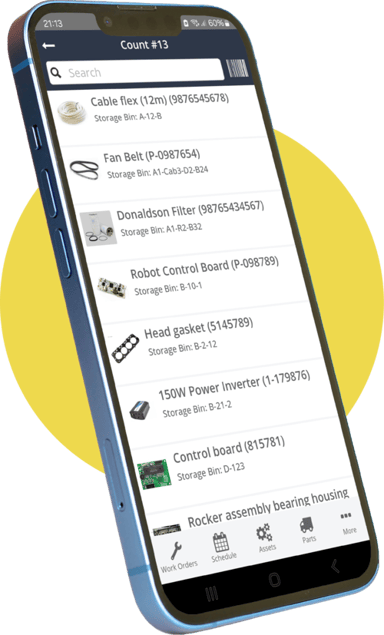
Parts and inventory tracking help you avoid scrambling to find a specific filter or belt when equipment goes down. Knowing what you have on hand and getting alerts when stock runs low saves time and money. With those criteria in mind, here are the top 10 CMMS options for agriculture and farming.
1. Zoidii
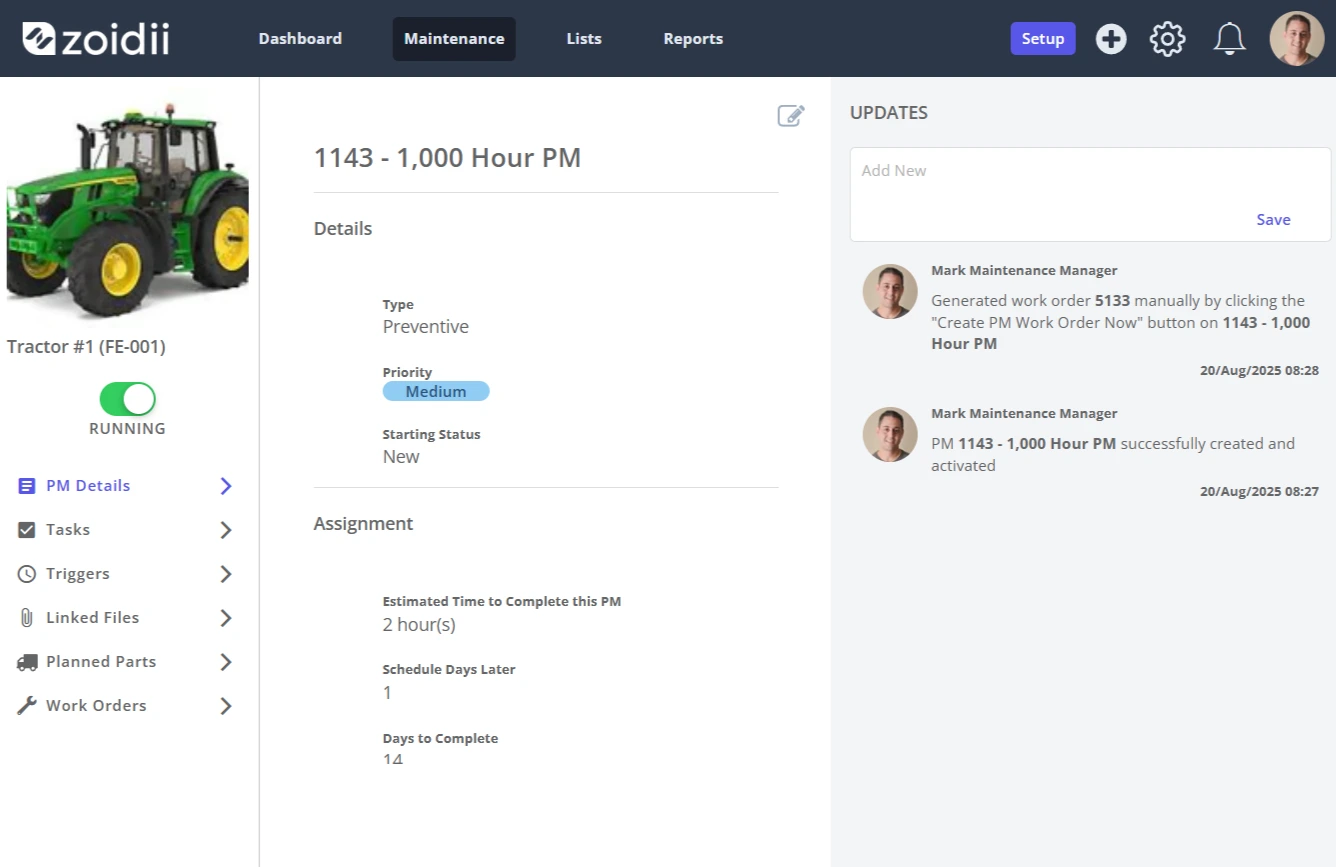
Zoidii is one of the most popular CMMS platforms on the market today, and for good reason. It's modern, mobile-first, and genuinely easy to use - which makes a meaningful difference when you're trying to get a maintenance crew on board without weeks of training.
For agricultural users, Zoidii's QR code-based asset tracking is a practical feature. You can print and attach QR code tags to each piece of equipment, and then any team member with a phone can scan a tag to instantly pull up that asset's maintenance history, open a work order, or report an issue. This is low-tech in the best way - it doesn't require specialized hardware, and it works reliably in the field.
For agricultural operations, Zoidii shines in its mobile app experience. Technicians can receive work orders on their phones, log completed tasks, attach videos or photos of issues, and update asset records from anywhere on the property.
The platform handles preventive maintenance scheduling well, letting you set triggers based on time, meter readings (like engine hours), or measurements. This flexibility is particularly useful for farm equipment where engine hours are often a more meaningful maintenance interval than calendar time.
Zoidii's asset management features are solid, with customizable asset hierarchies that let you organize equipment by type, location, or any structure that makes sense for your operation. The reporting dashboard gives you a clear picture of maintenance costs, equipment downtime, and technician productivity.
The main limitation for very large agricultural enterprises is that the more advanced analytics and automation features are gated behind higher-tier pricing plans. But for small to mid-sized operations, the base plans offer strong value. Best for: Small to mid-sized farms and agribusinesses looking for a modern, easy-to-adopt platform.
2. Fiix (by Rockwell Automation)
Fiix is a cloud-based CMMS that has built a strong reputation in asset-intensive industries, and agriculture fits squarely within that wheelhouse. After being acquired by Rockwell Automation, Fiix has access to deeper resources and a broader integration ecosystem, which benefits users who are connecting their maintenance software to other operational systems.
What stands out about Fiix for agricultural users is the depth of its asset management and work order functionality. You can build detailed asset profiles that include manufacturer specs, warranty information, maintenance history, attached manuals, and custom fields - essentially a complete digital file for every piece of equipment in your operation.
The preventive maintenance module is flexible and powerful. You can schedule recurring work orders based on time, meter readings, or condition-based triggers, and the system will automatically generate and assign tasks based on those rules. For farms running dozens of pieces of equipment across multiple locations, this kind of automation saves a significant amount of manual planning time.
Fiix also integrates well with ERP systems, which is valuable for larger agribusinesses that manage procurement, finance, and operations through a central platform. The ability to push purchase orders, track parts costs, and connect maintenance data to financial reporting makes Fiix a strong choice for operations with more complex administrative structures.
The learning curve is steeper than some alternatives, and the interface, while functional, doesn't feel quite as intuitive as newer competitors. But the depth of functionality it offers more than compensates for that. Best for: Mid-to-large agricultural operations and agribusinesses with complex asset portfolios and integration needs.
3. Hippo CMMS
Hippo has been around long enough to have figured out what works in practical maintenance management settings, and it shows. The platform strikes a nice balance between functionality and usability - it's not the flashiest CMMS on the market. Still, it covers the core use cases very well without overwhelming users with unnecessary complexity.
For agricultural environments, Hippo's work order system is a highlight. Creating, assigning, and tracking work orders is quick and intuitive, which matters when you're dealing with a breakdown during a busy season and need to mobilize a response fast. The system supports both reactive maintenance (fixing what breaks) and preventive maintenance (staying ahead of breakdowns), and it handles both workflows smoothly.
One feature that's particularly useful for farms managing multiple locations or large properties is the interactive floor plan and map functionality. You can upload site maps, mark equipment locations, and associate assets with specific areas of your property. For an operation spread across multiple fields, storage facilities, and machine shops, this spatial context is genuinely helpful.
Hippo's inventory management is functional and lets you track parts, set reorder points, and associate parts usage with specific work orders. It doesn't have the most advanced procurement features, but it handles the fundamentals well.
The platform is web-based with mobile access, though the mobile experience isn't quite as polished as some mobile-first competitors. That said, for operations where most maintenance management happens from a central office or shop, it's more than adequate. Best for: Small to medium agricultural operations that want reliable core functionality without a steep learning curve.
4. FMX
FMX (Facilities Management eXpress) was originally built with facilities management in mind, but it has evolved into a capable CMMS for a broader range of industries, including agriculture. What sets it apart is an unusually clean and intuitive interface that makes onboarding new users genuinely quick.
For farms and agricultural businesses, FMX's strength lies in how easy it makes the day-to-day work of managing maintenance requests and work orders. Anyone on the team - from a field hand who notices something wrong with a piece of equipment to an equipment manager - can submit a request in minutes. The system routes those requests to the appropriate technician and tracks them through to completion.
FMX handles preventive maintenance scheduling with a visual calendar interface that makes it easy to see upcoming maintenance tasks and spot potential scheduling conflicts. This visual calendar is especially valuable in agriculture, where you want to front-load maintenance before busy seasons and avoid taking critical equipment offline at the wrong time.
The platform also has solid reporting tools that help managers track maintenance costs, technician performance, and equipment reliability over time. Building a picture of which assets are costing you the most in maintenance hours and parts can be eye-opening and help you make smarter decisions about equipment replacement.
FMX is cloud-based with a mobile app for field use. Implementation support is consistently praised by customers, which matters if you're a smaller operation without dedicated IT resources. Best for: Operations that prioritize ease of use and fast team adoption, especially those with mixed technical comfort levels among staff.
5. Asset Panda
Asset Panda takes a broader view of asset tracking than most CMMS platforms - it's built around a highly flexible, configurable data structure that lets you track virtually any kind of asset and define your own workflows around them. For agricultural businesses that deal with a wide variety of asset types beyond just heavy machinery, this flexibility is a real advantage.
Beyond the standard equipment categories you'd track in any CMMS, Asset Panda can handle livestock tagging data, land assets, vehicles, tools, chemical inventory, and anything else you need to keep tabs on. The platform lets you build custom fields, forms, and workflows for each asset category, so you're not forcing your unique operational data into a one-size-fits-all structure.
The mobile app is well-regarded and supports barcode and QR code scanning, which can speed up asset check-ins, maintenance logging, and inventory management significantly. If you've tagged your equipment and parts with barcodes, managing them through Asset Panda's app becomes very efficient. One thing to be aware of is that because Asset Panda is so configurable, initial setup can take more time than a more opinionated platform. You'll need to invest some time upfront in defining your asset structures and workflows. But that investment pays off in a system that actually fits how your operation works, rather than a generic template you're always working around.
Pricing is per-device rather than per-user, which can be cost-effective for operations where a small team is sharing a few tablets or workstations.
Best for: Agricultural operations with diverse asset tracking needs and the willingness to invest in proper configuration upfront.
6. Maintenance Connection (by Accruent)
Maintenance Connection is a mature, enterprise-grade CMMS that's been used across a wide range of industries for well over two decades. It has the kind of depth you'd expect from that lineage - comprehensive work order management, sophisticated preventive maintenance scheduling, detailed asset tracking, and robust reporting capabilities.
For larger agricultural operations - think commercial farming enterprises, food processing facilities connected to farming operations, or multi-site agribusinesses - Maintenance Connection offers the kind of scalability and configurability that smaller platforms can't match. You can manage thousands of assets across multiple locations, support large maintenance teams with varied roles and permissions, and integrate with enterprise systems for finance and supply chain management.
The platform includes a strong parts and inventory management module with procurement workflow support, which is valuable when managing a large parts inventory for diverse equipment. Automated reorder alerts and purchase order generation reduce the administrative burden of keeping critical parts stocked.
Maintenance Connection is also known for its compliance and documentation features. For agricultural operations that deal with food safety regulations, environmental compliance, or equipment certification requirements, the ability to attach compliance documentation, track inspections, and generate audit-ready reports is genuinely valuable.
The trade-off for all this capability is complexity. Maintenance Connection is not a quick-start platform - it takes time and often professional implementation support to set up properly. It's also priced for enterprise use, which puts it out of reach for smaller operations. Best for: Large agricultural enterprises, food production facilities, and multi-site agribusinesses with complex maintenance programs.
7. eMaint CMMS (by Fluke)
eMaint has long been a respected name in the CMMS space, and its acquisition by Fluke - a company with deep roots in industrial maintenance and measurement - has only strengthened it. For agricultural operations running precision equipment where sensor data and condition monitoring are part of the maintenance program, eMaint's integration with Fluke's broader tool ecosystem is a meaningful differentiator.
The core platform covers work order management, preventive maintenance, asset tracking, and inventory management thoroughly and reliably. What elevates eMaint for technically sophisticated agricultural users is its support for condition-based maintenance - the ability to trigger maintenance tasks based on sensor readings, meter data, or other performance indicators rather than just time or usage intervals.
For high-value equipment like large grain dryers, processing equipment, or precision irrigation systems, connecting maintenance triggers to real operational data means you're performing maintenance when it's actually needed rather than on an arbitrary schedule. That translates to fewer unnecessary maintenance events and better equipment reliability.
eMaint is highly configurable, with custom fields, workflows, and reports that let you shape the system around your specific needs. The reporting module is particularly strong, with a wide library of pre-built reports and the ability to build custom analytics dashboards.
The mobile app supports offline use and is capable, though some users find the interface a bit dated compared to newer competitors. Implementation and customer support are generally well-reviewed, which is important when deploying a complex platform. Best for: Agricultural operations with sophisticated equipment programs where condition-based maintenance and sensor integration add real value.
8. Limble CMMS
Limble has been one of the standout success stories in the CMMS market over the last several years, earning consistently high marks from users for its usability, customer support, and the speed at which it keeps adding new features. For agricultural operations looking for a modern, reliable platform without an enterprise price tag, Limble deserves serious consideration.
The user experience is genuinely excellent - Limble has clearly invested heavily in making the platform intuitive for people who aren't maintenance software experts. Work orders are easy to create and manage, the mobile app is polished and fast, and the preventive maintenance scheduling interface is one of the cleaner ones you'll find in this category.
The inventory management module has improved significantly in recent versions and now handles parts tracking, reorder points, and basic procurement workflows competently. It may not satisfy the needs of very large operations with complex procurement programs, but for most farms, it's more than sufficient. Limble's customer support is frequently cited as a genuine competitive advantage. The team is responsive and knowledgeable, which matters when you're dealing with an equipment crisis and need help getting something sorted quickly.
Best for: Small to mid-sized agricultural operations that want a modern, highly usable platform with excellent support.
9. Agworld (and AgriSync)
While most of the platforms on this list are general-purpose CMMS tools that agricultural operations have adapted to their needs, it's worth acknowledging that there are software tools built specifically for agriculture that incorporate maintenance management features alongside crop planning, scouting, and field record-keeping.
Agworld is primarily a crop management platform, but it includes features for tracking equipment and field activities that smaller farming operations may find sufficient without needing a dedicated CMMS. For operations where the maintenance program is relatively straightforward - routine service schedules for a modest fleet of equipment - having everything in one agriculture-specific platform can simplify the tech stack considerably.
AgriSync, meanwhile, is focused specifically on facilitating technical support and maintenance for farm equipment. It connects farmers and equipment operators directly with dealers and technicians via video and messaging, and includes documentation and case management features. It's not a full CMMS by any stretch, but for operations that rely heavily on dealer support for equipment maintenance, it can be a valuable complement to other systems.
The honest takeaway here is that purpose-built agricultural software often makes trade-offs - depth of maintenance management features for domain-specific convenience. If maintenance program sophistication is a priority, you'll want one of the dedicated CMMS platforms listed elsewhere in this article. But if you're a smaller operation looking for practical, agriculture-first tools, these are worth exploring.
Best for: Smaller farming operations that want agriculture-native software and are willing to trade some CMMS depth for domain specificity.
10. MPulse CMMS
MPulse rounds out this list as a reliable, mid-market CMMS that has served a wide range of industries - including agriculture and food production - for over twenty years. It's not the flashiest option on the market, but it's a dependable workhorse that covers the core CMMS use cases well at a reasonable price point.
For agricultural operations, MPulse's strength is its balanced approach to functionality and accessibility. The platform handles work order management, preventive maintenance scheduling, asset tracking, and parts inventory in a cohesive, well-integrated package. Nothing feels bolted on or out of place.
The preventive maintenance module supports multiple trigger types - calendar-based, meter-based, and event-based - and makes it straightforward to set up recurring maintenance schedules for a diverse equipment fleet. The reporting tools, while not as advanced as enterprise-tier competitors, provide practical visibility into maintenance costs, equipment history, and open work orders.
MPulse has a configurable permission structure that works well for operations where you need to give different team members different levels of access - technicians see their assigned work orders, supervisors see the full team's workload, and managers have visibility into costs and reporting.
Customer support is one area where MPulse gets consistently positive feedback. For operations without dedicated IT staff, having a responsive support team available when you hit a roadblock is genuinely important.
The mobile app covers the key functionality - accessing work orders, updating tasks, logging time and parts - and works adequately in the field. However, it doesn't match the experience of dedicated mobile-first platforms like Limble or Zoidii. Best for: Agricultural operations looking for proven, dependable CMMS functionality at a mid-market price point.
Comparing Your Options: A Practical Framework
Choosing between ten different software platforms can feel overwhelming, so here's a practical way to think about it.
If you're running a smaller operation - say, a few hundred acres with a crew of less than ten and a manageable equipment fleet - the most important factors are ease of use and mobile functionality. You don't need the most sophisticated feature set; you need something your team will actually use consistently. In that case, Limble, Zoidii, or FMX are strong starting points.
If your operation is mid-sized and growing - multiple locations, a larger equipment fleet, and a dedicated maintenance team - you want a platform with more depth in asset management, preventive maintenance automation, and reporting. Fiix, eMaint, or Maintenance Connection are worth evaluating at this tier.
If you're running a large-scale agribusiness or a vertically integrated food production operation, you need enterprise-grade functionality with robust integration capabilities. Maintenance Connection and eMaint are the most capable options in this category.
And if your equipment is diverse enough that standard CMMS asset categories don't fit well - or you track assets beyond just machinery - Asset Panda's flexibility makes it worth a serious look. One thing worth doing before you commit to any platform is running a pilot program. Most of these vendors offer free trials, and it's worth taking a month to actually run your real maintenance data through a platform before you make a decision. Have your technicians use the mobile app in the field. Try scheduling a month's worth of preventive maintenance. Run the reports you'd actually care about seeing. The friction points that matter most often only reveal themselves once you're working with real data and real workflows.
The ROI of Getting This Right
It's easy to treat CMMS software as an administrative expense - another tool the office needs to buy and maintain. But the operations that have integrated a good CMMS into their maintenance program tend to tell a different story.
The most direct financial benefit is reduced unplanned downtime. When a combine breaks down mid-harvest, you're not just paying for the repair - you're potentially losing days of harvest window that can't be recovered. A strong preventive maintenance program, consistently executed through a CMMS, catches the issues that cause catastrophic failures before they happen.
Parts and inventory management is another area where the savings add up. Without a system, operations tend to either overstock parts (tying up capital in shelf inventory) or find themselves scrambling to source a critical part at premium cost in an emergency. Knowing exactly what's on hand and getting alerts when stock drops below minimum levels solves both problems.
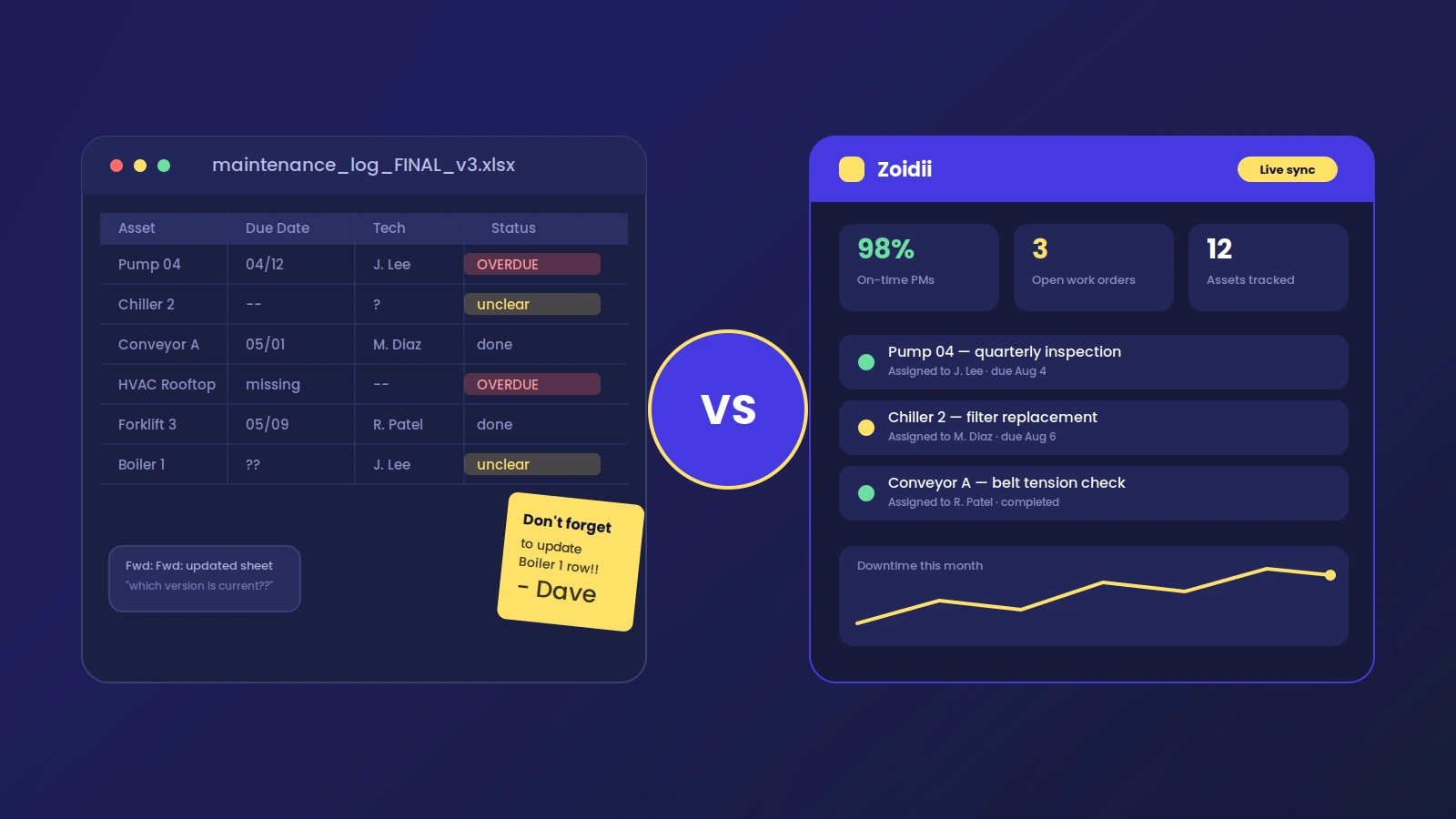
Labor efficiency improves, too. Maintenance teams that aren't manually tracking work orders on paper or spreadsheets, or spending time hunting for maintenance history on a specific machine, can focus their time on actual maintenance work. That's a real productivity gain, especially during the compressed time windows that define agricultural operations. Finally, there's the longer-term asset management picture. Having a complete maintenance history for each piece of equipment helps you make better decisions about repair versus replacement, identify chronic problem assets early, and build a factual basis for capital equipment budgets. Those decisions, made better, compound over the years into a significant financial impact.
Final Thoughts
Agricultural operations have always demanded a certain resourcefulness - making things work with what you have, improvising when things go wrong, and staying one step ahead of the constant demands of the land and the seasons. Good maintenance software doesn't change that fundamental character. What it does is give you better tools to channel that resourcefulness, so less of your energy goes toward fighting fires and more of it goes toward running a productive, sustainable operation.
The ten platforms covered in this article represent a solid range of options across different operation sizes, budget ranges, and feature priorities. None of them is perfect for every situation, but most agricultural operations will find at least a couple of these worth a closer look. The best CMMS is ultimately the one your team will use consistently - the one that fits into your workflows without creating more friction than it removes. Start there, and you'll be making a sound investment.
Frequently Asked Questions
Q: What is a CMMS, and why does a farm need one? A CMMS (Computerized Maintenance Management System) is software that helps you plan, track, and manage all the maintenance work on your equipment and facilities. For farms, it means fewer surprise breakdowns, better-organized service records, and a clear picture of what your equipment is actually costing you to maintain. If you're still tracking service intervals in a notebook or spreadsheet - or worse, relying on memory - a CMMS replaces that with something automated, searchable, and accessible to your whole team.
Q: How much does agricultural CMMS software typically cost? Pricing varies widely depending on the platform and the size of your operation. Entry-level plans from platforms like Limble or Zoidii can start around $35–$75 per user per month, making them accessible for smaller farms. Mid-market options like Fiix or eMaint typically run higher, often in the $100–$200+ per user per month range for full-featured plans. Enterprise platforms like Maintenance Connection are usually priced through custom quotes. Many vendors also offer free trials, so you can test before you commit.
Q: How long does it take to implement a CMMS on a farm? It depends on the complexity of your operation and the platform you choose. Simpler, more intuitive platforms like Limble or FMX can be up and running in a matter of days for a small team. More complex enterprise platforms may require weeks of setup, data migration, and staff training - sometimes with the help of a vendor implementation team. The biggest time investment is usually getting your asset data loaded into the system initially, but that groundwork pays off quickly once the platform is live. Q: What's the difference between reactive and preventive maintenance, and can a CMMS help with both? Reactive maintenance is fixing things after they break. Preventive maintenance is performing scheduled service before failures occur. A good CMMS supports both - it helps you manage emergency work orders when something goes down unexpectedly, while also automatically generating and scheduling preventive maintenance tasks based on time, equipment hours, or sensor readings. The goal over time is to shift more of your maintenance activity from reactive to preventive, which reduces costly unplanned downtime and extends equipment life.