
Senior technicians are retiring faster than manufacturers can replace them, and most of their critical know-how lives in their heads, not in any manual. By 2030, an estimated 2.4 million manufacturing jobs could go unfilled. Structured mentorship, documented SOPs, knowledge capture interviews, and a solid CMMS are the best tools for passing knowledge to junior technicians before it walks out the door. Start now, not six months before someone's retirement party. The manufacturing industry is at a crossroads. Technology is reshaping how plants operate, but a quieter crisis keeps building underneath: experienced technicians are leaving the workforce, and they're taking decades of irreplaceable expertise with them.
Many of these veterans have spent 20 or 30 years learning the quirks of specific equipment, developing troubleshooting instincts, and building process knowledge that no training manual covers. The problem? Most of that knowledge has never been written down. If manufacturers don't get serious about bridging the gap between senior and junior technicians, they risk losing institutional intelligence that took a generation to build. That makes an already difficult skills shortage even worse.
The Growing Skills Gap in Manufacturing
Retirement Wave and Labor Shortages
A 2025 update from Deloitte and The Manufacturing Institute projects that roughly 2.4 million manufacturing jobs may go unfilled by 2030, up from earlier estimates of 2.1 million. The acceleration is driven by a wave of baby boomer retirements that shows no signs of slowing.
Here's what the numbers look like in 2026:
- Approximately 27% of U.S. manufacturing workers are now 55 or older.
- The National Association of Manufacturers (NAM) reports that around 10,000 baby boomers still retire every day, and a significant portion hold skilled trade positions.
- NAM's most recent workforce survey found that 71% of manufacturers struggle to recruit skilled maintenance and technical workers, a figure that has crept upward for three consecutive years.
Why This Matters
Manufacturing processes are complex and often unique to individual plants. Senior technicians carry knowledge about how machines actually behave (not just how they're supposed to behave), past failures, facility-specific layouts, and custom fixes developed over years of trial and error. None of that shows up in an OEM manual.
Without a structured approach to passing this knowledge along, junior technicians face a brutal learning curve that leads to:
- Increased downtime from slower troubleshooting
- Higher maintenance costs caused by repeated mistakes
- Lower equipment reliability across the board
- Safety risks from inexperienced handling of critical systems
The Challenge of Tacit Knowledge
One of the biggest barriers to effective knowledge transfer is tacit knowledge: the kind of expertise that senior technicians carry in their muscle memory and gut instincts. It's extremely hard to document using standard methods.
Think about examples like these: the subtle change in a motor's sound right before a bearing fails, a workaround for calibrating a finicky sensor on a specific machine, how humidity levels in a particular building affect equipment performance, or historical failure patterns unique to a single production line. Capturing this kind of information requires deliberate strategies and organizational commitment, not just a suggestion box.
Strategies for Effective Knowledge Transfer
1. Structured Mentorship Programs
Pairing senior technicians with junior staff through a formal mentorship program creates space for hands-on, personalized training. The keyword here is "structured." Ad-hoc shadowing, where a new hire follows someone around for a week, doesn't cut it. A real mentorship program includes:
- Scheduled weekly or biweekly check-ins
- Defined goals and learning outcomes for each phase
- Skill assessment benchmarks tied to specific competencies
- Feedback loops so both parties can adjust
2. Job Shadowing and Rotational Assignments
Allow junior technicians to shadow veterans during both routine maintenance and emergencies. This is especially valuable in high-stakes scenarios like:
- Emergency breakdown repairs
- Complex diagnostic procedures
- System commissioning and startup
3. Standard Operating Procedures (SOPs) and Work Instructions
Encourage senior technicians to document their processes while they're still on the job. Don't wait until someone puts in their two weeks' notice. Focus on capturing:
- Troubleshooting workflows for common and uncommon failures
- Preventive maintenance steps with specific tolerances and sequences
- Preferred tool usage and part substitutions
- Vendor contacts for hard-to-source components
4. Conduct Knowledge Capture Interviews
Before a senior technician retires, sit down with them for a structured interview designed to pull out insights that might otherwise be lost. Ask specific questions like:
- "What equipment has the most quirks, and how do you handle them?"
- "What are the most common mistakes new technicians make on this line?"
- "What's the fastest way to troubleshoot [specific issue]?"
- "Are there any undocumented fixes you've developed over the years?"
How a CMMS Supports Knowledge Transfer
A Computerized Maintenance Management System (CMMS) is one of the most practical tools for capturing and distributing institutional knowledge. Here's what it actually does in the context of bridging the gap between experienced and newer technicians:
Specific Ways a CMMS Helps
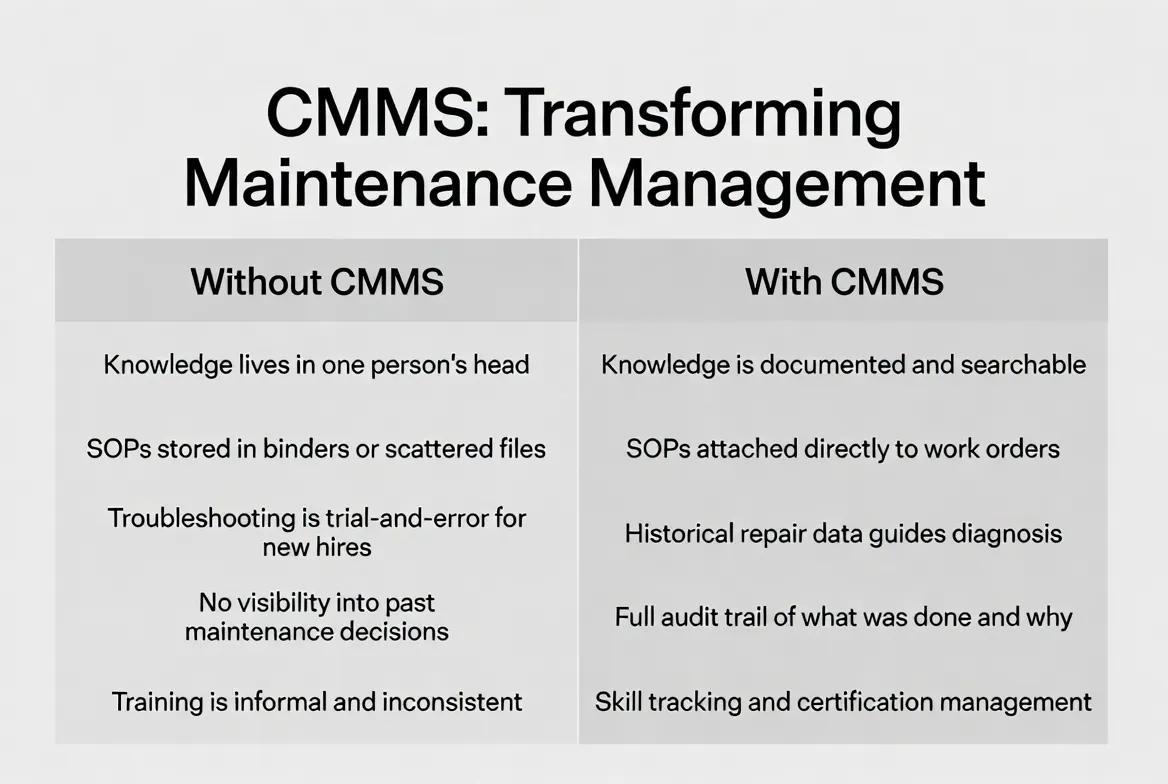
Centralized knowledge base. Every repair note, troubleshooting step, and maintenance history lives in one place. When a junior tech gets a work order for a machine they've never touched, they can pull up every previous repair, see what parts were used, and read notes left by the technician who last worked on it.
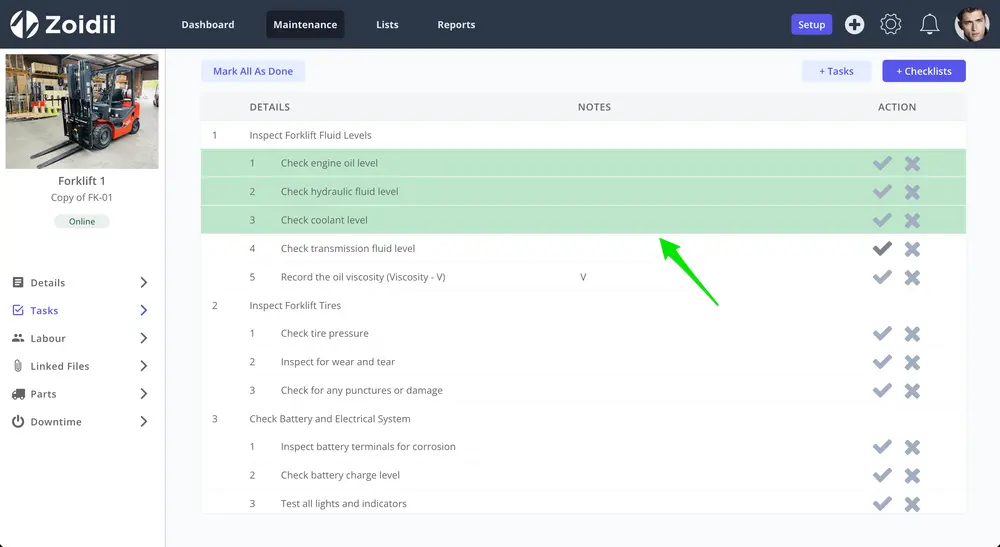
Embedded SOPs and checklists. Attach detailed procedures directly to work orders so junior techs have step-by-step guidance at their fingertips. No hunting through filing cabinets or asking around.
Historical data and failure patterns. A CMMS tracks every work order, which means it builds a searchable history of equipment behavior. That recurring issue with the conveyor belt motor? The system can show a junior tech that it's happened four times in the last two years and what fixed it each time.
Skill tracking and training management. Track which certifications each technician holds, flag skill gaps, and assign training accordingly. This turns development from a guessing game into a data-driven process. A facility that implemented a CMMS for knowledge management reported cutting new technician ramp-up time by roughly 35%, translating to an estimated $45,000 in annual savings from reduced errors and faster troubleshooting. Those numbers add up fast across a multi-site operation.
Building a Culture That Values Knowledge Sharing
Tools and programs only work if the culture supports them. Senior technicians need to feel that sharing their knowledge is valued, not that they're training their replacement and being shown the door. Recognize and reward knowledge-sharing behavior. Give experienced techs dedicated time in their schedules for mentoring and documentation rather than treating it as an afterthought squeezed in between work orders.
Junior technicians, for their part, need to show up ready to learn. That means asking questions, taking notes, and respecting the experience that comes from years on the floor. The best knowledge transfer happens when both sides are genuinely invested.
FAQ
How long does it take to set up a structured knowledge transfer program? Most facilities can get a basic mentorship and documentation framework running within 60 to 90 days. Full CMMS integration with embedded SOPs and historical data typically takes three to six months.
What if senior technicians resist sharing their knowledge? This is common. Address it by framing knowledge sharing as a legacy, not a threat. Offer incentives, public recognition, or adjusted schedules that make participation easier. Most resistance fades when veterans see their contributions genuinely valued.
What's the ROI of investing in knowledge transfer? Facilities that invest in structured programs and CMMS-based documentation typically see maintenance error rates drop by 20-30% within the first year. Reduced downtime and fewer repeat failures often deliver a 1:4 or better return on investment.
Ready to stop losing critical knowledge? Book a tour of Zoidii and see how a CMMS can help your team capture, organize, and share the expertise that keeps your plant running.