
Warehouses are the backbone of logistics operations, yet most facility managers spend their days putting out fires rather than preventing them. Equipment breaks down at the worst possible moment. Spare parts vanish into some organizational black hole. Technicians chase paper work orders across the floor while shipments stack up at loading docks.
A computerized maintenance management system changes this dynamic entirely. CMMS software centralizes maintenance tracking, automates scheduling, and gives you actual visibility into what's happening with your equipment before problems cascade into expensive disasters.
This isn't theoretical. Warehouses running CMMS platforms report 25-30% reductions in unplanned downtime and maintenance cost savings between 15-25% within the first year of implementation, according to 2026 industry benchmarks. Here's exactly how these systems deliver those results.
What is a CMMS?
CMMS software handles the administrative burden of maintenance management: tracking assets, scheduling preventive work, managing work orders, and storing maintenance history. Think of it as the central nervous system for your maintenance operation.
For warehouses specifically, this matters because you're dealing with a diverse equipment mix: forklifts, conveyor systems, dock levelers, HVAC units, automated storage and retrieval systems, and increasingly, robotics and IoT-connected devices. Each piece of equipment has different maintenance requirements, different failure patterns, and different consequences when it goes down. A CMMS keeps all of this organized in one place. Technicians pull up equipment history on their phones. Managers see which assets are due for service. Parts inventory updates automatically when someone uses a replacement component. The system remembers everything your team would otherwise forget.
Key Benefits of a CMMS for Warehouses
1. Improved Equipment Reliability and Uptime
The math on warehouse downtime is brutal. A single conveyor failure during peak shipping hours can cost $10,000-50,000 in delayed orders, overtime labor, and expedited shipping fees. Forklift breakdowns create bottlenecks that ripple through entire shifts.
Preventive maintenance is the obvious solution, but most warehouses struggle to execute it consistently. Paper-based systems rely on someone remembering to check the maintenance calendar. Spreadsheets get outdated. Tasks slip through the cracks.
A CMMS automates the scheduling piece entirely. You set up maintenance intervals based on time, usage hours, or meter readings, and the system generates work orders automatically. Technicians receive mobile notifications when tasks are due. Managers see at a glance which equipment is overdue for service.
The results compound over time. Equipment that receives consistent preventive care fails less often and lasts longer. A 2026 study from the Warehousing Education and Research Council found that facilities using CMMS platforms experienced 28% fewer emergency repair situations compared to those relying on manual tracking methods.
2. Enhanced Inventory Management
Spare parts inventory is one of the most overlooked maintenance challenges. Order too many parts, and you're tying up capital in components that sit on shelves for years. Order too few and a $50 bearing becomes a $15,000 production delay while you wait for overnight shipping.
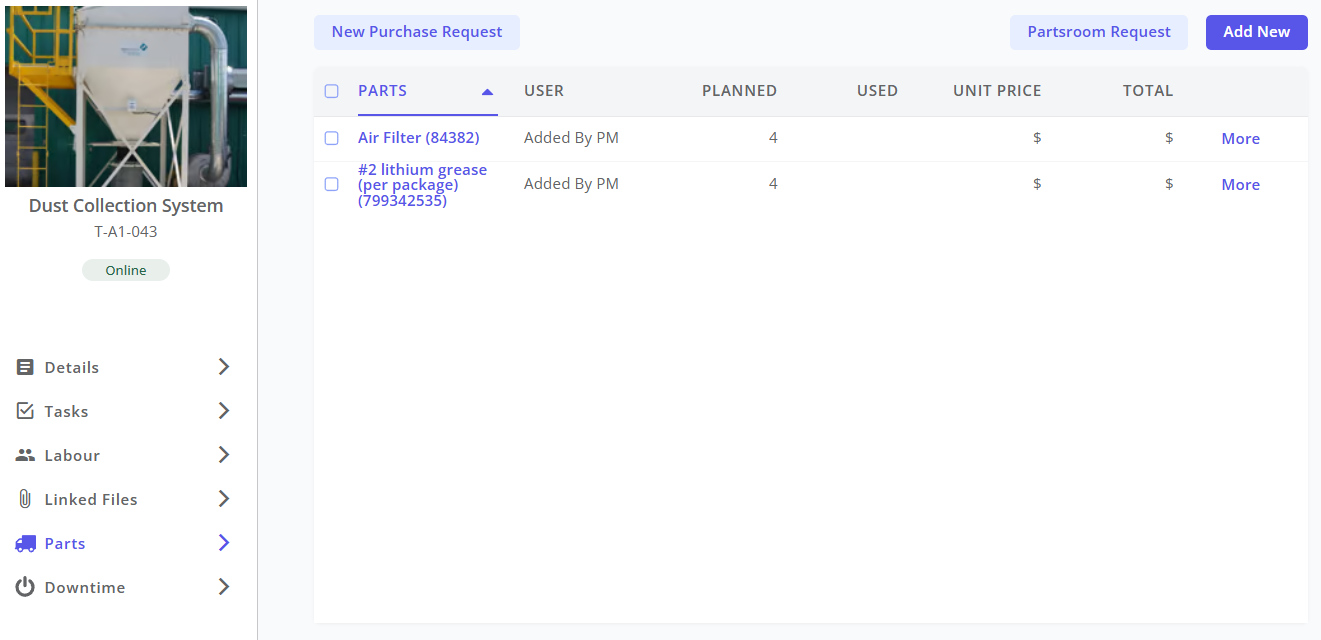
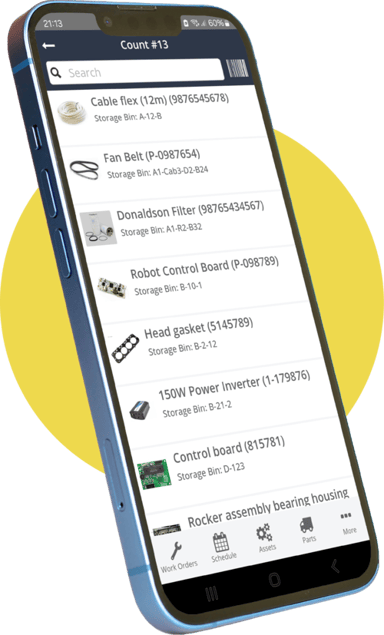
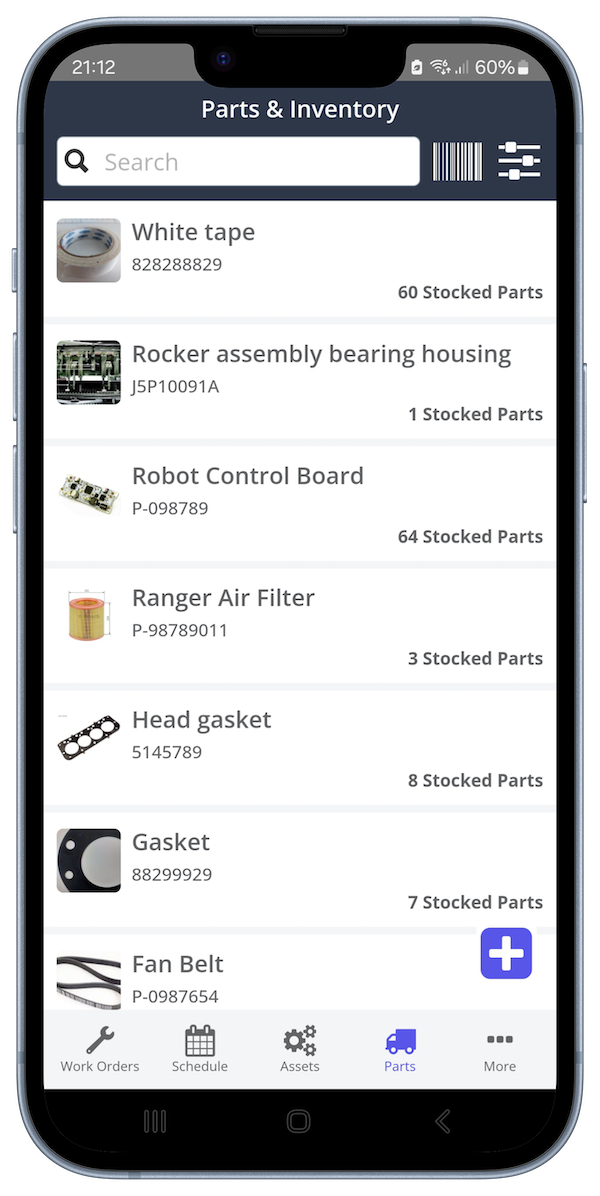
Modern CMMS platforms track parts usage automatically. When a technician closes a work order and logs the parts used, inventory levels update in real-time. The system can trigger reorder alerts when stock drops below minimum thresholds.
Better yet, the historical data helps you right-size your inventory over time. You can see exactly which parts you're using, how frequently, and for which equipment. That $200 motor that's been sitting in the parts room for three years? You don't need to reorder it. Those conveyor belts you keep running out of? Time to increase your safety stock.
Platforms like Zoidii include parts inventory management as a core feature, connecting parts usage directly to work orders and equipment records. This integration eliminates the manual reconciliation that makes spreadsheet-based inventory tracking so unreliable.
3. Streamlined Work Order Management
High-volume warehouses generate dozens of maintenance requests daily. Without a system, these requests arrive via radio calls, text messages, sticky notes, and hallway conversations. Things get lost. Priorities get confused. Technicians waste time tracking down information.
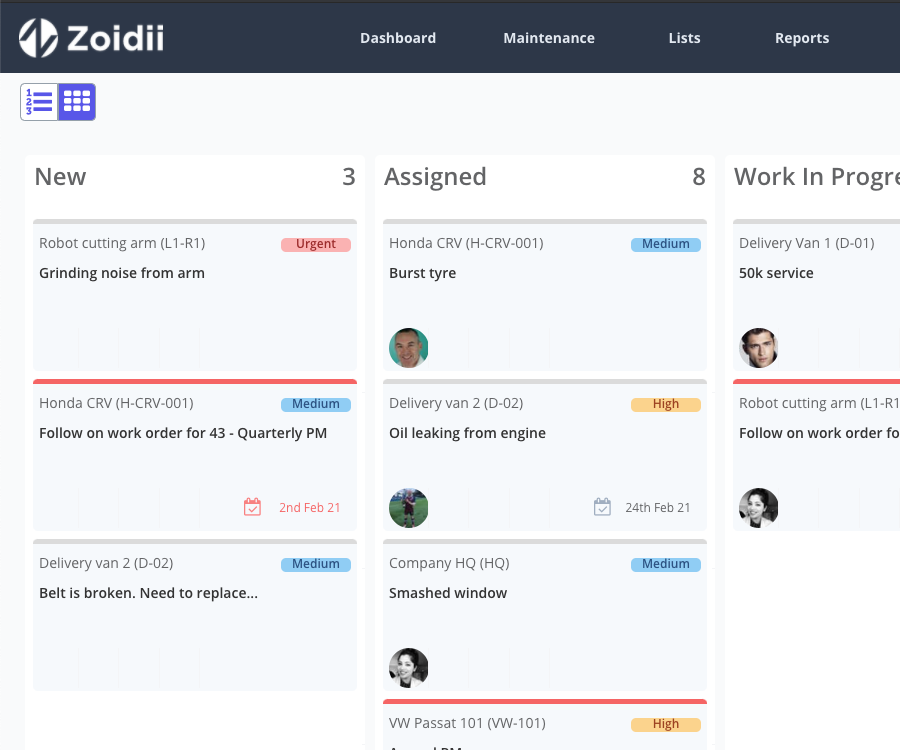
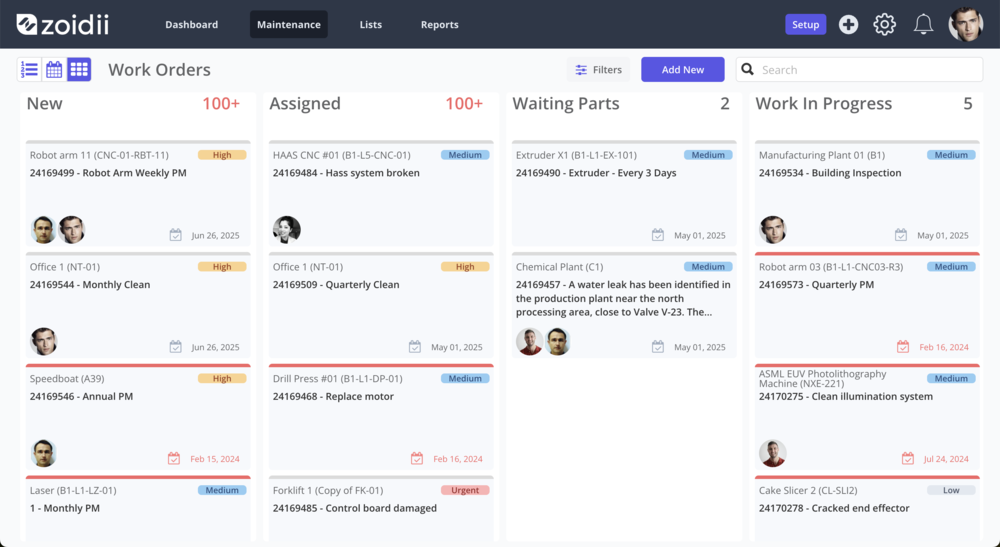
A CMMS centralizes everything. Operators submit requests through a simple QR code. The system captures the equipment, location, problem description, and timestamp automatically. Maintenance supervisors review incoming requests and assign them based on urgency and technician availability.
Each work order contains the information technicians need: equipment specifications, maintenance history, attached manuals, and step-by-step procedures. No more walking back to the office to look up part numbers or calling the equipment manufacturer for troubleshooting guidance.
The efficiency gains are substantial. Facilities typically report 20-35% improvements in technician productivity after implementing CMMS work order management, primarily from reduced administrative time and fewer trips back and forth for information.
4. Cost Savings
Maintenance costs at most warehouses fall into three buckets: labor, parts, and contractor services. A CMMS helps reduce spending in all three areas.
Preventing costly breakdowns: Emergency repairs cost 3-5 times more than planned maintenance for the same issue. You're paying premium rates for parts, overtime labor, and expedited shipping. Preventive maintenance catches problems early when fixes are cheaper.
Optimizing labor allocation: When you can see all pending work orders in one view, you can batch similar tasks together, route technicians efficiently, and avoid situations where multiple people show up for the same job. The scheduling visibility alone typically saves 2-4 hours of wasted technician time per week.
Extending equipment lifespan: Forklifts that receive regular maintenance last 12,000-15,000 operating hours. Neglected forklifts often need replacement at 8,000-10,000 hours. That's a significant capital expenditure difference when you're managing a fleet of 20-30 units.
One distribution center in the Midwest documented $340,000 in annual maintenance savings after implementing a CMMS: $180,000 from reduced emergency repairs, $95,000 from better parts management, and $65,000 from improved labor efficiency.
5. Compliance and Safety
OSHA requires documented inspection records for powered industrial trucks, fall protection systems, fire suppression equipment, and numerous other warehouse assets. During an inspection, you need to produce these records quickly and completely.
Paper inspection logs create problems. They get lost, damaged, or filed incorrectly. Handwriting becomes illegible. Inspections get skipped when supervisors are busy with other priorities.
A CMMS maintains inspection records digitally with timestamps, technician signatures, and photographic documentation. Recurring inspections are generated automatically based on regulatory requirements. The system flags overdue inspections before they become compliance violations.
Beyond regulatory compliance, this documentation protects you in liability situations. If a forklift accident occurs, you can demonstrate exactly what maintenance and inspections the equipment received. This documentation has proven invaluable in workers' compensation cases and insurance claims.
6. Data-Driven Decision Making
Most maintenance managers operate on intuition and tribal knowledge. They know which equipment is problematic because they've dealt with it repeatedly. They sense when something is about to fail based on experience.
A CMMS converts this intuition into data. You can see exactly which assets generate the most work orders, which failure modes occur most frequently, and which equipment consumes the most maintenance labor and parts.
This visibility changes how you make decisions. Is that conveyor section generating three work orders per month? The data might show it's time for replacement rather than continued repairs. Is the forklift fleet showing increasing maintenance costs? You can identify which specific units are driving the trend.
Key metrics to track include:
- Mean time between failures (MTBF) by equipment type
- Maintenance cost per operating hour
- Planned vs. unplanned maintenance ratio
- Work order completion rates and average resolution time
- Parts usage and inventory turnover
7. Scalability and Flexibility
Warehouse operations rarely stay static. You add new equipment, open additional facilities, and adjust staffing levels based on seasonal demand. Your maintenance management system needs to accommodate these changes without requiring a complete overhaul.
Cloud-based CMMS platforms scale naturally. Adding new assets takes minutes. New technicians can access the system immediately from their mobile devices. Additional facilities connect to the same central database, enabling cross-location visibility and standardized maintenance procedures.
This flexibility matters particularly for multi-site operations. Corporate maintenance managers can compare performance across facilities, identify best practices, and ensure consistent maintenance standards. Regional variations in equipment care become visible rather than hidden in local spreadsheets.
The cloud architecture also eliminates IT infrastructure headaches. No servers to maintain, no software updates to install, no backup procedures to manage. The vendor handles all of that, leaving your team free to focus on actual maintenance work.
8. Improved Communication and Collaboration
Maintenance problems rarely stay contained within the maintenance department. Production supervisors need to know when equipment will be back online. Warehouse managers need to adjust staffing around planned maintenance windows. Purchasing needs visibility into upcoming parts requirements.
A CMMS provides this cross-functional visibility without requiring constant meetings and status updates. Production supervisors can check work order status themselves. Managers can see the maintenance schedule for the coming week. Everyone works from the same information.
The real-time nature of modern CMMS platforms accelerates communication further. When a technician updates a work order status from their phone, that change is immediately visible to everyone with system access. No more waiting for end-of-shift reports or tracking down technicians for verbal updates.
This transparency also improves accountability. Work order timestamps show exactly when tasks were assigned, started, and completed. Response times become measurable rather than estimated.
9. Energy Efficiency
Energy costs represent 15-25% of total warehouse operating expenses, and that percentage continues climbing with 2026 utility rate increases averaging 8-12% across most regions. Maintenance practices directly impact energy consumption.
HVAC systems operating with dirty filters work harder and consume more electricity. Dock doors with worn seals leak conditioned air. Conveyor motors with failing bearings draw excess current before they fail. Lighting systems with aging components operate inefficiently.
A CMMS helps identify these energy drains through systematic tracking. Preventive maintenance schedules ensure filters get changed, seals get replaced, and equipment operates within design parameters. Some facilities integrate utility monitoring data directly into their CMMS to correlate maintenance activities with energy consumption patterns.
The sustainability angle matters increasingly for corporate reporting requirements and customer expectations. Documenting your maintenance-related energy efficiency improvements provides concrete data for ESG reporting and green certification programs.
10. Enhanced Customer Satisfaction
Everything in warehouse operations ultimately connects to customer experience. Late shipments, damaged products, and inventory errors all trace back to operational problems that maintenance directly influences.
When conveyors run reliably, orders move through the facility on schedule. When forklifts stay operational, loading and unloading happen without delays. When climate control systems maintain proper conditions, temperature-sensitive products arrive undamaged. The connection isn't always obvious, but it's measurable. Warehouses with strong maintenance programs consistently outperform on order accuracy, shipping timeliness, and product quality metrics. The operational stability that good maintenance provides creates the foundation for everything else.
Next Steps to Warehouse Maintenance Excellence
In an industry where efficiency and reliability are paramount, a CMMS is an invaluable tool for warehouses. The benefits are clear: From improving equipment reliability and reducing costs to enhancing safety and customer satisfaction, a CMMS can streamline operations, stay competitive, and position warehouses for long-term success. Read about how Arcadia Cold Storage implemented maintenance excellence with Zoidii.
In 2026, adopting advanced tools like a CMMS is no longer optional—it's essential. Whether managing a small warehouse or a large distribution center, a CMMS can help you achieve your operational goals and drive business growth.
If you haven't invested in a CMMS for your warehouse operations, schedule a meeting with us to discuss how CMMS software can enhance your operations.