
Manufacturing plants run on uptime. Every unplanned breakdown, missed preventive maintenance task, or disorganized work order is a direct hit to production output, labor efficiency, and profit margins.
In 2026, the pressure has only intensified. With the global CMMS market valued at $2.4 billion and growing at a 9%+ CAGR, more than 60% of manufacturing facilities now use a Computerized Maintenance Management System (CMMS) to manage their operations. The plants that are pulling ahead aren't just investing in better equipment — they're investing in smarter maintenance.
This article breaks down exactly how a CMMS improves manufacturing plant efficiency and what it means in practical terms for your team on the floor.
What Is a CMMS in Manufacturing?
A Computerized Maintenance Management System (CMMS) is software that centralizes all maintenance activities into a single, accessible platform. In a manufacturing context, that means:
- Work orders (planned and reactive)
- Preventive maintenance schedules
- Asset records and history
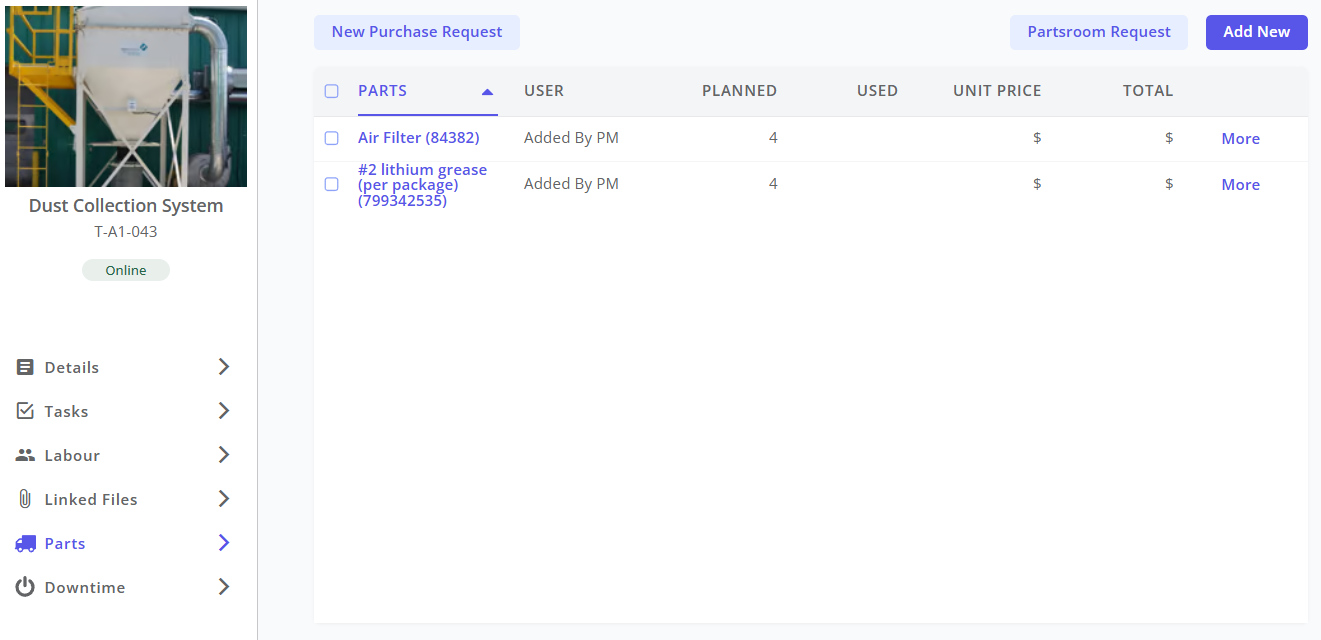
- Spare parts inventory
- Compliance and safety documentation
- KPI reporting and analytics
The Real Cost of Inefficient Maintenance in 2026
Before diving into the benefits, it helps to understand what's at stake. Manufacturing plants operating without a CMMS — or with disconnected, manual systems — face measurable, documented costs:
- Unplanned downtime costs manufacturers an average of $260,000 per hour (Aberdeen Group)
- 82% of manufacturing plants experienced at least one unplanned downtime event in the past three years (Aberdeen Group)
- The average Fortune 500 manufacturer loses approximately $1.4 trillion collectively per year to unplanned equipment failures — roughly 11% of total revenue
- Unplanned downtime accounts for 34.2% of all OEE efficiency losses across discrete manufacturing sectors
6 Ways a CMMS Makes a Manufacturing Plant More Efficient
1. Dramatically Reduces Unplanned Downtime
The most direct efficiency gain from a CMMS is the shift from reactive to preventive maintenance. When PMs are scheduled and executed consistently, equipment failures are caught before they become production stoppages.
The results are well-documented:
- Plants investing in structured maintenance programs decrease overall downtime by an average of 44%
- Organizations with mature preventive maintenance programs report 35–45% downtime reduction (U.S. Department of Energy)
- Plants using a CMMS platform typically reduce Mean Time to Repair (MTTR) by 20–30% through better coordination and faster diagnosis
2. Improves Overall Equipment Effectiveness (OEE)
OEE — the gold standard metric for manufacturing productivity — measures the combined impact of availability, performance, and quality. World-class plants target 85% OEE or higher. Most facilities operate between 60–65%.
The gap between average and world-class OEE is largely a maintenance problem. Equipment that breaks down unexpectedly, runs below rated speed due to wear, or produces defects due to poor calibration all drag OEE down.
A CMMS directly addresses OEE's availability component — the one most impacted by maintenance decisions — by:
- Automating PM schedules to prevent availability losses from unexpected failures
- Logging every work order so maintenance history informs future scheduling
- Tracking MTBF (Mean Time Between Failures) per asset to identify chronic underperformers
- Generating real-time dashboards that give managers visibility into which assets are offline and why
3. Streamlines Work Order Management
Without a CMMS, work orders are typically tracked on paper, whiteboards, or spreadsheets — systems that create delays, miscommunication, and lost records. Technicians waste time searching for information instead of turning wrenches.
A CMMS digitizes the entire work order lifecycle:
- Requests are submitted via mobile, web, or QR code scan
- Work orders are automatically assigned based on priority and technician availability
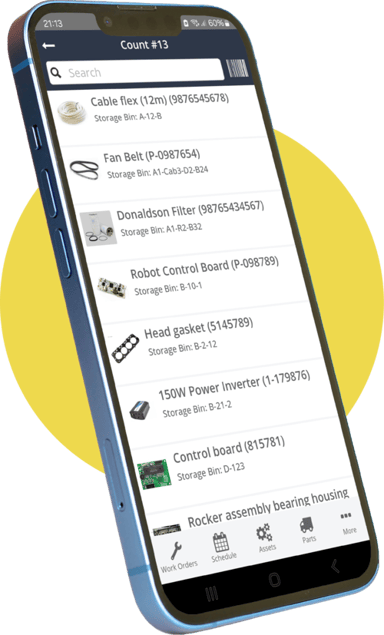
- Technicians receive instant mobile alerts and access full asset history, SOPs, and parts lists from their phones
- Completed work is documented in real time with photos, notes, and labor times
4. Optimizes Spare Parts Inventory
Parts shortages extend downtime. Overstocked inventory ties up capital. Managing MRO inventory manually — through spreadsheets or tribal knowledge — leads to both problems simultaneously.
A CMMS tracks parts usage in real time, automatically depleting stock when work orders are closed and alerting managers when levels fall below minimum thresholds. This means:
- Technicians can confirm parts availability before beginning a repair
- Reorder points trigger automatically, preventing costly emergency procurement
- Purchasing data is tied to specific assets, giving visibility into which equipment drives the highest parts spend
5. Supports Safety and Compliance Documentation
Manufacturing plants face ongoing regulatory scrutiny — from OSHA inspections to ISO certifications to customer audits. Incomplete inspection records, missing safety checklists, or undocumented equipment changes create liability and audit risk.
A CMMS maintains a full, timestamped audit trail of every maintenance activity: who performed the work, when, what parts were used, and what was found. Safety inspection checklists can be built directly into work orders, ensuring compliance steps are completed and documented every time.
For plants in regulated industries — food and beverage, pharmaceuticals, automotive — this documentation capability alone justifies the investment.
6. Gives Management the Data to Make Better Decisions
One of the most underappreciated benefits of a CMMS is what it does for decision-making above the technician level. Maintenance managers and plant operations leaders gain access to KPIs that are impossible to calculate consistently from paper records or spreadsheets:
- MTBF — identifying assets that are failing more frequently than expected
- MTTR — measuring how quickly your team recovers from failures
- PM compliance rate — tracking what percentage of scheduled PMs are completed on time (best-in-class plants target 90%+)
- Maintenance cost per asset — revealing which equipment has crossed from cost-effective to replacement-worthy
- Planned vs. unplanned work ratio — world-class plants keep planned maintenance above 85% of total work
From Reactive to Preventive: The Efficiency Shift That Changes Everything
Most manufacturing plants start reactive — fixing things when they break, scrambling for parts, pulling technicians off planned work to fight fires. This mode is expensive, unpredictable, and exhausting for maintenance teams.
A CMMS is the infrastructure that makes the shift to preventive maintenance operationally sustainable. Industry data shows that 71% of maintenance professionals now use preventive maintenance as their primary strategy — yet 58% of facilities still spend less than half their time on scheduled maintenance, meaning the majority of plants are still fighting too many reactive fires. The path forward is clear: implement systems that automate scheduling, reduce administrative burden, and give technicians the information they need to complete work efficiently. That's exactly what a CMMS does.
What to Look for in a Manufacturing CMMS
Not all CMMS platforms are built for manufacturing environments. When evaluating options for your plant, prioritize:
Mobile-first design — Technicians work on the floor, not at desks. The CMMS needs a full-featured mobile app for submitting, updating, and closing work orders from any device.
Asset hierarchy and history — Manufacturing plants have complex asset structures. The system should support parent-child asset relationships, full maintenance histories per asset, and document attachments (manuals, diagrams, OEM specs).
Flexible PM triggers — Preventive maintenance in manufacturing often needs to trigger on meter readings or runtime hours, not just calendar dates. Look for CMMS platforms that support time-based, usage-based, and condition-based PM scheduling.
Parts inventory integration — Work orders and parts should be linked, so technicians can check availability and managers can track consumption per asset.
Fast implementation — Enterprise-grade CMMS platforms can take months to deploy. For plants transitioning from spreadsheets and paper for the first time, purpose-built tools like Zoidii are designed to get teams live in days, not months.
Making the Case for CMMS Investment
The ROI conversation for CMMS software doesn't require complex modeling. The math is straightforward:
If a single unplanned downtime event costs $260,000 per hour, preventing just one additional breakdown per month through better preventive maintenance scheduling generates more value than most CMMS subscriptions cost in a year. Add the MRO inventory savings, labor efficiency gains, reduced overtime, and improved audit readiness — and the business case becomes compelling at almost any plant scale.
Getting Started
For manufacturing teams making the move from paper, Excel, or disconnected systems to a CMMS for the first time, the key is choosing a platform designed for fast adoption. The biggest implementation failure point isn't the software — it's user adoption. Choose a tool your technicians will actually use.
Zoidii is purpose-built for manufacturing companies making this transition. Most teams are live within days, with no IT resources required and an interface simple enough that — as one Zoidii customer put it — "if your team can use social media, they can use Zoidii."
Ready to see what a CMMS can do for your plant? Start your free Zoidii trial today.