
A staggering 30% of organizations don't know what assets they own, where they’re located, or who is actually using them. If you’re still relying on a "master" spreadsheet that hasn't been updated since last quarter, your fixed asset management strategy is likely costing you thousands in ghost assets and maintenance delays.
It’s frustrating to send a tech across the plant for a part that doesn't exist or to find out a critical piece of equipment hasn't been serviced because it simply wasn't on the list.
We agree that most software is just too stupid complex for a busy maintenance team to actually use. This guide is here to help you move beyond those messy files to a system that works for the people on the floor. You’ll learn how to create a single source of truth for your physical assets and reduce downtime with better tracking.
We’ll also show you how to generate the kind of clear reports that prove ROI to your C-suite. Let's get your facility organized and your data back on track.
Key Takeaways
- Stop wrestling with messy spreadsheets and start seeing your equipment clearly with a real-time tracking strategy.
- Identify and eliminate "Ghost Assets" to stop paying insurance and taxes on equipment you no longer own.
- Focus on essential features that reduce unplanned downtime without the headache of over-engineered software.
- Master a no-nonsense, 5-step process for implementing fixed asset management that your maintenance team will actually understand and use.
- Simplify your daily workflow using visual Kanban boards to keep your facility organized and productive.
What is Fixed Asset Management in the Modern Facility?
Fixed asset management is the operational backbone of a facility. It involves the systematic tracking of physical equipment, vehicles, and machinery throughout their entire functional life.
Unlike inventory management, which handles items intended for quick sale or consumption, this discipline focuses on long-term value. You aren't tracking boxes of screws; you're tracking the $250,000 CNC machine that keeps your production line moving.
Modern facilities have moved away from reactive "where is it?" tracking. Instead, they use data to drive proactive performance management. Understanding what is fixed asset management allows teams to shift their focus from finding lost tools to maximizing the return on every dollar spent on Property, Plant, and Equipment (PPE). This transition is vital for any team that wants to stop guessing and start knowing exactly how their gear is performing.
Fixed Assets vs. Current Assets: The Operational Reality
Maintenance teams prioritize PPE over cash flow because machines, not bank balances, drive daily output. Current assets are things like cash or inventory that you expect to convert to value within a year. Fixed assets are the heavy hitters. They are the assets that generate revenue rather than being the revenue itself. For example, a delivery truck is a fixed asset; the packages inside it are inventory.Effective management requires identifying critical assets. These are the "can't fail" machines that would stop operations if they went offline. In most industrial settings, 20% of your assets typically cause 80% of your maintenance headaches. Focusing oversight on these critical pieces of gear ensures that your most expensive investments don't become your biggest liabilities.
The 5 Stages of the Asset Lifecycle
Managing an asset is a continuous loop, not a one-time event. Most facilities fail because they stop tracking the asset the moment it's bolted to the floor. To keep things stupid simple, follow these five stages:- Acquisition: This starts on day one. You must record serial numbers, warranty details, and initial costs to set a clean data foundation.
- Commissioning: This involves installing the asset and verifying it meets safety standards before it enters the workflow.
- Utilization: This is the core of the CMMS workflow. You track run hours, output, and how often the asset is actually working.
- Maintenance: This stage covers all PMs and repairs. It's where you prevent the asset from failing prematurely.
- Disposal: When the asset reaches end-of-life, it must be removed from the books. Ghost assets, which are lost or unusable items still listed in the system, account for 15% to 30% of inventory in poorly managed facilities. Proper disposal prevents you from paying insurance and taxes on gear you no longer own.
Why Most Asset Management Strategies Fail (And How to Fix Them)
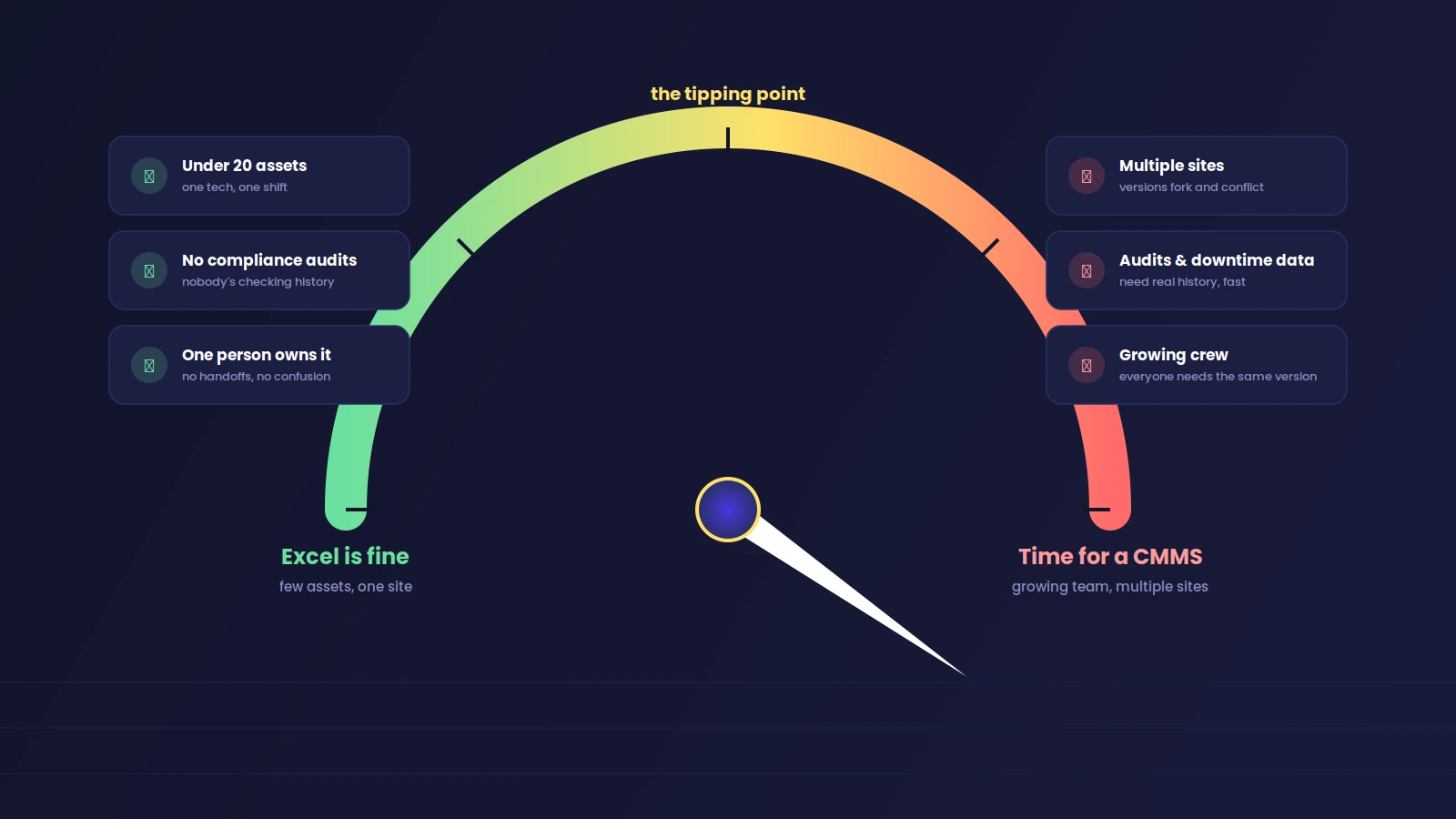
Most companies treat fixed asset management as a once-a-year chore for the accounting team. This approach is a recipe for wasted capital. If your strategy relies on a dusty Excel file, you're already losing money.
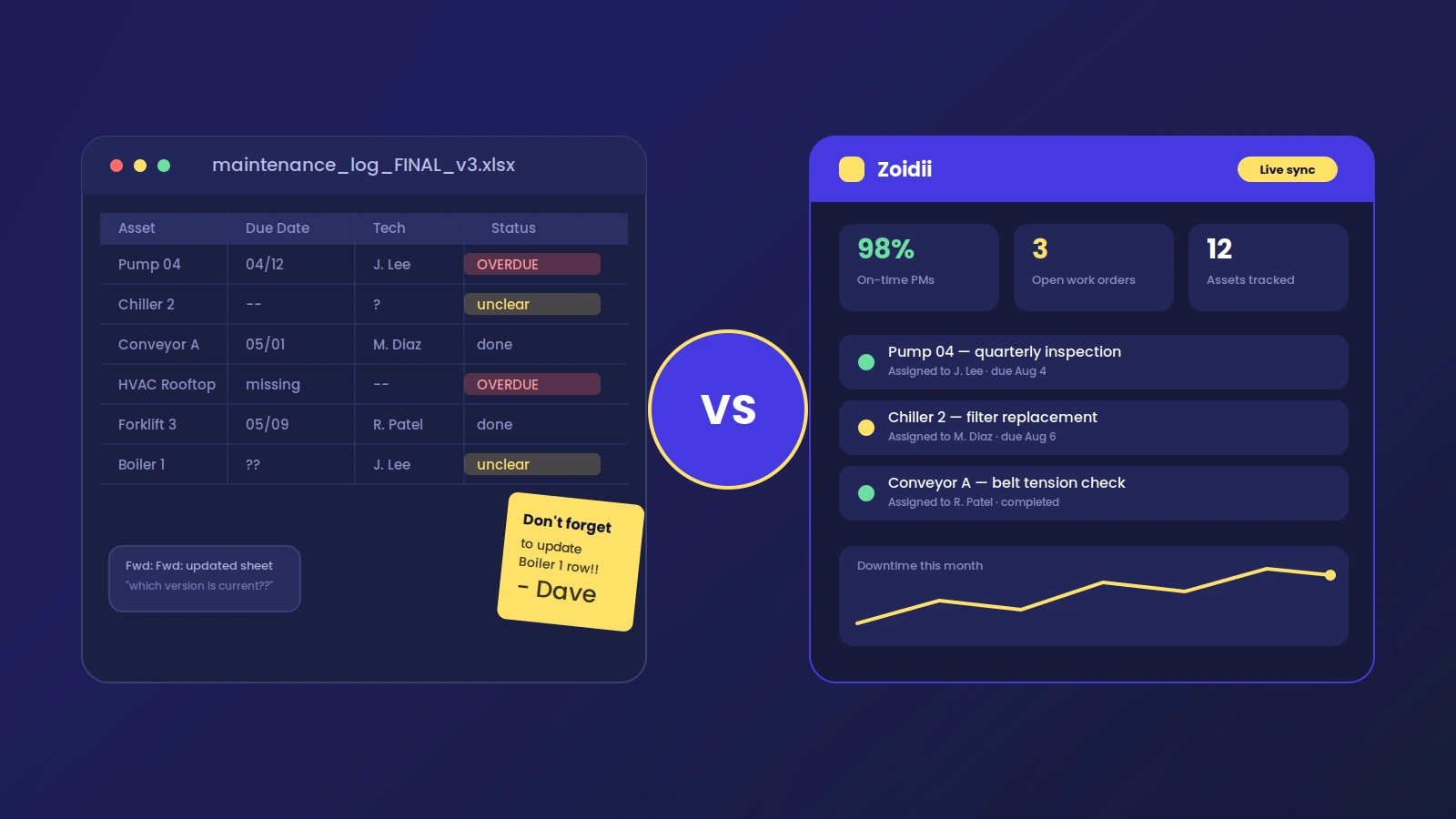
The "Spreadsheet Trap" is the primary reason visibility dies. Excel isn't real-time; it's a static snapshot of the past. When a technician replaces a motor at 3:00 AM, that change won't hit the spreadsheet until a monthly meeting, if it ever gets recorded at all.
This lack of visibility leads to the high cost of "Ghost Assets." Industry data suggests that up to 30% of assets on a typical balance sheet no longer exist or are unusable. You're likely paying insurance premiums and property taxes on equipment that was scrapped three years ago.
At the same time, data silos keep accounting and maintenance from speaking the same language. Finance cares about depreciation; the shop floor cares about uptime. Without a unified system, these teams stay at odds.
The final hurdle is the "Stupid Complex" software problem. Many organizations invest in over-engineered ERPs that require a PhD to navigate. These systems eventually become "shelfware" because they're too difficult for daily use.
A pragmatic Essential Features of a Fixed Asset Management System must prioritize usability. If a tool isn't stupid simple, your crew will ignore it, and your data will remain a mess.
The Hidden Costs of Disorganized Asset Tracking
- Emergency Procurement: Misplaced tools cause 15% of project delays. When a $4,000 specialized drill goes missing, companies often panic-buy a replacement rather than finding the original.
- Audit Compliance: Poor tracking leads to failed safety certifications. A 2022 study showed that disorganized records increase audit preparation time by 40%
- ROI of Digital: Moving from manual logs to digital tracking can reduce asset loss by 25% within the first 12 months.
Bridging the Gap Between Finance and the Shop Floor
The CFO needs accurate data for tax purposes, but the maintenance crew needs a tool that doesn't slow them down. You can satisfy both by syncing maintenance history directly with depreciation schedules.When every repair is logged in a system that's built for the shop floor, the data flows upward automatically.
This allows you to justify new equipment purchases with hard facts. If you can prove a specific CNC machine cost $14,000 in unplanned repairs last year, the budget for a replacement becomes an easy "yes" for the finance team.
Essential Features of a Pragmatic Fixed Asset Management System
Most software vendors try to sell you every bell and whistle under the sun. We don't. For a maintenance team, less is usually more. You don't need a 500-page manual; you need a system that gets out of the way.
Effective fixed asset management is about getting the right data to the right person at the right time. When you strip away the fluff, you're left with tools that actually help your team work faster.
Real-time visibility is the backbone of this approach. When an asset breaks, you need to know its history immediately. This visibility cuts unplanned downtime because technicians aren't hunting for manuals or old repair notes.
If you're still wondering what is fixed asset management in a modern facility, it's the ability to see the health of your entire operation from a smartphone. Mobile access turns a technician's phone into a diagnostic tool. It ensures data flows directly into work orders without a single trip back to the office.
QR Codes and Barcoding: The End of Manual Entry
Manual entry is a productivity killer. It's slow and prone to mistakes. Every asset needs a digital twin, a digital record that lives in your system and updates instantly. By using QR codes or barcodes, you create a direct link between the physical machine and its digital history.While RFID is useful for high-value tracking across large zones, QR codes are the pragmatic choice for most facilities. They're cheap to produce and stupid simple to use. Studies show that mobile scanning reduces data entry errors by 90% compared to paper logs. This ensures your records actually reflect reality.
Preventive Maintenance (PM) Integration
An asset record without a linked maintenance schedule is just a list. It's effectively useless. To realize your operational goals, you must link your fixed asset management data to specific triggers. These triggers can be based on simple time intervals, usage meters, or condition-based monitoring. When the data flows correctly, the system generates work orders automatically.This keeps your team proactive instead of reactive. You can learn more about how to set these up in our Preventive Maintenance Scheduling guide. Integration ensures that when a technician scans a code, they don't just see what the asset is; they see exactly what it needs right now.
A 5-Step Guide to Implementing Fixed Asset Management
Implementing a fixed asset management system doesn't have to be a bureaucratic nightmare. It's about getting control of your floor and stopping the financial leak caused by lost or broken equipment. If you want a system that actually works, follow these five pragmatic steps.
Step 1 & 2: The Cleanup and Categorization
You can't manage what you can't see. Start with a wall-to-wall physical audit to identify every asset you own. This process clears out ghost assets, which are items on your books that don't exist, and zombies, which are broken machines taking up space.Industry data suggests that ghost assets can make up 15% to 30% of a company's recorded inventory. You shouldn't pay insurance or taxes on equipment that isn't there.
To perform this audit without halting operations, use a rolling zone approach. Audit one department or production line per week until the facility is mapped. During this phase, establish a naming convention that makes sense to the people on the tools.
Use a standardized parent-child hierarchy for complex machinery. For example, a CNC machine is the parent asset, while the spindle and cooling system are child assets. This allows you to track maintenance costs at a granular level.
- Rank by Criticality: Categorize assets on a scale of 1 to 5 based on how much downtime they cause.
- Standardize Names: Don't let one tech call it a "Lathe" while another calls it "Turning Center 01."
- Verify Locations: Record exactly where the asset sits, down to the room or bin number.
Step 3 & 4: Going Digital and Mobile
Stop using paper logs and clipboards. Tag every piece of equipment with a QR code for instant mobile identification. For harsh environments like machine shops or outdoor yards, skip the cheap paper stickers. Use anodized aluminum tags or 3M polyester labels that resist oil, heat, and abrasion. A quick scan with a smartphone should immediately pull up the asset's history and manual.Once you've tagged the floor, migrate your data from messy spreadsheets to a cloud-based CMMS. Use the "clean data in, clean data out" rule. Scrub your spreadsheets for duplicates and formatting errors before importing them.
This ensures your new digital system provides accurate reports from day one. If you're ready to ditch the spreadsheets, you can explore cloud-based CMMS software solutions to automate your tracking.
Step 5: Train the Team
The best fixed asset management system will fail if the team won't use it. Adopt a KISS (Keep It Stupid Simple) approach to training. Your technicians should be able to scan a tag and log a work order in under 60 seconds.If the software is over-engineered, they'll revert to memory and whiteboards. Focus training on the immediate benefits for the user, such as finding parts faster and spending less time on paperwork. When the system is easy, adoption follows naturally.
Realizing Operational Excellence with Zoidii
Most software platforms fail because they are too complex for the people actually using them. Zoidii takes a different path. We built our platform on a "stupid simple" interface that removes the friction from fixed asset management. You don't need a week of training or a thick manual to get started.
It's designed to be intuitive from the first click, ensuring your team spends more time maintaining assets and less time fighting with a database.
The heart of Zoidii’s visual management is the Kanban maintenance board. This tool transforms a cluttered list of tasks into a clear, drag-and-drop roadmap. You can see exactly which assets are undergoing repairs, which are waiting for parts, and which are ready for service. This visual clarity eliminates the guesswork that often leads to downtime.
Managers can reallocate resources in seconds, keeping the workflow moving without the usual administrative headache.
Reporting shouldn't be a chore that takes up your entire Friday afternoon. Zoidii generates reports that speak the language of the C-suite automatically. Instead of manual data entry, you get instant access to the metrics that matter, such as uptime percentages and maintenance costs.
It provides the hard data needed to justify budget requests and prove that your department is a center of efficiency rather than a cost center.
Mobile Asset Tracking That Techs Actually Love
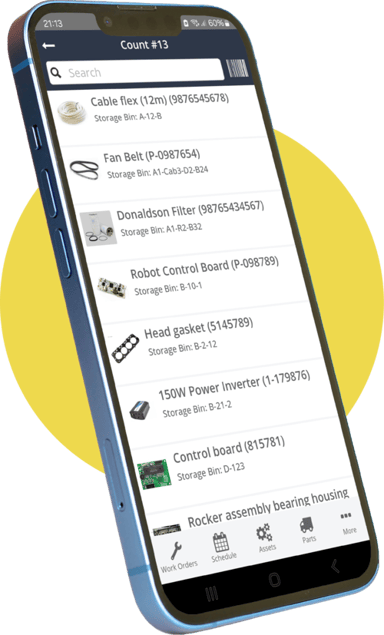
Techs hate paperwork, and they hate returning to a desk to update a status. Zoidii’s mobile-first design puts the entire fixed asset management system in their pockets. By using our mobile app, teams have reduced the "paper trail" by 100% in many facilities, leading to much higher data accuracy. Techs get real-time updates and can see the full history of an asset while standing right in front of it.Instant Status Updates: Know the condition of any asset, anywhere, the moment a change is made.
- QR Code Integration: Scan a tag to pull up manuals, parts lists, or maintenance history instantly.
- Guest Work Orders: Allow non-users to report issues via a simple scan. This lets anyone in the building flag a problem without needing a dedicated login, catching issues before they escalate.
Proving ROI with Advanced Maintenance Analytics
Winning the budget battle requires proof. Zoidii tracks the Total Cost of Ownership (TCO) for every major asset in your inventory. This data is vital for identifying "lemon" assets, those specific pieces of equipment that cost more in recurring repairs than they are worth in production value.When you can pinpoint exactly which machines are draining your budget, you can make informed replacement decisions based on facts rather than gut feelings.
This level of transparency shifts the conversation with leadership. You aren't just asking for money; you're presenting a data-driven case for operational improvement. By surfacing these insights without manual effort, Zoidii helps you realize your goals faster and keeps your facility running at peak performance.
Chat with a Zoidii product expert to see it in action.
Stop Tracking Chaos and Start Realizing Results
Success in the modern facility starts with a lean approach to your inventory. You've learned that manual spreadsheets lead to ghost assets and that a pragmatic, 5-step implementation plan is the only way to ensure your strategy actually sticks.
Effective fixed asset management isn't about complex jargon or bloated software; it's about having the right data to make fast decisions. Maintenance teams in Dublin, Toronto, and across the globe are already moving away from disorganized systems to protect their bottom line.
Zoidii is rated the #1 cloud-based CMMS for ease of use because we've stripped away the fluff. Our users regularly reduce equipment downtime by up to 25% while ensuring every piece of gear is accounted for. Don't let over-engineered tools slow your team down. You can eliminate the guesswork and get your facility organized in days, not months.
It's time to ditch the stress and embrace a system that just works. Book a demo to see how Zoidii makes asset management stupid simple.
You've got the roadmap, now get the tool that helps you reach the finish line.