
The Food Safety Crisis Demands Better Maintenance Technology
Food safety has never been more critical — or more difficult to manage. In 2025, the FDA issued 571 food recalls, up 15.4% from the prior year, with total recalled units surging 209% by volume according to Sedgwick's 2026 State of the Nation U.S. Product Safety and Recall Index. Meanwhile, the average direct cost of a single food recall exceeds $10 million, not counting brand damage, lost sales, or litigation costs.
For food manufacturers operating under HACCP (Hazard Analysis and Critical Control Points) frameworks, these numbers are a stark reminder: proactive maintenance and documentation are not optional. They are your first line of defence. A Computerized Maintenance Management System (CMMS) is one of the most powerful tools available to food manufacturers seeking to meet HACCP compliance requirements, reduce recall risk, and build a culture of food safety. In this article, we explore exactly how a CMMS supports each of the seven HACCP principles — and why 2026 is the year to make the switch from spreadsheets and paper logs to a centralized digital system.
Key Takeaways:
1. Food recall risk is at a nine-year high — 571 FDA recalls in 2025, up 15.4%, with unit volumes surging 209%
2. A CMMS directly supports all 7 HACCP principles — from hazard analysis through to record-keeping
3. Automated preventive maintenance is your best contamination defence — eliminating the missed PMs that create compliance gaps
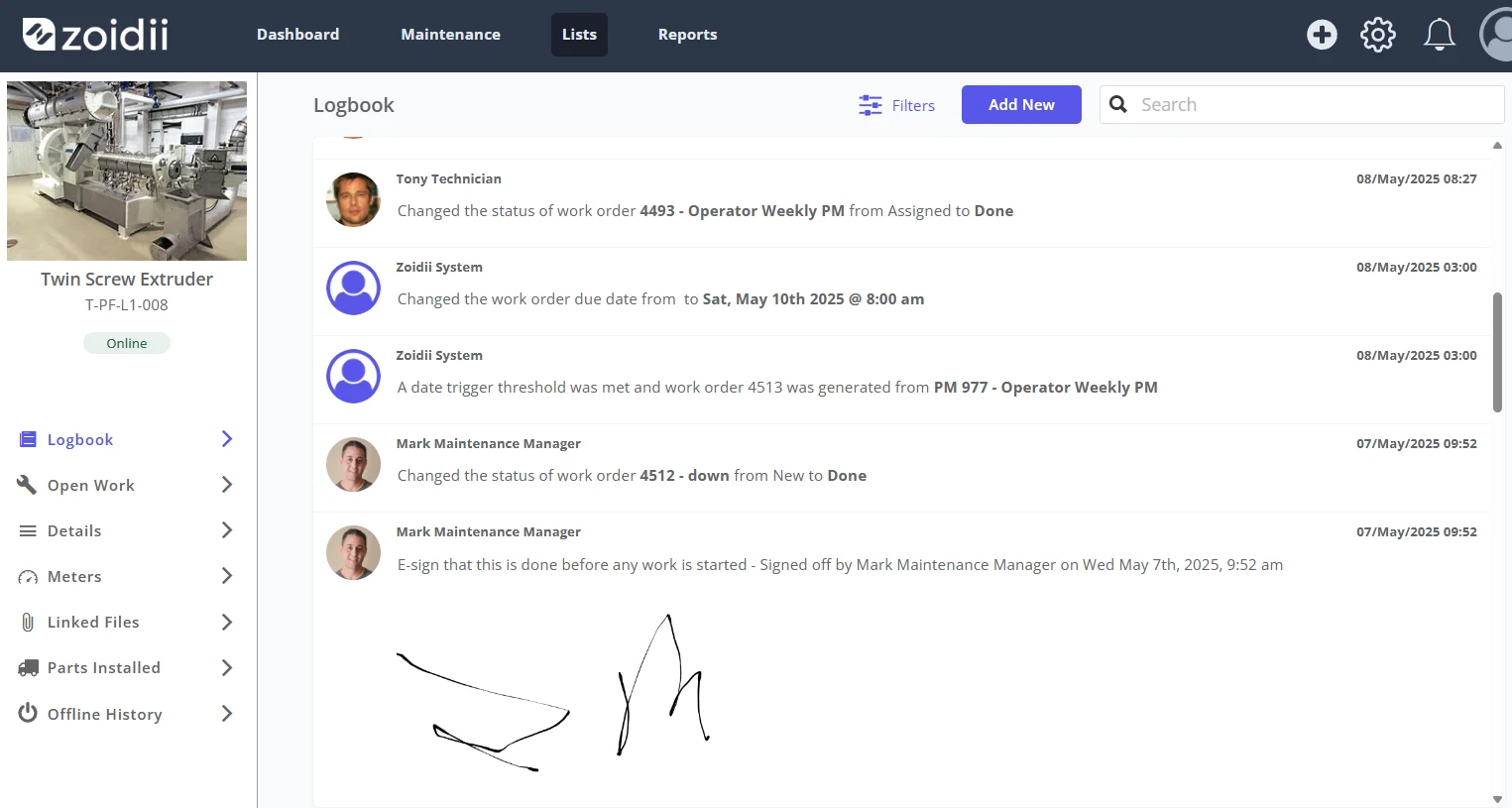
4. Audit-ready documentation is a CMMS's biggest compliance superpower — every action timestamped and instantly exportable
5. The regulatory environment is tightening — facilities that adopt CMMS now will be ahead of the FDA Traceability Rule enforcement in 2028
What Is HACCP? A Quick Overview
HACCP — Hazard Analysis and Critical Control Points — is a globally recognized, science-based system used to identify, evaluate, and control biological, chemical, and physical hazards in food production. Developed in the 1960s and now mandated or strongly recommended by regulators across North America, Europe, and beyond, HACCP shifts food safety from reactive inspection to proactive prevention.
The system is organized around seven core principles:
• Conduct a Hazard Analysis • Identify Critical Control Points (CCPs) • Establish Critical Limits for each CCP • Establish Monitoring Procedures • Establish Corrective Actions • Establish Verification Procedures • Establish Record-Keeping and Documentation Procedures
Every one of these principles depends heavily on structured maintenance, real-time monitoring, and reliable documentation — exactly what a modern CMMS provides.
What Is a CMMS? And Why Does It Matter for HACCP?
A CMMS (Computerized Maintenance Management System) is software that centralizes and automates the management of maintenance operations. It tracks work orders, preventive maintenance schedules, asset histories, parts inventory, technician assignments, and compliance documentation — all in one place.
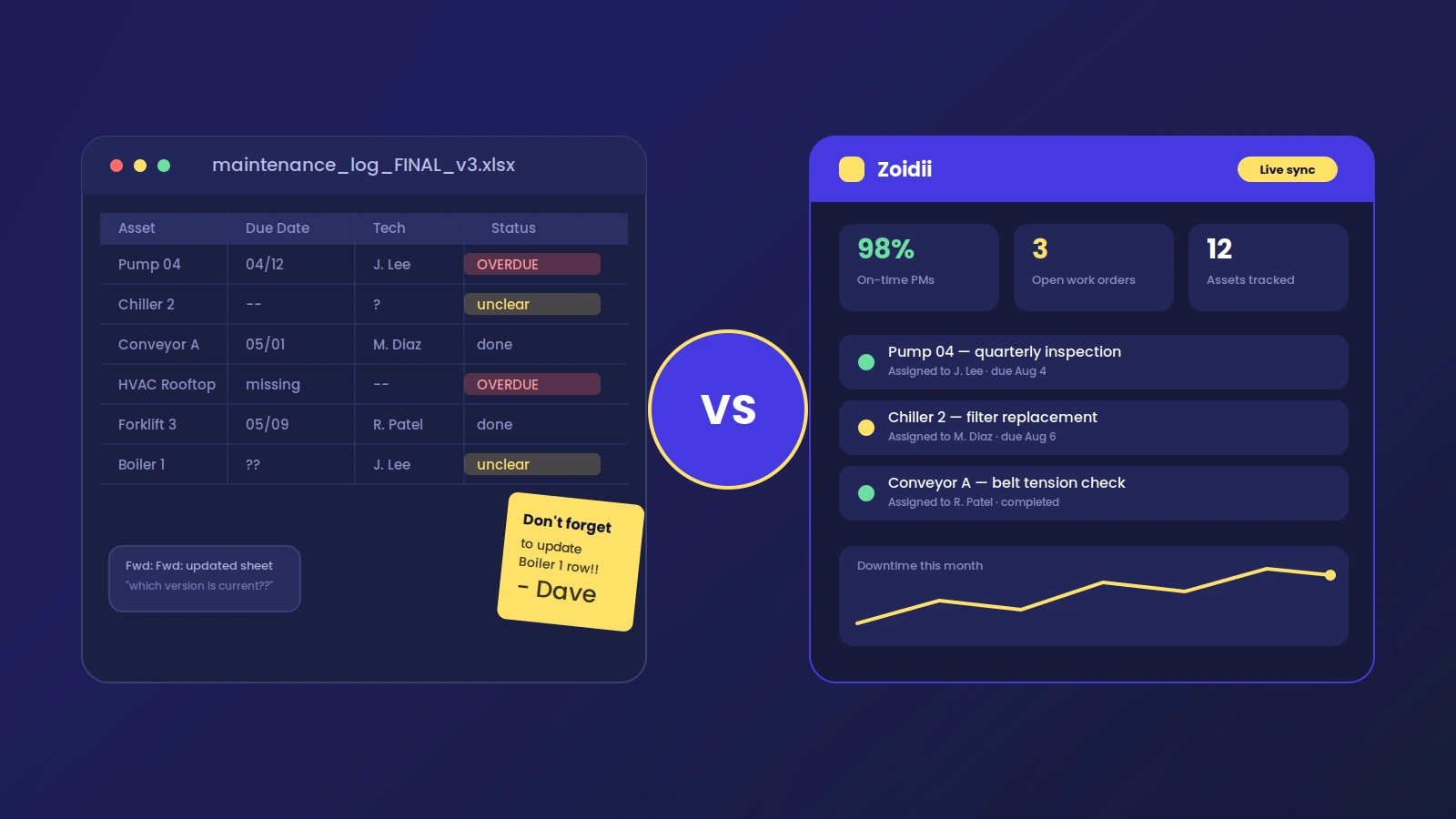
For food manufacturers, a CMMS bridges the gap between your maintenance team and your food safety program. It ensures that every scheduled inspection, calibration, sanitation task, and equipment repair is documented with timestamps, technician names, and completion status — creating an auditable digital trail that is ready for FDA, USDA, HACCP, FSMA, SQF, or BRC inspections at a moment's notice.
How a CMMS Supports Each of the 7 HACCP Principles
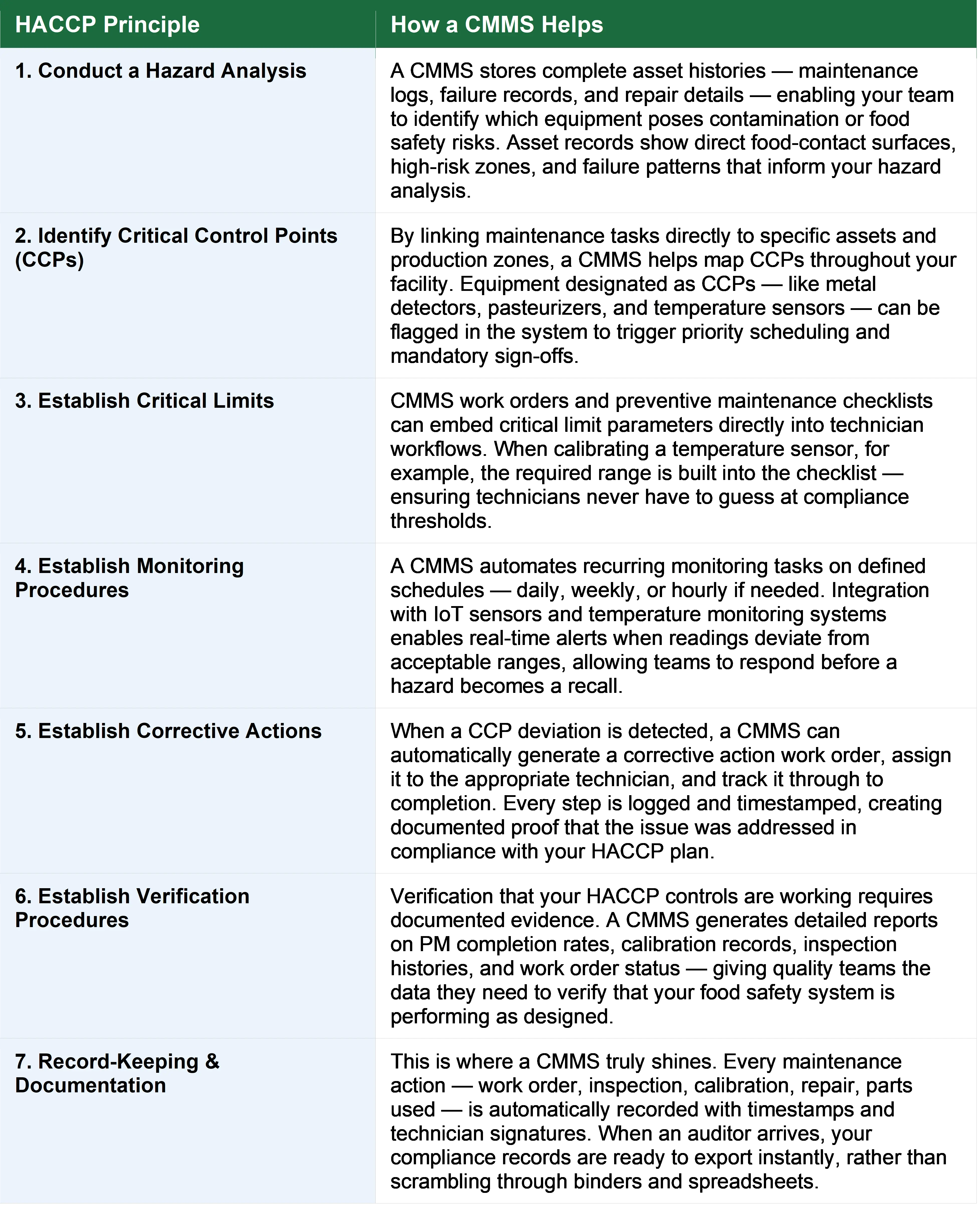
6 Key Benefits of CMMS for HACCP Compliance in 2026
1. Automated Preventive Maintenance Scheduling HACCP compliance depends on equipment that works as intended, all the time. A CMMS automates preventive maintenance schedules for every asset in your facility — from food-contact conveyors to refrigeration units and processing equipment. Automated scheduling eliminates missed PMs, reduces emergency breakdowns, and ensures that your equipment is always inspection-ready.
2. Real-Time CCP Monitoring and Alerts Modern CMMS platforms can integrate with temperature sensors, IoT monitors, and environmental controls to provide real-time visibility into critical control points. When a temperature exceedance occurs or a piece of equipment falls out of spec, the system triggers an immediate alert. It can auto-generate a corrective action work order — dramatically shrinking the response window that separates a controlled deviation from a costly recall.
3. Instant Audit-Ready Documentation In 2025, 40% of food recalls were caused by undeclared allergens, and bacterial contamination drove 37 additional recall events in Q3 alone. Regulators are scrutinizing maintenance records more closely than ever. A CMMS ensures that every maintenance task, inspection, calibration, and repair is logged and retrievable on demand. No more last-minute scrambling to compile paper records before an audit.
4. Contamination Prevention Through Maintenance Traceability A CMMS tracks direct food-contact assets separately from non-contact equipment, helping teams identify contamination risks before they occur. If a worn seal, an unlubricated bearing, or a failed gasket on a food-contact surface is logged as a work order, the system links that maintenance event directly to the asset and the production line — enabling root cause analysis in the event of a complaint or recall.
5. Recall Management Support If a recall does occur, a CMMS becomes an invaluable resource. Asset logs show every maintenance action performed on equipment linked to affected production runs, including scheduled maintenance, work orders, and parts used. This detailed traceability enables teams to communicate rapidly with regulators, identify root causes, and contain the recall scope — all of which reduce both the cost and duration of a recall event.
6. Continuous Improvement Data HACCP is not a set-it-and-forget-it system. It requires continuous improvement based on real performance data. A CMMS delivers reporting and analytics on equipment reliability, PM compliance rates, mean time between failures, and corrective action resolution times — giving your food safety team the data needed to identify weak points and optimize your maintenance program year over year.
Signs Your Facility Needs a CMMS for HACCP Compliance
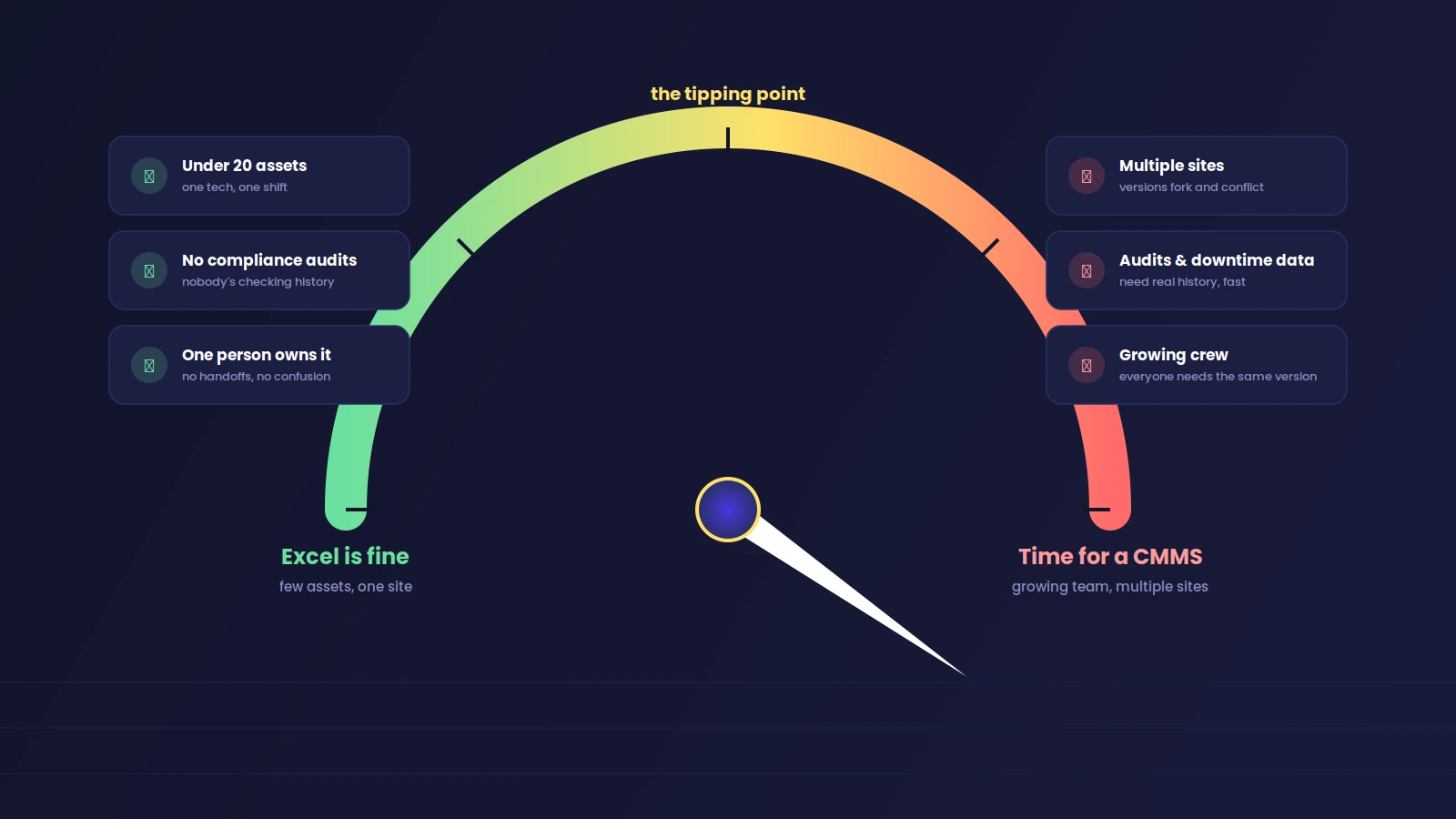
If your food manufacturing facility is still relying on paper maintenance logs, spreadsheets, or disconnected software tools, you may already be at risk. Here are common warning signs:
• Auditors frequently request documentation that takes hours or days to compile • Missed preventive maintenance tasks are discovered after equipment failures, not before • Corrective actions for CCP deviations are tracked informally and inconsistently • Temperature or environmental deviations are discovered after the fact, not in real time • Different team members maintain separate records with no single source of truth • Your maintenance team spends more time searching for records than performing maintenance Any one of these issues creates HACCP compliance risk. Together, they represent a systemic vulnerability that a CMMS can directly address.
CMMS, HACCP, and FSMA: A Unified Compliance Approach in 2026
The Food Safety Modernization Act (FSMA) — the most significant overhaul of U.S. food safety law in decades — requires food manufacturers to implement preventive controls, monitor their effectiveness, and document corrective actions. These requirements align directly with HACCP principles, and a CMMS supports both simultaneously.
Notably, the FDA delayed the implementation of its Traceability Rule from January 2026 to July 2028, but food manufacturers should not treat this as an opportunity to slow down. The direction of regulatory travel is clear: greater traceability, more rigorous documentation, and higher accountability. Facilities that invest in CMMS technology now will be ahead of the curve when enforcement begins.
Why Zoidii CMMS Is Built for Food Manufacturers
Zoidii is a cloud-based CMMS designed to be genuinely easy to use — without sacrificing the features that food manufacturers need to stay compliant. With Zoidii, food production facilities can:
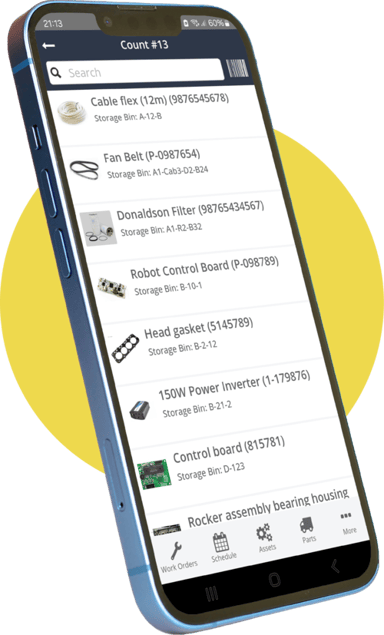
• Schedule and automate preventive maintenance for all food-contact and non-contact equipment • Create and manage work orders with full technician accountability and digital sign-offs • Attach compliance checklists to recurring maintenance tasks tied to your HACCP plan • Generate instant compliance reports for FDA, USDA, HACCP, and FSMA audits • Track parts inventory to ensure only approved, food-grade materials are used in maintenance • Access the system from any device — including mobile on the production floor Unlike enterprise systems with months-long implementation timelines, Zoidii is built for facilities making the transition from paper and spreadsheets for the first time. Onboarding is fast, the interface is intuitive, and support is responsive — so your team can start capturing compliance data from day one.
Conclusion: CMMS Is Not Optional for HACCP-Compliant Facilities in 2026
With food recalls at a nine-year high, regulatory scrutiny intensifying, and the average recall costing upward of $10 million, food manufacturers cannot afford to leave their HACCP compliance to chance. A CMMS directly addresses every one of the seven HACCP principles — automating preventive maintenance, monitoring critical control points, documenting corrective actions, and generating audit-ready records with zero manual effort.
2026 is the year to close the gap between your maintenance program and your food safety plan. The facilities that thrive will be the ones that treat maintenance and HACCP compliance as a single, integrated system — powered by the right CMMS.
Frequently Asked Questions (FAQs)
Q1: What is a CMMS, and how does it relate to HACCP compliance? A CMMS (Computerized Maintenance Management System) is software that centralizes maintenance operations — scheduling preventive maintenance, tracking work orders, managing asset histories, and storing compliance documentation. For HACCP compliance, a CMMS is essential because it creates the documented, auditable maintenance workflows that HACCP requires at every one of its seven principles. It replaces paper logs and disconnected spreadsheets with a single, timestamped digital record of all maintenance activity tied to food-contact equipment and critical control points.
Q2: Is a CMMS required for HACCP certification? A CMMS is not legally required to achieve HACCP certification, but it is widely regarded as best practice — and in practical terms, it makes compliance far easier to demonstrate. HACCP requires detailed, consistent documentation of maintenance activities, corrective actions, and CCP monitoring. While this can technically be done on paper, manual systems are prone to gaps, inconsistencies, and errors that auditors frequently flag. A CMMS automates and standardises this record-keeping, significantly reducing the risk of a compliance failure during an audit or inspection.
Q3: How does a CMMS help prevent food recalls? A CMMS prevents food recalls in several ways. First, it ensures food-contact equipment is inspected, cleaned, and calibrated on schedule — reducing the risk of contamination from worn seals, failed gaskets, or out-of-spec temperature controls. Second, it integrates with real-time monitoring systems to alert teams immediately when a critical control point deviates, enabling rapid corrective action before the affected product leaves the facility. Third, it maintains detailed asset and maintenance histories so that, if a quality issue does arise, root cause analysis can be conducted quickly and the scope of any recall can be minimised. With FDA food recalls surging to a nine-year high in 2025, proactive CMMS-backed maintenance is one of the most effective risk-reduction strategies available.
Q4: Can a CMMS help with FSMA compliance as well as HACCP? Yes — a CMMS supports both HACCP and FSMA (Food Safety Modernization Act) compliance simultaneously. FSMA requires food manufacturers to implement documented preventive controls, monitor their effectiveness, and record corrective actions. These requirements closely mirror the seven HACCP principles, and a CMMS addresses both at once by automating preventive maintenance schedules, logging CCP monitoring data, and generating the audit-ready documentation that both frameworks demand. As the FDA’s Traceability Rule takes effect in July 2028, facilities with a CMMS already in place will be substantially better prepared for the expanded traceability requirements ahead. Q5: How long does it take to implement a CMMS in a food manufacturing facility? Implementation timelines vary depending on the size of your facility and the complexity of your asset inventory. Still, modern cloud-based CMMS platforms like Zoidii are designed to get facilities up and running quickly — often within a matter of days or weeks rather than months. For first-time CMMS adopters transitioning from paper or spreadsheets, the key steps are asset data entry, PM schedule configuration, and team onboarding. Zoidii’s intuitive interface and pre-loaded food and beverage templates are designed to make this transition as fast and painless as possible, so your team can start capturing compliant maintenance records from day one.