
The pressure on maintenance teams has never been greater. In 2026, unplanned downtime costs the world's largest companies $1.4 trillion annually — and the workforce capable of preventing it is shrinking fast. Over 68% of facility operators and technicians are now over the age of 45, with a wave of retirements pulling decades of institutional knowledge out the door every year.
Yet the teams that are thriving aren't just the ones with the biggest budgets or the newest equipment. They're the ones with the right structure, the right culture, and the right tools — including a CMMS (Computerized Maintenance Management System) that keeps everyone aligned and accountable. Whether you're building a maintenance team from scratch or trying to get more from the crew you already have, these six tips will help you create a team that's not just keeping up — but consistently staying ahead.
Why Building the Right Maintenance Team Matters More Than Ever in 2026
The stakes for maintenance performance have never been higher. According to the 2025 State of Industrial Maintenance report, 45% of maintenance leaders cite a lack of resources as their primary obstacle, while 30% point to a shortage of skilled labor. Meanwhile, the mean time to repair (MTTR) has climbed from 49 minutes to 81 minutes on average, driven largely by skills gaps and supply chain delays.
A strong maintenance team is the most direct antidote to these challenges. And a well-implemented CMMS is the infrastructure that makes that team scalable, measurable, and consistently effective.
Tip 1: Define Clear Roles and Responsibilities
One of the most common causes of maintenance inefficiency isn't a lack of skill — it's a lack of clarity. When technicians don't know exactly what they're responsible for, tasks get duplicated, things fall through the cracks, and accountability disappears.
Building a high-performing maintenance team starts with clearly defined roles. At a minimum, most teams need:
- Maintenance Manager — Sets strategy, oversees performance, aligns maintenance with broader business goals
- Planner/Scheduler — Develops PM schedules, coordinates resources, ensures work orders are complete before work begins
- Technicians — Execute day-to-day maintenance and repairs, log work in the CMMS, and flag issues early
- Reliability Engineer (for larger teams) — Analyzes failure data, drives predictive maintenance, extends asset lifecycles
- Parts/Inventory Coordinator — Manages spare parts, tracks stock levels and prevents parts-related work order delays
The CMMS advantage: When roles and responsibilities are mapped into your CMMS, there's no ambiguity about who owns what. Every work order has an assigned technician, a priority level, and a due date. That clarity alone drives faster completion rates and reduces the "I thought someone else was handling it" problem.

Tip 2: Set SMART Goals and Track Them With CMMS Data
A maintenance team without measurable goals is just reacting. The best teams operate with clearly defined targets tied to KPIs that are reviewed regularly and updated as conditions change.
In 2026, the teams pulling ahead are the ones that have made the shift from gut-feel management to data-driven decision-making. Organizations with strong maintenance data discipline reduce unplanned maintenance work to just 36% of total activity — compared to 56% for teams with weak data practices.
That 20-point gap translates directly into schedule stability, reduced overtime, and lower emergency repair costs.
Key CMMS-powered KPIs to set goals around:
- Preventive vs. Reactive Maintenance Ratio — Aim to drive reactive work below 30–40% of total work orders
- PM Compliance Rate — Track the percentage of scheduled PMs completed on time
- Mean Time to Repair (MTTR) — Set benchmarks and monitor trends by asset type or technician
- Work Order Completion Rate — What percentage of work orders are closed by their due date?
- Overall Equipment Effectiveness (OEE) — A composite measure of availability, performance, and quality
Tip 3: Invest in Ongoing Training and Skills Development
The maintenance skills gap is one of the defining challenges of 2026. The U.S. Bureau of Labor Statistics projects over 500,000 manufacturing jobs will go unfilled through 2030, with skilled maintenance technicians at the center of that shortfall. Baby Boomer retirements are accelerating the loss of institutional knowledge, while the complexity of modern CNC systems, automation, and IoT-connected assets is outpacing what traditional training programs can deliver.
High-performing maintenance teams respond to this reality not by hoping the hiring market improves — but by investing aggressively in the team they already have.
Effective training strategies for maintenance teams in 2026:
- On-the-job and hands-on learning — Have senior technicians mentor junior staff on specific assets and failure modes. Pair people intentionally.
- Certifications and formal programs — Industry credentials in predictive maintenance, safety compliance, electrical systems, and CMMS usage build credibility and capability.
- Capturing tribal knowledge in your CMMS — When an experienced technician knows that a particular machine always vibrates before a bearing failure, that knowledge needs to be in the system — not just in their head. Build checklists, SOPs, and asset notes in your CMMS before your best people walk out the door.
- CMMS training itself — Studies show that 70% of CMMS implementations fail to meet their goals because teams don't fully adopt the system. Structured, role-based CMMS training — focused on the real tasks each person does daily — is one of the highest-ROI investments a maintenance manager can make.

Tip 4: Build a Culture of Communication and Accountability
Skills and tools only go so far. The difference between a good maintenance team and a great one is often cultural: how openly people communicate, how quickly problems get escalated, and whether the team feels ownership over outcomes — not just completion of tasks.
In practice, a strong maintenance culture looks like:
- Short daily or shift-start check-ins — A 10–15 minute huddle to review open work orders, flag urgent issues, and confirm priorities. Your CMMS dashboard makes this fast — everything visible in one place.
- Transparent KPI reporting — Share team performance data openly and regularly. When technicians can see their PM compliance rate or average response time, they take ownership of it.
- Psychological safety around reporting problems — Near-misses, equipment anomalies, and process concerns should flow upward quickly. Teams where people are afraid to raise problems are teams where small issues become large failures.
- Recognition for proactive behavior — Catching a failing component before it causes an unplanned outage should be celebrated, not taken for granted.
Tip 5: Leverage CMMS Software as Your Team's Operating System
This is the tip that multiplies the impact of everything else. A well-implemented CMMS doesn't just organize work orders — it becomes the central nervous system of your maintenance operation, connecting people, assets, parts, and performance data in one place.
In 2026, approximately 50–60% of maintenance-heavy organizations have adopted a CMMS or EAM system. But adoption alone isn't the differentiator — it's utilization. High-performing teams capture 82% of all maintenance work in their CMMS, while low-performing teams capture only 45%. The teams that fully embrace their CMMS are the ones seeing the results: fewer breakdowns, lower repair costs, and maintenance programs that scale without adding headcount.
What a CMMS like Zoidii does for your maintenance team:
- Work Order Management — Create, assign, prioritize, and track every maintenance task from request to completion. Nothing gets lost, nothing gets forgotten.
- Preventive Maintenance Scheduling — Automate recurring PMs by time interval or meter reading. Get alerts when tasks are due. Stop relying on memory or spreadsheets.
- Asset Management — Maintain a full history of every asset: repairs performed, parts used, downtime events and inspection results. That history is the foundation of smarter maintenance decisions.
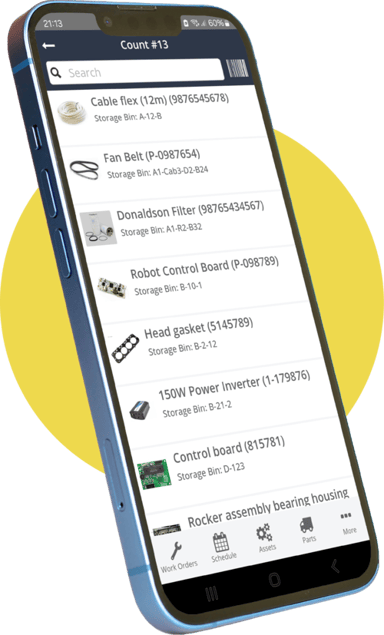
- Parts and Inventory Control — Track spare parts, set reorder points, and attach parts to work orders at the planning stage — so technicians have what they need when they arrive on-site.
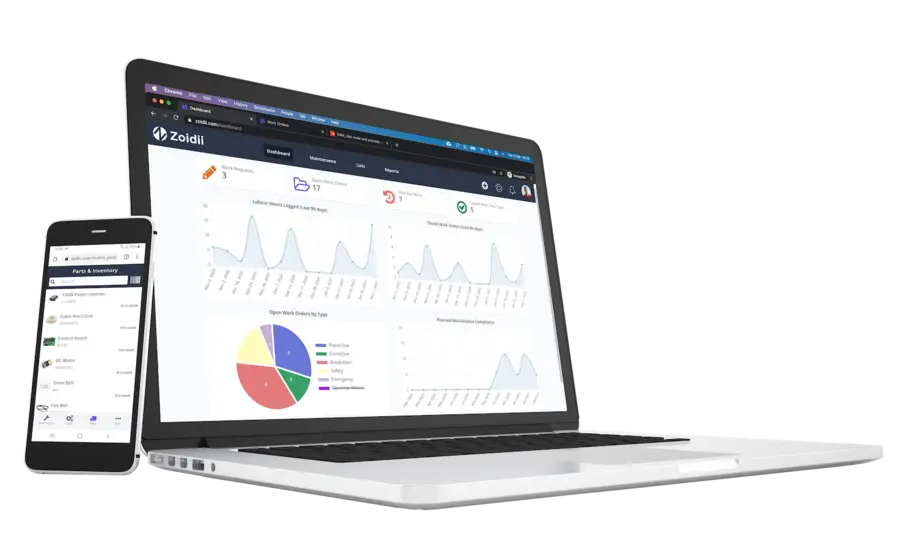
- Reporting and KPIs — Generate reports on work order trends, PM compliance, asset reliability, and team performance. Bring data to every maintenance conversation.
- Mobile Access — Technicians can view, update, and close work orders from the floor using a mobile device — no paper, no delays, no "I'll log it later."
Zoidii is built specifically for teams that are moving off spreadsheets and paper-based systems for the first time. It's designed to be simple enough that technicians with no prior CMMS experience can pick it up quickly — without sacrificing the features that maintenance managers need to run a data-driven operation.
Tip 6: Commit to Continuous Improvement
The best maintenance teams are never finished building. They're constantly evaluating what's working, identifying bottlenecks, and making incremental improvements to processes, scheduling, and skills.
Continuous improvement in maintenance isn't about big overhauls — it's about building habits. Habits like reviewing last week's CMMS data in your Monday meeting. Habits like asking technicians to suggest improvements to PM checklists after they complete them. Habits like tracking one new KPI per quarter and acting on what it reveals.
Practical continuous improvement actions for maintenance teams in 2026:
- Monthly CMMS data reviews — Look at open work order aging, PM completion rates, repeat failures on the same assets, and parts usage trends. Let the data surface the problems before they surface as breakdowns.
- Post-breakdown analysis — When an unplanned failure occurs, use your CMMS asset history to trace the root cause. Was there a missed PM? A parts delay? A recurring failure mode that needs to be redesigned out? Equipment failure accounts for 42% of all unplanned downtime — most of it is preventable with better analysis.
- Quarterly team retrospectives — What did the team do well? What slowed us down? What would we do differently? Structured retrospectives build ownership and surface improvements that managers alone would never identify.
- Technology adoption roadmap — More than two-thirds of maintenance teams expect to adopt AI-powered maintenance solutions by 2026. Start building the data foundation now — reliable CMMS data today is what enables predictive analytics, condition monitoring, and AI-driven scheduling tomorrow.
Building Your Maintenance Dream Team With Zoidii CMMS
A high-performing maintenance team in 2026 has six things working in its favor: clearly defined roles, measurable goals, ongoing training, a strong communication culture, a CMMS as its operating system, and a commitment to continuous improvement.
Zoidii is the CMMS built to make all six of these easier to execute. It's cloud-based, mobile-friendly, and designed to be up and running quickly — without the complexity or the steep learning curve of enterprise systems. Maintenance managers use it to stay on top of work orders, PMs, assets, and parts. Technicians use it to get clear task assignments, log their work, and surface issues fast.
Whether you manage a manufacturing plant, a food and beverage facility, a fleet, or a multi-site operation, Zoidii gives your team the visibility and structure to move from reactive to proactive — and stay there.
Start your free trial of Zoidii today → No credit card required. Get your team set up quickly and start building the maintenance program your operation deserves.
Frequently Asked Questions
What is a CMMS and why does a maintenance team need one? A CMMS (Computerized Maintenance Management System) is software that centralizes all maintenance operations — work orders, preventive maintenance schedules, asset records, and parts inventory — in one platform. Maintenance teams use CMMS software to eliminate manual tracking, reduce missed PMs, improve response times, and generate performance data that drives better decisions.
What roles should a strong maintenance team have? At a minimum, a well-structured maintenance team should include a maintenance manager, planners/schedulers, technicians, and an inventory coordinator. Larger teams benefit from adding a reliability engineer focused on failure analysis and predictive maintenance strategy.
How can a CMMS help reduce downtime? A CMMS reduces downtime by automating PM schedules so critical maintenance tasks aren't missed, tracking asset history so failure patterns become visible, and managing parts inventory so technicians have what they need without delays. Organizations that implement comprehensive CMMS solutions decrease overall downtime by an average of 44%.
What maintenance KPIs should I track with my CMMS? The most important CMMS KPIs include PM compliance rate, reactive vs. preventive maintenance ratio, mean time to repair (MTTR), work order completion rate, and asset availability or uptime percentage. These metrics give maintenance managers a data-driven view of team performance and maintenance program health.