
A Maintenance Management System used to be treated like a digital filing cabinet: work orders in, work orders out. That view is outdated—and it’s a big reason many implementations underdeliver.
In 2026, organizations expect a Maintenance Management System to function as a reliability operating system:
- Standardize how work is requested, planned, scheduled, executed, and verified
- Connect maintenance execution with parts, purchasing, contractors, and cost
- Create trustworthy data that exposes chronic failures and enables smarter decisions
- Scale best practices across shifts, plants, and portfolios (without relying on tribal knowledge)
- Too much reactive work and unplanned downtime
- PMs that exist “on paper” but don’t get done consistently
- Parts stockouts that turn minor failures into production events
- “We fixed it last month,” repeat breakdowns—without clear root causes
- Limited visibility into maintenance cost drivers and labor utilization
- Compliance and audit documentation that’s time-consuming and inconsistent
What is a Maintenance Management System? (Definition)
A Maintenance Management System is a software application used to provide work and materials management for maintenance activities—commonly in manufacturing organizations.
That “work and materials” phrase is the core of the Maintenance Management System's value. A Maintenance Management System is not just a ticketing tool; it is designed to manage:
- Work: requests → work orders → backlog → planning → scheduling → execution → verification
- Materials: parts → inventory → purchasing → receiving → kitting → usage → cost tracking
- What assets do we maintain? (asset register, hierarchy, criticality)
- What work needs to happen? (requests, work orders, backlog)
- When should it happen? (PM schedules, meter triggers, shutdown planning)
- What will it take? (labor, skills, tools, parts, permits, contractors)
- What happened and what did it cost? (history, failure codes, KPIs, spend)
Why Maintenance Management System matters now (and why it fails without a program)
Most operations don’t suffer from a lack of effort. They suffer from coordination and consistency issues:
- Requests are vague, and duplicates are common
- Dispatch is driven by urgency and noise instead of asset criticality and risk
- PM schedules exist, but aren’t executed reliably
- Technicians waste time searching for manuals, parts, and context
- Spare parts are either missing when needed or overstocked “just in case.”
- Work history is incomplete, so chronic failures are never fully solved
A useful mental model:
- Buying a Maintenance Management System is like buying gym equipment.
- Building a Management System is about the training, coaching, and habits that produce results.
What a Maintenance Management System does: core modules and workflows
Most maintenance management platforms share similar capabilities. The difference between average and elite outcomes is how well you configure workflows, enforce standards, and drive adoption.
asset management: the foundation
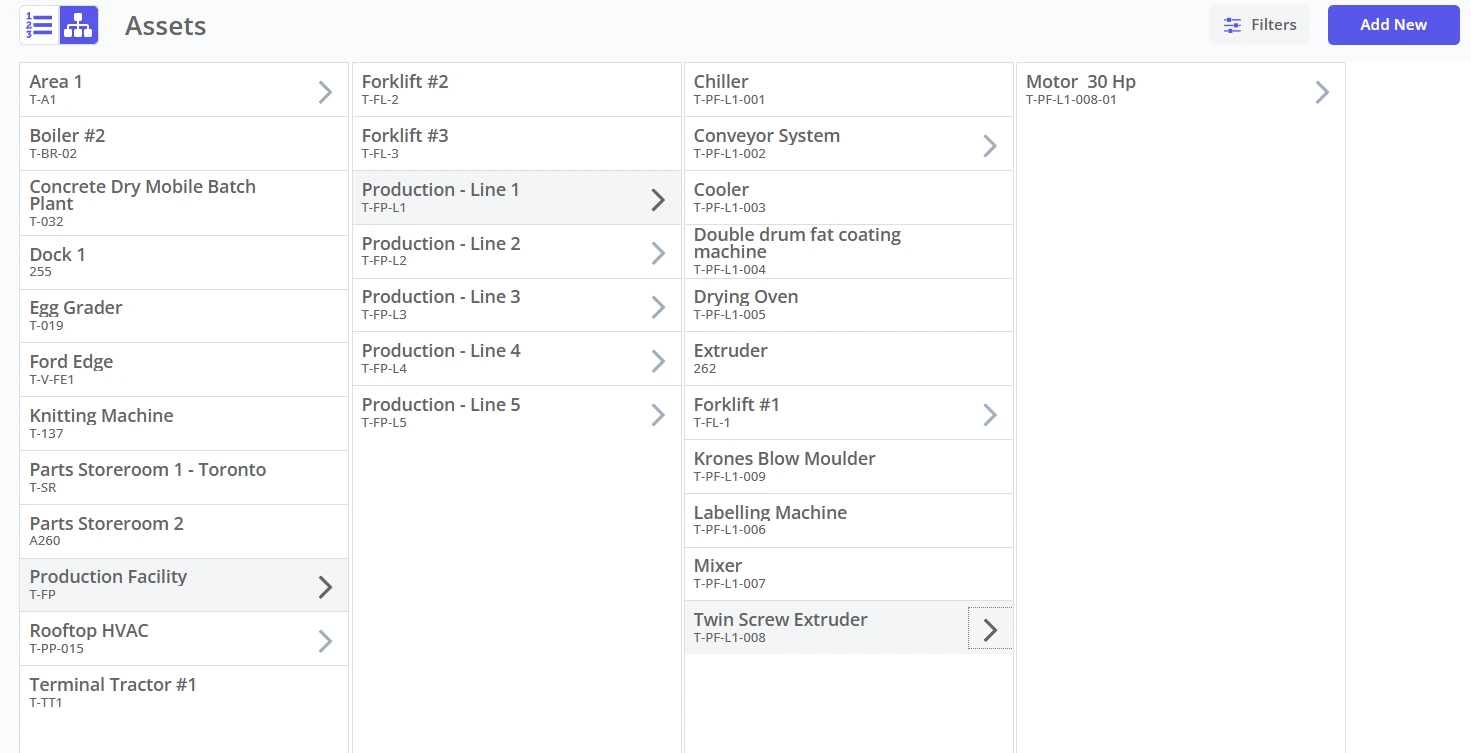
A Maintenance Management System starts with an asset register—your authoritative list of maintainable items and their locations. Good Maintenance Management System asset hierarchies mirror how you run the operation, such as:
- Site → Area → Line → Cell → Machine → Subsystem → Component
- Utilities: compressors, boilers, chillers, HVAC, water systems
- Infrastructure: switchgear, UPS, generators, safety systems
- Mobile assets: forklifts, pumps, tools, fixtures (when relevant)
- OEM, model/serial, install date, warranty
- Criticality rating (A/B/C or similar)
- Manuals, SOPs, drawings, photos
- Parent/child relationships for accurate history
Maintenance Management System work request intake: the “front door” to quality data
Work requests determine whether your system produces useful history or a pile of ambiguous tickets. A mature maintenance management system request process includes:
- Categories (Safety / Quality / Downtime / Improvement)
- Priority logic (Impact × Urgency)
- Routing rules (area, trade, shift)
- Required fields (asset, location, symptom, short description)
- Good: “Leak at Valve V-203 on Line 2 near filler.”
- Bad: “Fix leak.”
Work orders: execution and accountability
Work orders are the heart of a maintenance management system. High-performing teams standardize what “good” looks like: A strong maintenance management system work order includes:
- Symptom/problem (what triggered the job)
- Cause (failure code—simple and consistent)
- Remedy (what was done)
- Labor time and downtime impact (if applicable)
- Parts used (tied to inventory)
- Evidence (photos, readings, QA checks)
- Verification steps (test run, signoff, inspection)
Preventive maintenance: where reliability is built
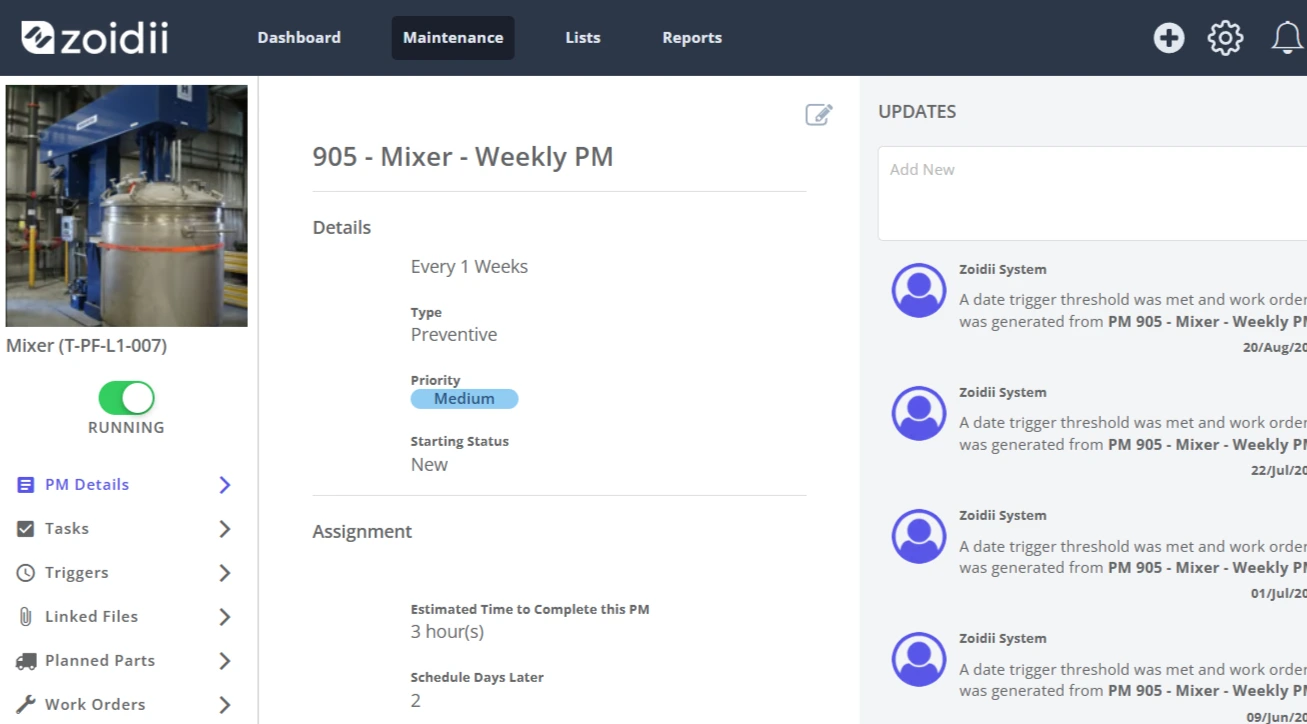
Preventive maintenance is where maintenance management systems deliver the biggest long-term value—when PM is designed to reduce real failure modes rather than create “busy work.”
Common PM types:
- Time-based (weekly/monthly/quarterly)
- Meter-based (runtime hours, cycles, starts)
- Condition-triggered (threshold triggers inspection or intervention)
- Each PM maps to a failure mode or risk
- Job plans include tools, parts, safety steps, and acceptance criteria
- Intervals are reviewed using asset history (PM optimization)
- PM completion is measured and managed like a production KPI
- Identify top downtime assets or chronic troublemakers
- Review system history: symptoms, causes, parts consumption, repeat events
- Adjust PM tasks/intervals to detect failures earlier or prevent them
- Track results: do breakdowns and repeat failures decline?
Planning, scheduling, and dispatch: turning backlog into results
A maintenance management system is the tool; planning and scheduling are the disciplines.
Scheduling workflow usually includes:
- Backlog grooming rules (approve/reject/defer)
- “Ready-to-work” criteria (job plan + parts + permits + access)
- Weekly schedule creation (or daily dispatch in some environments)
- Shift handover and carryover visibility
- Schedule compliance tracking
Inventory and MRO parts: cutting downtime from stockouts
Inventory is one of the biggest system opportunities—and one of the most common blind spots.
A maintenance management system inventory module typically supports:
- Parts master data and alternates
- Min/max and reorder points
- Asset BOMs (recommended spares per machine)
- Kitting for planned jobs
- Issue/return tied to work orders (traceable costs)
Purchasing and vendors: controlling external spend
Many maintenance management systems include purchasing and vendor workflows:
- requisitions → purchase orders → receiving
- contractor dispatch and SLA tracking
- vendor compliance docs and performance reviews
- spend reporting by area, asset, or contractor
Mobile execution: where adoption is won (or lost)
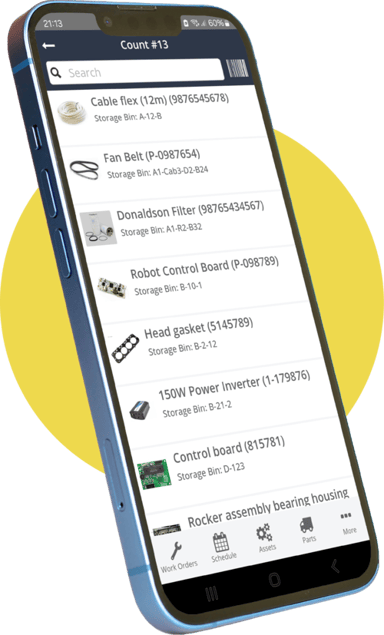
A maintenance management system that lives only on desktops becomes an admin tool. A maintenance management system that works in the field becomes the operational system of record.
Look for mobile workflows that support:
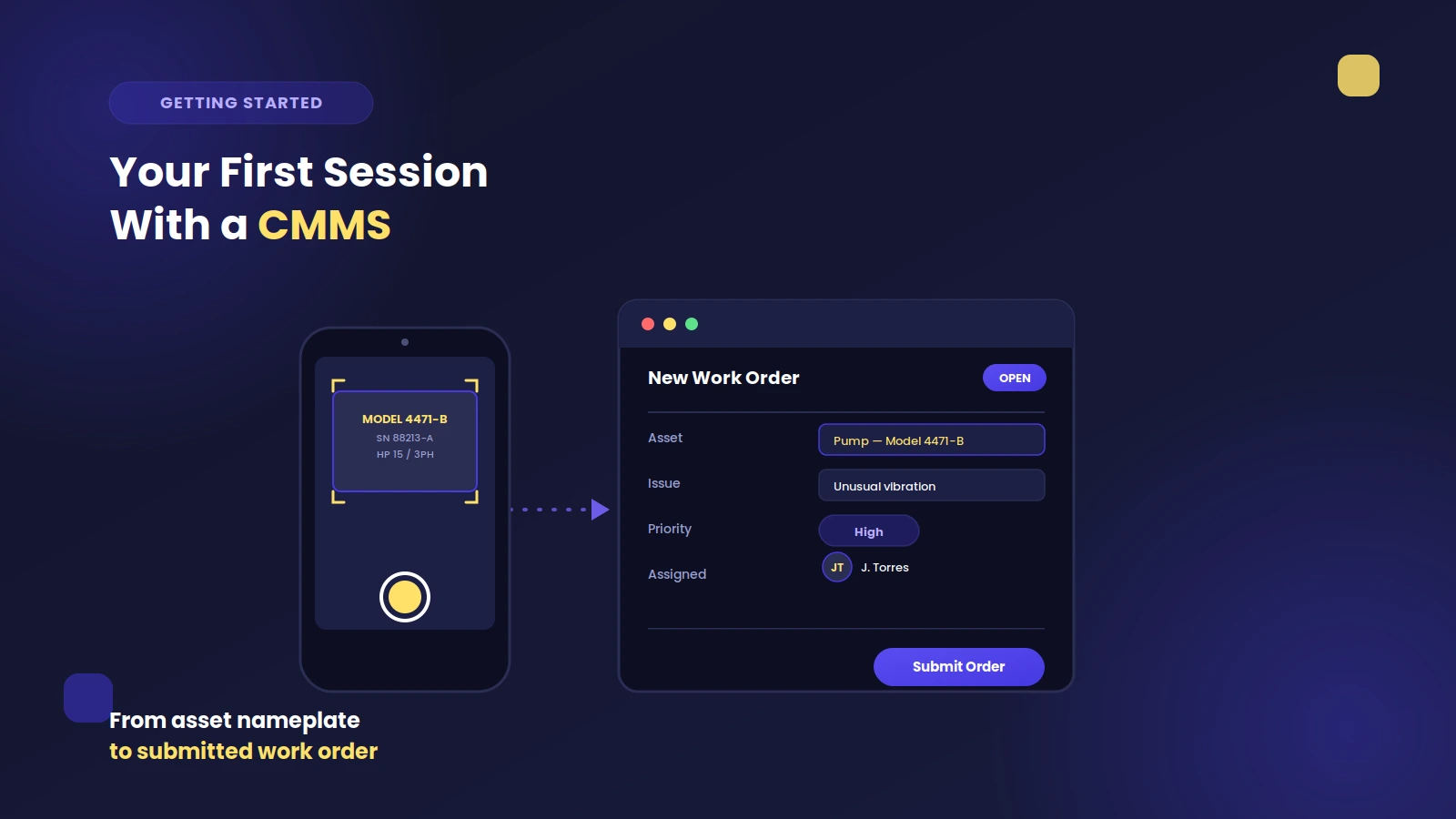
- Fast asset access (QR code, location lists)
- Photos/video and readings at the point of work
- Checklists and signoffs
- Simple closeout with required fields
Reporting and analytics: turning history into decisions
Reporting should help leaders answer:
- What are our top repeat failures and chronic assets?
- Are we increasing the planned work percentage?
- Where is the backlog aging and why?
- Are PMs effective—or just being checked off?
- Which assets consume the most parts and labor?
- Where do contractors help or hurt performance?
Key benefits of maintenance management systems (and how to actually capture them)
A maintenance management system can create huge gains. But the benefits only show up when you measure the right things and manage the behaviors that drive them.
1. Reduces unplanned downtime
Maintenance management systems reduce downtime through:
- Better PM scheduling and completion
- Faster dispatch and real-time visibility
- Improved troubleshooting via asset history
- Earlier identification of chronic failures
- Improved parts availability
2. Increases planned work percentage (and reduces firefighting)
A core reliability maturity indicator is the balance between planned and reactive work.
Maintenance management systems support planned work by:
- Structuring backlog and prioritization
- Enabling weekly scheduling routines
- Enforcing “ready-to-work” job planning
- Reducing failed jobs due to missing parts or unclear scope
3. increases technician productivity (more wrench time)
Maintenance management systems reduce non-value-added time:
- less searching for manuals, history, and parts info
- fewer return trips due to missing parts/permits
- fewer duplicate requests and rework
- better coordination across shifts
4. Improves MRO inventory control and spend visibility
By linking parts usage to work orders and assets, maintenance management systems enables:
- fewer downtime-causing stockouts
- better min/max settings using actual consumption
- identification of high-cost parts tied to chronic failures
- clearer maintenance cost drivers by line/asset/area
5. Strengthens compliance and audit readiness
Maintenance management systems creates traceability:
- who performed the work
- which checklist/SOP was used
- what evidence was captured
- timestamped audit trails
6. Supports asset management maturity
Organizations aligning with formal asset management practices often reference the ISO 55000 family. ISO describes ISO 55000:2024 as providing principles and terminology for proactive asset management, and ISO 55001:2024 as specifying requirements for an asset management system. The Institute of Asset Management notes multiple new/updated standards released in 2024 across the ISO 55000 series.
A maintenance management system becomes the operational engine that makes those principles real—by enabling consistent execution, traceable history, and measurable performance.
Industries that use a maintenance management system (and why)
A maintenance management system is not “just for factories.” Any organization with assets that must be maintained - especially when uptime, safety, or compliance are at stake -can benefit from a maintenance management system. Below are the most common industries that use a maintenance management system:
1. Manufacturing (discrete and process)
Used to protect throughput, quality, and delivery by minimizing downtime and repeat failures.Common priorities:
- PM discipline on bottleneck assets
- work order history to troubleshoot faster
- spare parts availability and BOMs
- shift handover and schedule compliance
- RCA triggers for chronic assets
2) Food and beverage manufacturing
Used where compliance, sanitation, and quality risk are high; downtime is expensive, and interruptions can cause spoilage.Common priorities:
- sanitation and inspection checklists
- compliance evidence capture
- calibration schedules (where applicable)
- controlled PM execution aligned to production windows
3) Pharmaceuticals and biotech
Used where validation, documentation, and change control expectations are often stringent.Common priorities:
- audit trails, controlled workflows, and approvals
- calibration/qualification schedules
- controlled documentation and evidence attachment
- strict role-based permissions
4) Healthcare (hospitals and clinics)
Used to ensure life-safety and critical equipment readiness, plus accreditation and inspection requirements.Common priorities:
- preventive maintenance for critical clinical and facility systems
- compliance documentation and inspections
- contractor management and response SLAs
5) Facilities and property management (commercial real estate, campuses)
Used where high volume of service requests, distributed assets, compliance checks, and contractor coordination.Common priorities:
- service request intake and triage
- HVAC/electrical/plumbing PM schedules
- contractor SLAs and documentation
- asset lifecycle tracking for capital planning
6) Energy and utilities (power, water/wastewater)
Used where reliability and safety are essential; assets are expensive; outages have major consequences.Common priorities:
- asset criticality and risk-based maintenance
- outage/shutdown planning
- deep work history for long-lived assets
- strong parts management and vendor coordination
7) Oil and gas, chemicals, and mining
Used in harsh environments, safety risks, critical rotating equipment, and high downtime costs.Common priorities:
- permit-to-work integration (where required)
- inspections and compliance evidence
- predictive/condition-based workflows for rotating assets
- contractor governance and performance
8) Transportation and logistics (fleet, rail, ports, warehouses)
Used where the uptime of material handling and fleet assets directly impacts throughput and on-time delivery.Common priorities:
- Scheduled maintenance driven by meters/usage
- Parts availability across sites
- Mobile execution and quick closeouts
- Asset tracking across facilities
9) Data centers and critical environments
Used where reliability expectations are extremely high; even minor failures can cascade.Common priorities:
- Rigorous PM and inspection compliance
- Change control workflows
- Vendor SLAs and response times
- Detailed work evidence for audits and clients
10) Education and public sector (universities, municipalities)
Used in large asset portfolios, budget accountability, and compliance inspections.Common priorities:
- Transparent work tracking and reporting
- Lifecycle tracking for capital planning
- Contractor coordination and service levels
- Consistent processes across departments
Types of maintenance management system solutions (with examples)
Not all maintenance management systems tools are built the same. Use these categories to frame your shortlist based on scope, complexity, and growth plans.
1) Cloud (SaaS) maintenance management system
Best for: fast deployment, multi-site visibility, strong mobile apps, frequent updates. Common strengths: quick configuration, easier administration, simpler scaling.
2) On-premise maintenance management system
Best for: organizations with strict internal hosting requirements or constrained connectivity. Tradeoffs: higher IT overhead, slower upgrades, more internal dependency.
3) Mobile-first maintenance management system
Best for: environments where technician adoption and execution speed matter most. Strengths: better data capture, faster closeout, higher field adoption.
4) Enterprise EAM-adjacent tools
Best for: large organizations that need multi-site governance, complex workflows, and deep integration. Tradeoffs: implementations can be longer; change management matters more.
5) Integrated with APM/IIoT analytics
Best for: organizations ready for condition-based/predictive approaches. Best architecture pattern: analytics detects anomalies; triggers scheduled work; outcomes feed back into models. Examples you’ll encounter in the market (illustrative): Zoidii, Fiix, MaintainX, UpKeep, eMaint, and enterprise-oriented platforms such as IBM Maximo or Infor EAM, depending on the scope.
Maintenance management systems vs EAM vs APM vs ERP maintenance modules (quick clarity)
- Maintenance management systems: best for maintenance execution—work and materials management
- EAM: broader asset lifecycle management (often enterprise-wide, multi-asset-class)
- APM: condition monitoring, predictive analytics, performance optimization
- ERP maintenance: strong financial/procurement integration; sometimes weaker on field execution usability
How to choose the right maintenance management system (a decision-maker framework)
Choosing a maintenance management system is less about feature checklists and more about fit with your operating model, data maturity, and improvement goals.
Step 1: Define outcomes in business terms (not software terms)
Examples:
- Reduce downtime on bottleneck assets by X%
- Increase planned work percentage from A → B
- Raise PM compliance on critical assets to Y%
- Eliminate downtime due to missing critical spares
- Reduce repeat failures within 30 days by Z%
- Improve maintenance cost per unit or per run hour
Step 2: Document your maintenance operating model
Your maintenance management system should support how you operate, including:
- centralized planning vs supervisor dispatch
- multi-shift handover routines
- contractor-heavy vs in-house
- shutdown/turnaround planning frequency
- how work is prioritized (safety, quality, throughput, cost)
Step 3: Validate technician usability first (not last)
In demos, insist on the full technician workflow:
- find an asset fast (QR code, search)
- open a work order
- view job plan, safety steps, and attachments
- capture readings/photos
- issue parts
- close out quickly with required codes
Step 4: Make data standards non-negotiable
You can’t get reliability insight from messy closeouts.Require:
- a sensible asset hierarchy model
- configurable required fields on closeout
- standardized failure codes (keep them simple)
- audit trails and role-based permissions
Step 5: Treat integrations as a first-class requirement
Your Maintenance management systems will likely touch:
- ERP/purchasing
- identity (SSO)
- production systems (optional, but valuable)
- historians/SCADA/IIoT for meters and triggers
- BI tools for leadership dashboards
- what APIs exist, and what’s included
- how data export works and who owns the data
- what typical integration architectures look like
- what security controls are available
Step 6: Evaluate security posture (especially in OT-adjacent environments)
Industrial cybersecurity expectations continue to rise. ISA describes the ISA/IEC 62443 series as defining requirements and processes for implementing and maintaining secure industrial automation and control systems.For maintenance management system buyers, practical security due diligence includes:
- SSO support (SAML/OIDC), MFA options
- role-based access control and least privilege
- audit logs and admin change tracking
- secure APIs and integration authentication
- clear data ownership and export policies
- vendor incident response practices and documentation
Step 7: Build a 3-year TCO model (don’t shop on license price)
Include:
- implementation/configuration services
- asset data cleanup and migration
- integrations
- training and change management
- internal system administration/reporting ownership
- optional modules (inventory, purchasing, analytics)
Step 8: Run a structured maintenance management system pilot (30–60 days)
A maintenance management system pilot should be narrow enough to execute and real enough to learn.
Good pilot scopes:
- one bottleneck line/cell
- one department (packaging, utilities, machining)
- a critical asset group (compressors, fillers, ovens)
- 80–90%+ of work closed in the maintenance management system
- closeout quality meets your standard
- PM compliance improves in scope
- reporting clearly identifies top downtime drivers
- technicians report that the maintenance management system reduces friction (not increases it)
How to implement a maintenance management system (a roadmap that avoids shelfware)
Most maintenance management system failures stem from implementation and adoption issues. A phased rollout with tight standards beats a giant “big bang.”
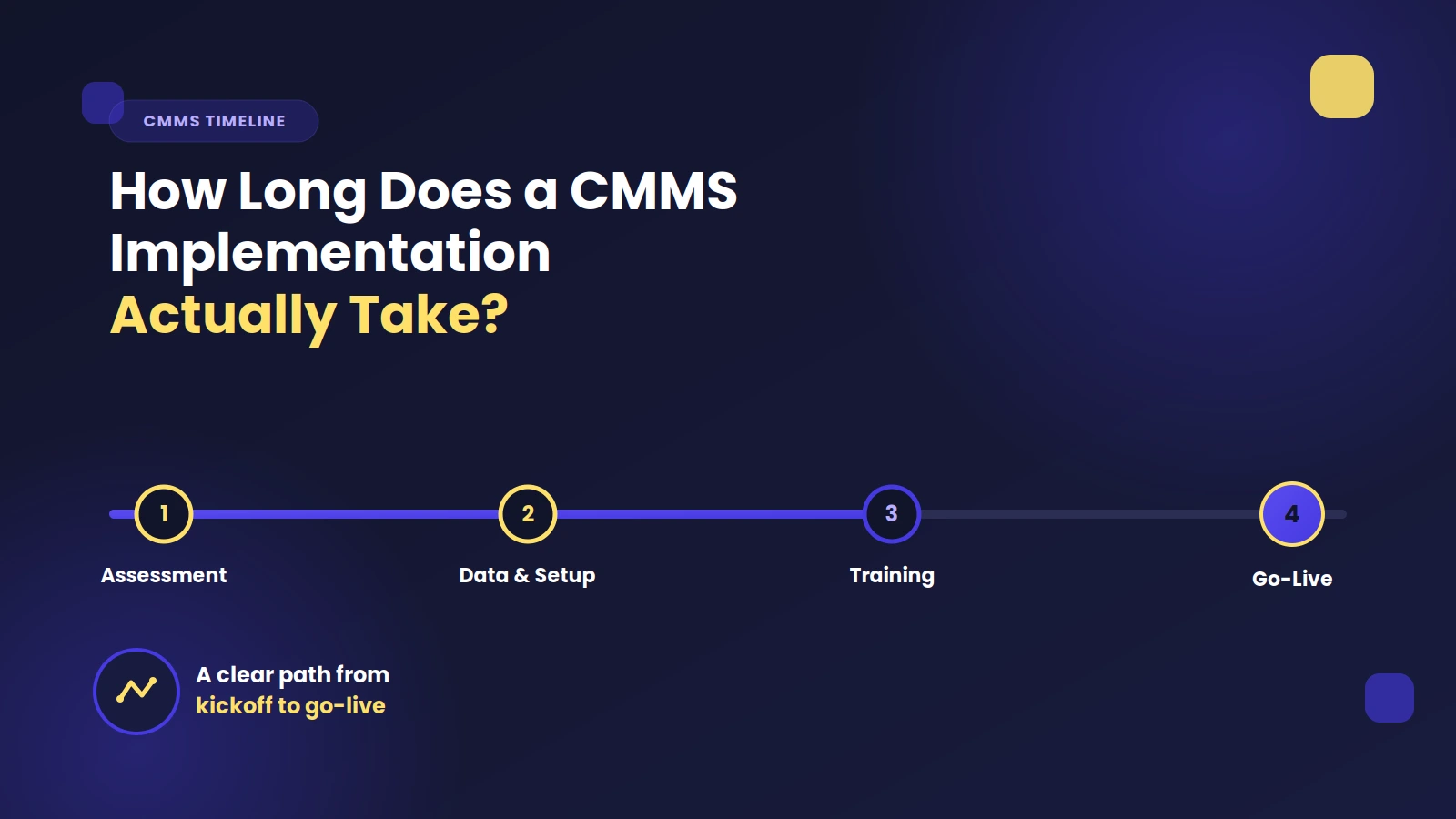
Phase 0: Prepare (2–4 weeks)
Key deliverables:
- executive sponsor + product owner
- documented workflows and definitions (priority, planned vs reactive, closeout standards)
- pilot scope chosen
- training plan and superusers identified
- data standards (asset naming, hierarchy, failure codes)
Phase 1: Build foundation (4–8 weeks)
Deliverables:
- critical asset register + hierarchy
- PM library for critical assets (small but high quality)
- mobile workflow tested on real devices, real locations
- attachments loaded for critical assets (manuals, SOPs, lockout steps)
Phase 2: Stabilize execution (8–12 weeks)
This is where the maintenance management system becomes routine.
Operational routines:
- backlog grooming + weekly schedule publishing
- daily schedule adherence check
- closeout audits (lightweight but consistent)
- escalation rules for critical downtime work
- Inventory transaction discipline tied to work orders
- PM compliance stabilizes upward
- planned work percentage rises
- Repeat failures become visible in reporting (so you can attack them)
Phase 3: Scale + improve (ongoing)
Once the maintenance management system is stable in one scope, replicate the template.
Scale:
- extend assets and PM library
- roll to additional lines/areas/sites
- standardize KPIs across sites
- PM optimization cycles
- RCA triggers for chronic assets
- condition-based triggers where data exists
- contractor performance and SLA management
Maintenance management system KPIs that actually drive reliability (with clear definitions)
Maintenance management systems generate many metrics. Focus on a balanced set that links behavior → outcomes.
Leading indicators (predict performance)
- PM Compliance (%) = PMs completed on time / PMs scheduled
- Planned work (%) = planned labor hours / total labor hours
- Schedule Compliance (%) = scheduled work completed/scheduled work planned
- Backlog Age = distribution of approved work order age
- Work Order Quality = % closed with required fields/codes/notes
Lagging indicators (measure results)
- Downtime hours by asset/line
- MTTR (mean time to repair)
- Repeat failure rate (repeat within X days)
- Maintenance cost per run hour / per unit
- Stockout incidents causing downtime
Zoidii maintenance management system case studies: what measurable success looks like
Below are several Zoidii case studies and the practical lessons decision-makers can replicate.
Zoidii case study 1: Broderick’s — reactive maintenance reduced by 60% in four months
Zoidii’s Broderick’s case study reports that four months after go-live, reactive maintenance was reduced by 60%.
What to copy:
- tighten work intake and priority standards
- enforce closeout discipline
- make backlog visible and schedulable
- establish weekly scheduling routines early
Zoidii case study 2: Holistic Industries — maintenance costs reduced by 36% in year one
Zoidii’s Holistic Industries case study reports a 36% reduction in maintenance costs in year one.
What to copy:
- connect parts usage to work orders for cost visibility
- reduce emergency work (which drives premium labor and expedited spend)
- use reporting to target top cost-driving assets for reliability work
Zoidii case study 3: Tricel — building best-in-class asset management habits
Zoidii’s Tricel case study emphasizes eliminating paper records and enabling technicians to search for and review work history and documentation, positioning the organization as a fast-becoming best-in-class asset management operation.
What to copy:
- make documentation part of the “definition of done”
- attach manuals/SOPs to critical assets first
- standardize asset naming so search works
- continuously improve job plans and PMs based on technician feedback
Additional Zoidii example: Grace Healthcare — paperless maintenance with compliance gains
Zoidii’s Grace Healthcare case study describes a transition to a paperless system with improved maintenance efficiency, productivity, and compliance.
What to copy:
- build evidence capture into the workflow (photos, checklists, signatures)
- reduce “shadow documentation” outside maintenance management system
- make audits easier by design, not by scramble
Maintenance management system trends to plan for (practical, not hype)
1) Maintenance management system as the “action layer” for IIoT and predictive maintenance
Sensors and analytics can detect anomalies, but maintenance management systems is where action becomes scheduled, traceable work: signal → diagnosis → work order → planned repair → verification
If predictive insights aren’t turning into maintenance management system work orders, you don’t have predictive maintenance—you have dashboards.
2) “Helpful AI” inside the maintenance management system is emerging
The near-term wins tend to be:
- better search and knowledge retrieval (“how did we fix this last time?”)
- suggested failure codes/job plans
- triage and routing assistance
- anomaly detection on maintenance management system data (repeat failures, parts spikes)
3) OT governance is intersecting with maintenance
CISA’s OT asset inventory guidance frames it as foundational to defensible architecture. While maintenance management systems aren’t an OT security tool, a disciplined maintenance management system, asset records, and change history can support broader governance.
4) Security diligence is becoming a standard maintenance management systems procurement step
ISA’s description of ISA/IEC 62443 underscores the structured approach that many organizations use to set OT security expectations.
Expect security questionnaires, SSO requirements, and audit logging to be part of the maintenance management systems buying process.
Maintenance management systems FAQs
Are maintenance management systems only for manufacturing?
No. Maintenance management systems is widely used across manufacturing, healthcare, facilities/property, utilities, transportation/logistics, public sector, and more—anywhere asset uptime and compliance matter.
What’s the biggest reason maintenance management systems implementations fail?
Low adoption and weak data standards. If people don’t consistently close work orders correctly, maintenance management systems become untrusted and unused.
What are the “must-have” maintenance management system features?
For most organizations:
- asset hierarchy + history
- work orders + mobile execution
- PM scheduling (time/meter)
- parts tracking tied to work orders
- basic dashboards: planned work, PM compliance, backlog, repeat failures
Conclusion: Your Maintenance management program is an advantage
So, what is a maintenance management system? It’s the system that turns maintenance from reactive heroics into a repeatable operating discipline: planned work, consistent execution, reliable data, and continuous improvement.
Call to action: If you want results (not just maintenance management software), shortlist 2–3 maintenance platforms and run a 30–60-day pilot in one critical area. Score each system on:
- technician adoption and closeout quality,
- execution improvements (PM compliance, planned work %, schedule compliance), and
- measurable impact (downtime drivers, repeat failures, parts availability).