
Maintaining reliable assets is one of the quiet superpowers of a healthy business. From production equipment and building systems to fleets and IT infrastructure, the question isn’t whether to maintain them, but how: do you build an internal maintenance organization, or do you contract specialists?
The right answer is rarely one-size-fits-all. It depends on cost structure, risk tolerance, asset criticality, compliance obligations, and the maturity of your operations.
This knowledge article provides a comprehensive, 360° view of both models, including their benefits, drawbacks, and the decision criteria that distinguish a good choice from a costly one.
Key Takeaways:
- There’s no universal winner. The right choice depends on asset criticality, compliance needs, workload volatility, and available management capacity.
- In-house excels at control and speed. You get tighter alignment with operations, faster response times, and stronger security governance—but at higher fixed costs and with potential skills gaps.
- Outsourcing offers breadth and flexibility. You gain specialist expertise, scalable labor, and predictable OPEX—while trading off some control and risking cost creep if contracts aren’t tight.
- Hybrid often wins in practice. Maintain a capable core team for routine work, rapid response, and compliance, while utilizing vendors for specialty skills, major outages, and surge coverage—on a shared CMMS/EAM backbone.
- Measure outcomes, not effort. Whether internal or external, anchor performance to uptime, MTTR/MTBF, first-time fix rate, schedule compliance, documentation quality, and cost per asset hour.
What We Mean by “Maintenance”
For clarity, “maintenance” here covers the full lifecycle of keeping assets available and safe:
- Preventive (scheduled inspections, lubrication, calibrations)
- Predictive/condition-based (sensor-driven replacements before failure)
- Corrective (repairs after faults)
- Shutdown/turnaround (planned cessation of production activities to perform maintenance)
- Documentation, compliance, and reliability engineering

In-House Maintenance
Benefits of In-House Maintenance:
1. Direct control and alignment When technicians are your employees, priorities align tightly with your production goals. You can reassign work instantly, escalate based on operational risk rather than contract scope, and tune procedures to your unique assets and culture.
2. Faster response for critical assets On-site teams can be at the fault location within minutes. For high-consequence environments (pharmaceuticals, food processing, utilities, hospitals), shaving even 10–30 minutes of downtime can pay for the headcount many times over.
3. Deep equipment familiarity Your team lives with your equipment. That tribal knowledge—quirks of a particular pump, a line that runs hotter after changeovers, the valve that always sticks during cold snaps—often reduces time-to-repair and prevents repeat failures.
4. Stronger data stewardship and security If your assets touch regulated processes or sensitive data (GxP manufacturing or defense), keeping work internal simplifies access control and audit trails.
5. Culture and retention advantages An internal career ladder (tech → planner → maintenance manager) helps retain knowledge, feed continuous improvement, and strengthen safety culture.

Drawbacks of In-House Maintenance:
1. Higher fixed costs Salaries, benefits, overtime, training, tooling, specialized diagnostic equipment, and software (CMMS/EAM) are ongoing obligations—regardless of production volume.
2. Skill coverage gaps You may not have full-time work for an ultrasound expert, a certified vibration analyst, or a controls engineer—but when you need them, you really need them. Building that expertise internally can be slow and expensive.
3. Scaling challenges Surges—such as annual shutdowns or the opening of new sites—can overwhelm an internal crew. Hiring is slower than adding supplier capacity.
4. Training and compliance burden You possess safety certifications, licensure, and lockout/tagout standards, and you stay current on codes and OEM bulletins.
5. Risk of complacency Internal teams often fall into the trap of “we’ve always done it this way.” Without external benchmarking, practices may lag behind best-in-class standards.

Outsourced Maintenance
Benefits of Oursourced Maintenance:
1. Access to specialized expertise Service providers aggregate demand across clients, funding specialists (vibration, PLCs, laser alignment, thermography), and invest in advanced tools. You get that capability when you need it, not on payroll year-round.
2. Variable cost structure and scalability Contracts convert capex and fixed labor into more predictable opex. It’s easier to ramp for shutdowns, after-hours coverage, and multi-site deployments.
3. Faster adoption of best practices Vendors see many plants and equipment families; they cross-pollinate proven PM templates, failure mode libraries, and reliability methods.
4. Reduced management overhead Recruiting, training, and scheduling headaches shift to the provider. You manage a relationship and outcomes, not a roster.
5. Extended coverage Many vendors offer 24/7 dispatch, spare-parts programs, and remote monitoring centers that would be impractical for a single company to replicate.
Drawbacks of Oursourced Maintenance:
1. Less direct control A contract and a dispatcher govern the technician’s priority queue, not your shift supervisor. SLAs bound response times and scopes.
2. Potential cost creep Change orders, “out-of-scope” findings, emergency call-outs, and travel can inflate totals beyond the headline rate. Poorly specified contracts are a classic budget trap.
3. Knowledge doesn’t automatically accumulate in your walls If documentation isn’t contractually required and enforced, you may lose history and insights when a vendor rotates staff or the contract ends.
4. Security and compliance exposure More badges at the door equals more risk. You’ll need robust access management, background checks, and clear data-handling rules—especially for IT/OT maintenance.
5. Standardization over customization Providers thrive on repeatable processes. That can clash with unique assets or niche production methods unless you negotiate tailored procedures.
Cost Considerations: Beyond the Day Rate
Many comparisons stop at hourly rates. A better analysis model for the total cost of reliability:
- Downtime impact: Minutes of lost availability × contribution margin per minute. If a vendor’s response is 40 minutes slower but your line loses $1,200/minute, “cheaper” labor isn’t cheaper.
- Planned vs. unplanned mix: Higher preventive/predictive coverage (whoever does it) reduces high-cost breakdowns. Compare PM efficacy, not just PM price.
- Inventory and spares: Who owns critical spares? What are the turns, carrying costs, and obsolescence risks? Vendors may offer consignment or guaranteed availability.
- Quality and rework: First-time fix rate, callbacks, workmanship warranties, and the cost of redoing a repair matter as much as hourly math.
- Management overhead: Supervisors, planners, schedulers, procurement, vendor management time—include it.
- Tooling and technology: Alignment lasers, vibration analyzers, CMMS licenses—are they included in the vendor scope or your burden?
Price it twice—once with internal assumptions, once via vendor pricing and SLA scenarios.
Risk and Quality: What to Measure Either Way
Regardless of the delivery model, insist on transparent KPIs:
- Availability and Mean Time Between Failures (MTBF)
- Mean Time to Repair (MTTR) and First-Time Fix Rate
- Planned vs. unplanned labor ratio
- Schedule compliance (planned work completed as scheduled)
- Backlog health (weeks of work on hand, by craft)
- Safety leading indicators (near misses, JSAs, permits quality)
- Documentation quality (as-found/as-left notes, photos, torque values, parts used)
- Cost per asset hour or cost per unit produced

When In-House Usually Wins
- High-criticality, unique assets where minutes of downtime are extremely costly and equipment quirks are nonstandard.
- Heavily regulated environments (pharmaceuticals, nuclear, defense) where access control and data integrity are paramount.
- Sites with a stable asset mix and long planning horizons are ideal for investing in deep internal expertise and predictive programs.
- Organizations prioritize proprietary process know-how as a competitive edge.
When Outsourcing Usually Wins
- Multi-site networks require standardized service across geographies, eliminating the need to build duplicate teams.
- Volatile workloads (seasonal demand, project-driven industries) where labor flexibility trumps fixed cost.
- Broad specialty coverage required sporadically (advanced diagnostics, OEM-specific certifications).
- Greenfield operations are seeking to accelerate their capability without a lengthy talent ramp.
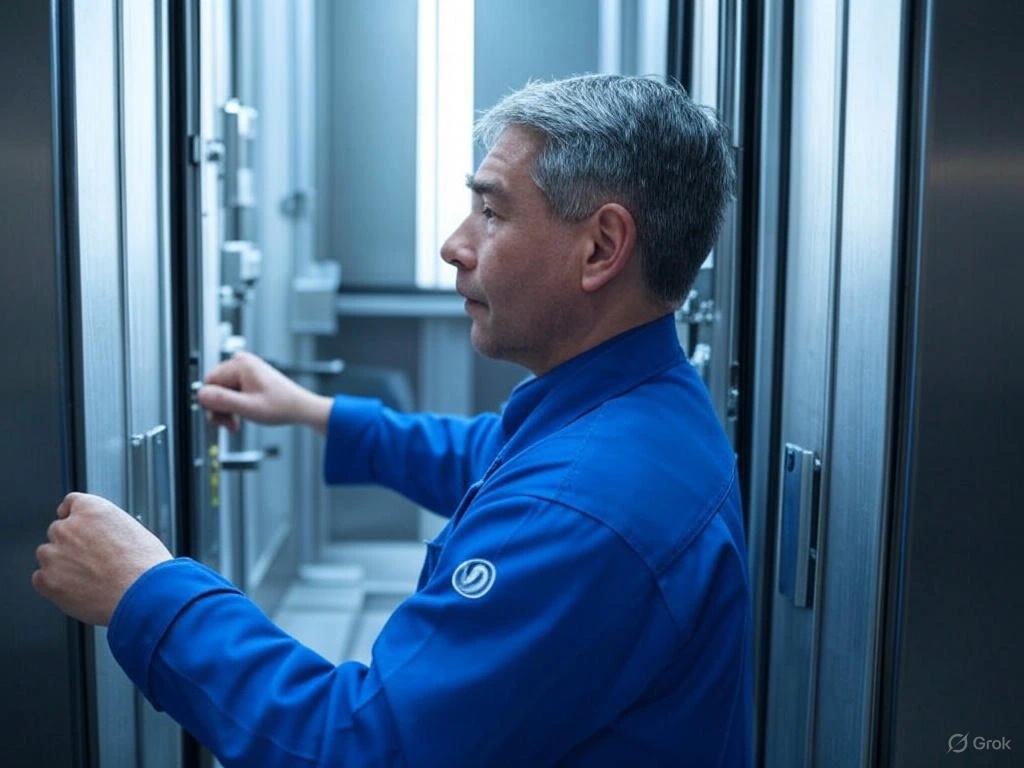
The Hybrid Model (Often the Best Answer)
Most mature operations blend the two:
- Core crew in-house handles daily PMs, rapid response, compliance documentation, and small projects.
- Specialists and surge labor are outsourced for advanced diagnostics, major overhauls, shutdowns, and after-hours coverage.
- Shared digital backbone: Your CMMS/EAM is the single source of truth. Vendors are required to log work orders, parts, measurements, photos, and failure codes directly into your system.
Key to making hybrid work is clear swim lanes:
- What is the distinction between “routine” and “specialty” by asset class and task list?
- What triggers a handoff (estimated hours, skill code, risk rating)?
- What data fields must be completed for every job to get paid?
- How are lessons learned routed back into PM templates and failure mode libraries?
Contracting for Success (If You Outsource)
- Write outcomes, not just activities. Tie payment to uptime, schedule compliance, and first-time fix, not only hours burned.
- Define documentation standards. As-found/as-left, torque specs, photos, meter readings, parts, and failure codes should be mandatory line items.
- Own the data. Your contract should stipulate that all maintenance data and analytics are your property, exported in usable formats.
- Set security expectations. Access tiers, background checks, tool control, and IT/OT segmentation must be explicit.
- Plan continuity. Include transition assistance, knowledge transfer, and staffing stability clauses to prevent loss of know-how.
Building an In-House Team That Competes with Vendors
- Invest in planners and schedulers. A well-planned internal crew can out-produce a larger, less organized team.
- Develop reliability engineering. Root cause analysis (RCA), PM optimization, and condition monitoring lift results beyond “wrench-turning.”
- Create a talent ladder. Apprenticeships, certifications, cross-training, and recognition programs keep skills current and retention high.
- Adopt modern tools. Mobile work orders, digital procedures, sensors, and analytics drive productivity and documentation quality.
- Benchmark externally. Participate in industry groups and audits to avoid insular practices.

A Quick Decision Framework
Ask (and score) the following, 1–5:
- Asset criticality: How costly is each hour of downtime?
- Workload volatility: How lumpy is demand across the year?
- Specialization depth: How many niche skills are required?
- Compliance intensity: How strict are security and regulatory needs?
- Geographic spread: How many sites and how far apart?
- Data & IP sensitivity: How sensitive is the process and maintenance data?
- Management capacity: Can you effectively recruit, supervise, and develop a team?
- Time horizon: Are you optimizing for this year’s budget or five-year reliability?
- High scores on 1, 4, 6: Bias toward in-house (or a very tight, on-site embedded vendor).
- High scores on 2, 3, 5: Bias toward outsourcing or hybrid.
- High score on 7: You can support an internal center of excellence.
- Short time horizon: Outsourcing accelerates capability; long horizon favors building internal equity.
Bottom Line: When Choosing In-House or Outsourced Maintenance
There isn’t a universal winner. In-house maintenance excels when control, speed, security, and intimate knowledge of equipment are paramount—and you’re willing to invest in people, tools, and process excellence.
Outsourcing shines when you need breadth of expertise, labor flexibility, faster ramp-up, and predictable costs—provided you contract for outcomes and protect your data.
For many organizations, the best answer is hybrid. You can maintain a sharp internal core for responsiveness and compliance, and augment it with specialized vendors for in-depth diagnostics, major events, and scaling.
Whichever path you choose, anchor it in clear metrics, disciplined planning, and relentless learning from every work order. That’s how maintenance becomes not just a cost center, but a competitive advantage.
FAQs
1) How do I decide if a task should be in-house or outsourced? Classify work by criticality and specialization. Keep high-criticality, high-frequency tasks in-house (fast response, tribal knowledge). Outsource low-frequency or highly specialized work (advanced diagnostics, major overhauls). Use triggers—estimated hours, skill codes, or risk ratings—to route jobs consistently.
2) What should an outsourcing contract include to avoid cost creep? Define outcomes (uptime, MTTR, schedule compliance), not just activities. Include detailed scopes, rate cards, and change-order rules. Mandate documentation standards (as-found/as-left notes, photos, readings, parts). Add SLA penalties/earn-backs, require vendors to enter data into your CMMS, and stipulate that you own the data.
3) Can a small company still justify an in-house team? Yes—if downtime is expensive and assets are unique. A lean internal crew covering routine PMs and rapid repairs, supplemented by on-call specialists for complex work, can outperform pure outsourcing. Invest in planning/scheduling and a right-sized CMMS to amplify productivity.
4) What metrics prove my maintenance strategy is working? Track a balanced set: Availability/uptime, MTBF, MTTR, first-time fix rate, planned vs. unplanned ratio, schedule compliance, safety leading indicators, backlog health, and cost per asset hour. Review trends monthly and tie incentives (internal or vendor) to these outcomes.
5) How do we prevent knowledge loss with vendors? Make knowledge capture a pay condition: every job must include standardized fields, photos, and measurements in your CMMS. Implement post-job debriefs, periodic RCA reviews, and template updates to PMs and failure modes, ensuring insights become integral to your playbook rather than the vendor’s.