
Key Takeaways
- Maintenance fatalities are rising. The BLS reported 356 maintenance worker deaths in 2024 alone, and a U.S. worker dies from a work-related injury every 104 minutes.
- Reactive maintenance is dangerous. Skipped inspections, deferred PMs, and undocumented procedures are leading causes of severe injuries and fatalities in maintenance environments.
- CMMS software shifts teams from reactive to proactive. Automated PM schedules, standardized work orders, and real-time hazard reporting close the gaps that lead to accidents before they happen.
- The financial case is compelling. Workplace injuries cost U.S. employers $167 billion per year. Every $1 invested in prevention returns $4–6 through reduced incidents, lower insurance costs, and improved productivity.
- Safety culture requires data. A CMMS gives managers the metrics — PM completion rates, open hazards, overdue inspections — to make safety visible, measurable, and continuously improving.
Maintenance work is one of the most hazardous occupations in the world. Technicians regularly work around heavy equipment, electrical systems, pressurized machinery, and chemical hazards — often under time pressure and with incomplete information about an asset's history. The consequences of a missed inspection or a skipped procedure can be catastrophic.
According to the U.S. Bureau of Labor Statistics' February 2026 report, there were 5,070 fatal work injuries in the United States in 2024 — meaning a worker died from a work-related injury every 104 minutes. Of particular concern for the maintenance industry, fatalities among building and grounds cleaning and maintenance workers reached 356 in 2024. Beyond fatalities, the National Safety Council estimates workplace injuries cost employers $167 billion per year, with the average single incident carrying a direct cost exceeding $40,000. These numbers make one thing clear: reactive approaches to maintenance safety are not enough. Organizations that want to protect their people need a proactive system — and that's exactly what a Computerized Maintenance Management System (CMMS) provides.
Why Maintenance Operations Are Inherently High-Risk
Understanding where risk originates is the first step toward eliminating it. In maintenance environments, the most dangerous conditions typically stem from:
Equipment failures and deferred maintenance. When preventive maintenance tasks are skipped or delayed, equipment degrades silently. A worn seal, a degraded insulation layer, or an unlubricated bearing can fail without warning — and failure during operation can be lethal.
Lack of standardized procedures. When technicians rely on tribal knowledge rather than documented processes, errors multiply. A step skipped during a lockout/tagout (LOTO) procedure, for example, can expose a worker to hazardous energy with deadly consequences.
Poor visibility into asset history. Without a centralized record of past maintenance, inspections, and repairs, technicians often have no way of knowing that a piece of equipment has a history of recurring faults or that a critical component is approaching end-of-life.
Compliance gaps. OSHA and other regulatory bodies impose strict requirements on safety inspections, certifications, and maintenance documentation. Falling out of compliance doesn't just invite fines — it means safety protocols that should be protecting workers may not be in place. As of 2025, serious OSHA violations can carry fines exceeding $15,000 per incident.
Reactive work culture. Organizations that only respond to problems after they occur put technicians in the most dangerous situations — rushing to fix failed equipment under pressure, often without the right parts, tools, or safety information on hand.
How CMMS Software Reduces Maintenance-Related Injuries and Fatalities
A CMMS is not just a scheduling tool. When implemented well, it becomes the operational backbone of a safer, more accountable maintenance program. Here's how:
1. Preventive Maintenance Scheduling
The most powerful safety feature of a CMMS is the ability to automate preventive maintenance (PM) schedules. Rather than waiting for equipment to fail, a CMMS prompts technicians to service assets on a regular, documented cadence — before a breakdown can endanger anyone.
Research consistently shows that organizations using structured preventive maintenance through a CMMS achieve 5–15% reductions in maintenance costs annually and reach ROI within 6–12 months. More importantly, they reduce the number of emergency reactive work orders — the kind most likely to result in injuries.
2. Standardized Work Orders and Safety Checklists
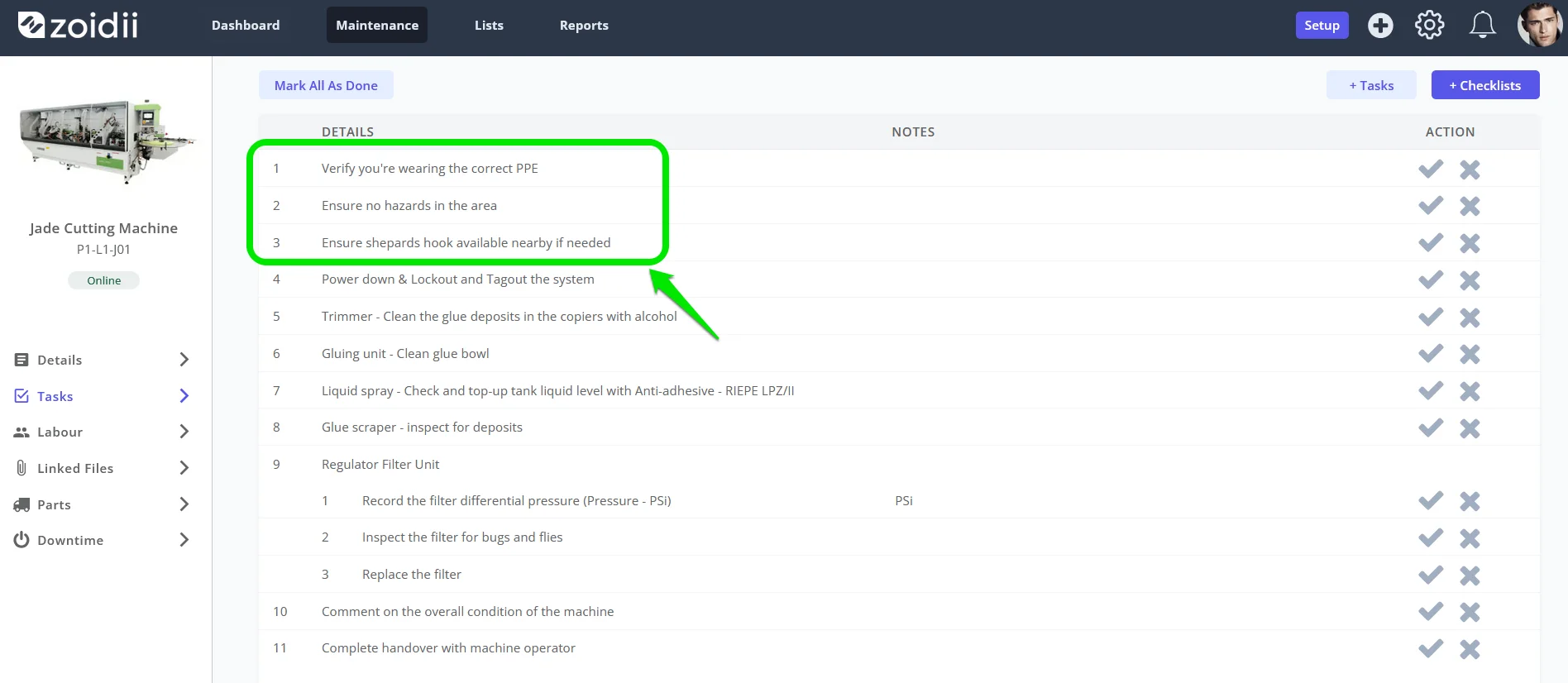
A CMMS allows maintenance managers to embed safety instructions automatically, LOTO procedures, PPE requirements, and step-by-step checklists directly into work orders. Every technician who picks up a job has access to the same standardized, up-to-date safety information — not just the steps they happen to remember.
This standardization is critical. OSHA statistics show that manufacturing accounts for 15% of all workplace injuries despite employing only 8% of the workforce — a disproportionate risk that is heavily tied to inconsistent procedures.
3. Full Asset Maintenance History
Every inspection, repair, part replacement, and anomaly is logged against the asset in a CMMS. When a technician is assigned a work order, they can immediately review the asset's complete history — identifying whether a fault is recurring, whether a safety-critical component has been recently serviced, and whether any open hazard reports exist.
This visibility is the difference between informed, safe work and guesswork in a potentially hazardous environment.
4. Real-Time Hazard Reporting
Modern CMMS platforms allow technicians to log safety hazards in real time directly from the job site — via mobile app or desktop. The report is instantly visible to supervisors and safety teams, enabling rapid response before the hazard causes harm. This real-time reporting replaces the slow, paper-based reporting processes that allow hazards to persist for days or weeks before being addressed.
5. Compliance Tracking and Audit Readiness
A CMMS creates an automatically updated, tamper-resistant record of every maintenance activity performed — with timestamps, technician signatures, parts used, and outcomes documented. When an OSHA inspection occurs or an internal safety audit is conducted, all evidence of compliance is in one place.
This is particularly valuable given OSHA's expanded data collection requirements in recent years and increasing enforcement activity across high-hazard industries.
6. Lockout/Tagout (LOTO) Procedure Management
LOTO failures are among the most common causes of severe maintenance injuries and deaths. A CMMS can store and enforce LOTO procedures as mandatory steps within relevant work orders — ensuring that no technician can mark a job complete without documenting that proper energy isolation was performed.
7. Root Cause Analysis and Continuous Improvement
When an incident does occur, a CMMS provides the data needed for a thorough root cause analysis: the asset's maintenance history, which procedures were followed, which parts were in use, and what the equipment condition was. This transforms incidents from isolated events into opportunities to prevent future harm.
The Business Case for CMMS Safety Investment
Safety is the right thing to do — but it's also a strong business decision. Research shows that every dollar invested in injury prevention returns $4–6 through reduced incident costs, improved productivity, lower workers' compensation premiums, and reduced legal exposure.
A comprehensive safety program that reduces injuries by 50% can save a mid-sized facility $500,000 to $2 million annually, with an ROI of 300–400% when all direct and indirect costs are factored in. For organizations running lean maintenance teams, those numbers can be the difference between profitability and crisis. Beyond cost, consider the regulatory environment in 2026. The BLS and OSHA have both expanded their data collection and publication programs, making workplace injury records more visible to the public, to insurers, and to prospective employees. A strong safety record — backed by a demonstrable CMMS program — is increasingly a competitive advantage.
Building a Culture of Safety with CMMS
Technology alone doesn't create safety — culture does. But a CMMS is one of the most powerful tools available for making safety culture visible, measurable, and sustainable. When managers can see PM compliance rates, open hazard reports, overdue inspections, and incident trends in a single dashboard, safety stops being abstract and becomes operational.
Key leading indicators to track in your CMMS include:
- Preventive maintenance completion rate — the percentage of scheduled PMs completed on time
- Open hazard reports — logged safety concerns awaiting resolution
- Overdue inspections — safety-critical checks that have passed their due date
- Mean time between failures (MTBF) — an indicator of equipment health and maintenance effectiveness
- Work order backlog — excessive backlogs increase the risk of deferred safety tasks
How Zoidii CMMS Supports Safer Maintenance Operations
Zoidii is a cloud-based CMMS built for maintenance teams that need simplicity without sacrificing power. It gives your team the tools to:
- Build and automate preventive maintenance schedules so nothing safety-critical slips through the cracks
- Attach safety procedures, checklists, and LOTO instructions automatically to work orders
- Access complete asset maintenance history from any device, on the shop floor or in the field
- Log and escalate hazard reports in real time via web or mobile
- Maintain a full, audit-ready compliance record for every maintenance activity
Conclusion: Proactive Maintenance Saves Lives
The data from 2024 and 2026 is clear: workplace fatalities and injuries in maintenance remain a serious, persistent problem. With a worker dying from a work-related injury every 104 minutes in the United States, and maintenance-specific fatalities on the rise, the stakes have never been higher.
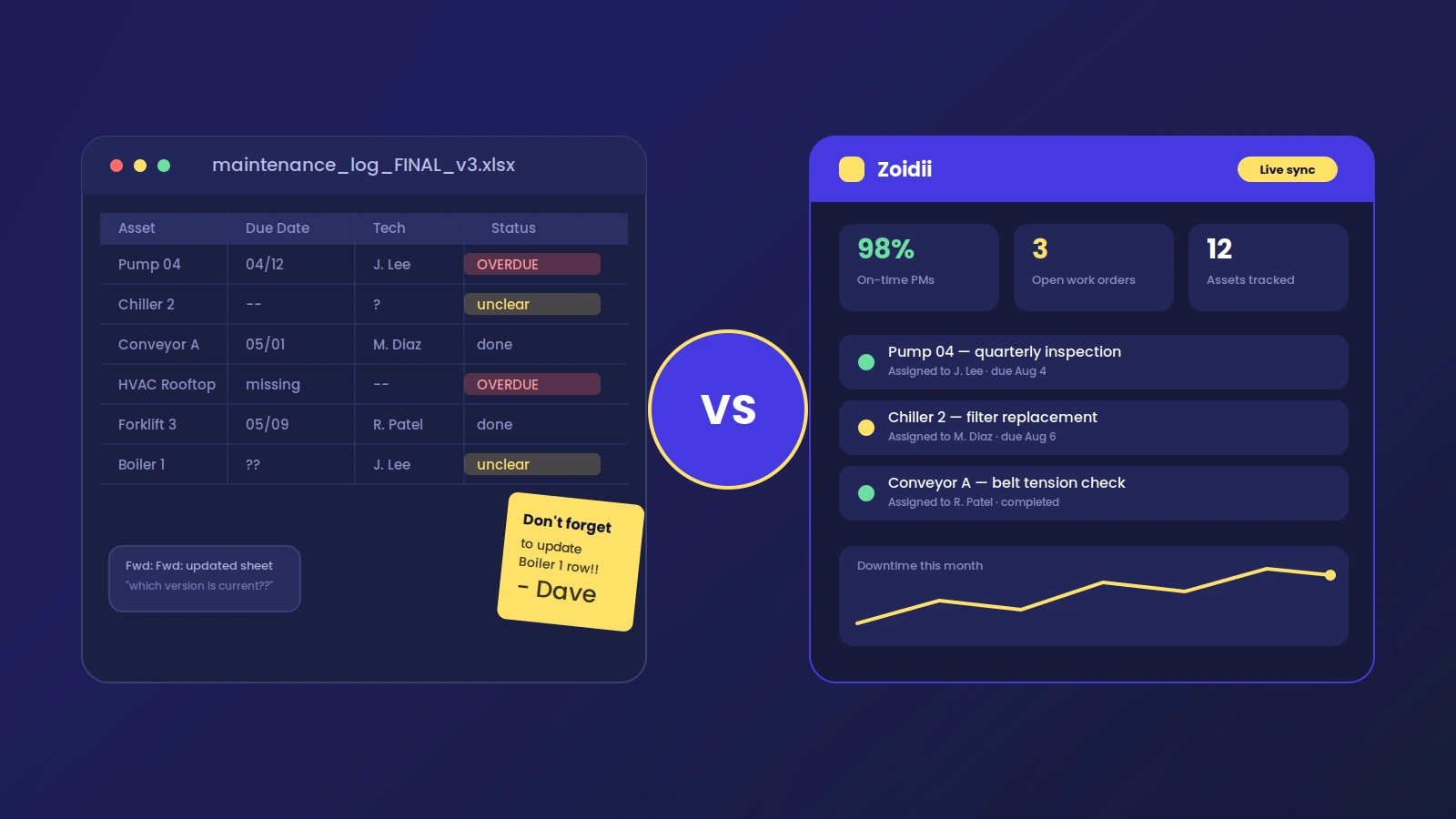
Organizations that implement a CMMS shift from a reactive, risk-prone approach to a proactive, data-driven safety culture. They protect their people, reduce their costs, and build the operational resilience that allows them to grow with confidence. If your team is still managing maintenance with spreadsheets, paper logs, or aging legacy systems, there has never been a better time to make the change. Start your free trial of Zoidii CMMS today →
Frequently Asked Questions (FAQs)
Q: What is a CMMS and how does it improve workplace safety? A CMMS (Computerized Maintenance Management System) is software that helps maintenance teams schedule, track, and document all maintenance activities in one centralized platform. It improves safety by automating preventive maintenance schedules, standardizing work procedures, logging asset histories, and enabling real-time hazard reporting — reducing the likelihood of equipment failures and human error that lead to injuries.
Q: How many maintenance workers are killed on the job each year? According to the U.S. Bureau of Labor Statistics' February 2026 report, 356 building and grounds maintenance workers were fatally injured in 2024. Across all industries, there were 5,070 fatal work injuries in the United States in 2024 — the equivalent of one worker dying every 104 minutes.
Q: Can a CMMS help with OSHA compliance? Yes. A CMMS automatically documents every maintenance task performed — including timestamps, technician assignments, parts used, and inspection outcomes — creating an audit-ready compliance record. This makes it significantly easier to demonstrate adherence to OSHA standards during inspections and helps avoid fines that can exceed $15,000 per serious violation.
Q: What is the ROI of investing in CMMS software for safety? Research shows that every dollar invested in workplace injury prevention returns $4–6 through reduced incident costs, lower workers' compensation premiums, improved productivity, and avoided legal liability. For a mid-sized facility, a safety program supported by a CMMS can save $500,000 to $2 million annually, with a typical ROI of 300–400%.
Q: What CMMS features matter most for preventing serious injuries? The most safety-critical CMMS features include automated preventive maintenance scheduling, built-in safety checklists and LOTO procedure management, complete asset maintenance history, real-time hazard reporting, compliance tracking, and incident logging for root cause analysis. Together, these features shift maintenance teams from reacting to failures to preventing them before anyone gets hurt.