
If you run a fabrication shop, you live and die by your machines. Laser cutters, press brakes, CNC mills and lathes, welding cells, powder-coat lines, air compressors, and overhead cranes all have one thing in common: when they’re down, money bleeds.
The right computerized maintenance management system (CMMS) keeps those assets healthy, your scheduling predictable, and your customers off your back about missed ship dates.
But “right” is contextual. The best CMMS for a high-mix sheet-metal shop won’t be identical to the best fit for a structural fabricator or a multi-site contract manufacturer.
This guide breaks down the top CMMS options for metal fabrication. It helps you pick based on the realities of a fab floor - meter-based PMs on CNC equipment, coolant management, welding calibration, tool crib control, safety/LOTO, ISO 9001 traceability, and integrations with your ERP and machine data.
Key Takeaways:
- Pick for fit, not hype: The best CMMS depends on your fab reality -asset mix, compliance needs, and integration landscape - not generic top-10 lists.
- Prioritize meter/condition-based PMs: Tie work orders to real machine signals (hours, cycles, alarms) to cut both surprise failures and over-maintenance.
- Mobile + SOPs win adoption (and audits): A technician-friendly mobile app with checklists, photos, e-signatures, and QR intake makes ISO 9001 evidence a by-product of daily work.
- Integrate with what runs the plant: Sync CMMS with ERP/MES and, where possible, machine-monitoring platforms to align downtime, parts usage, and job costing.
- Start small, standardize, then scale: Pilot one value stream, build a clean asset master, kit parts with min/max, and measure taps-to-complete—then roll out plant-wide.
What metal fabricators need from a CMMS (and why it’s different)
Metal fabrication is a special kind of manufacturing:
- Asset diversity: From precision CNCs and fiber lasers to ovens, robots, forklifts, and facilities utilities (air, nitrogen, vacuum). A good CMMS must handle wildly different maintenance models - calendar-based, meter-based (hours, cycles), and condition-based (vibration, temperature, alarms).
- High-mix, low-volume: Quick changeovers and tooling swaps create wear patterns that differ significantly from those in high-volume assembly plants. You need fast work-request intake (QR codes on assets), simple mobile flows for techs, and a clean backlog view for planners.
- Quality & compliance: Many fabricators are certified (or sell into regulated verticals) and must show clean maintenance records during audits. Your CMMS should make ISO 9001 (and customer) auditors happy with controlled procedures, documented maintenance, and traceable calibration histories.
- ERP & production reality: Maintenance can’t be an island. You want your CMMS to play nice with your ERP/MES for parts consumption, work-order costs, and planned downtime scheduling—so operations can build schedules around PMs instead of tripping over them.
- Machine data & automation: If your production monitoring system can trigger a maintenance work order automatically when a spindle hits X hours, cycle counts reach Y, or alarms spike, you get true condition-based maintenance instead of calendar guesswork.
How we evaluated CMMS for fabricators
We focused on the features that matter most on the fab floor:
1. Preventive & predictive maintenance depth Calendar and meter-based PMs (hours, cycles, starts), nested checklists, counter resets, and condition triggers.
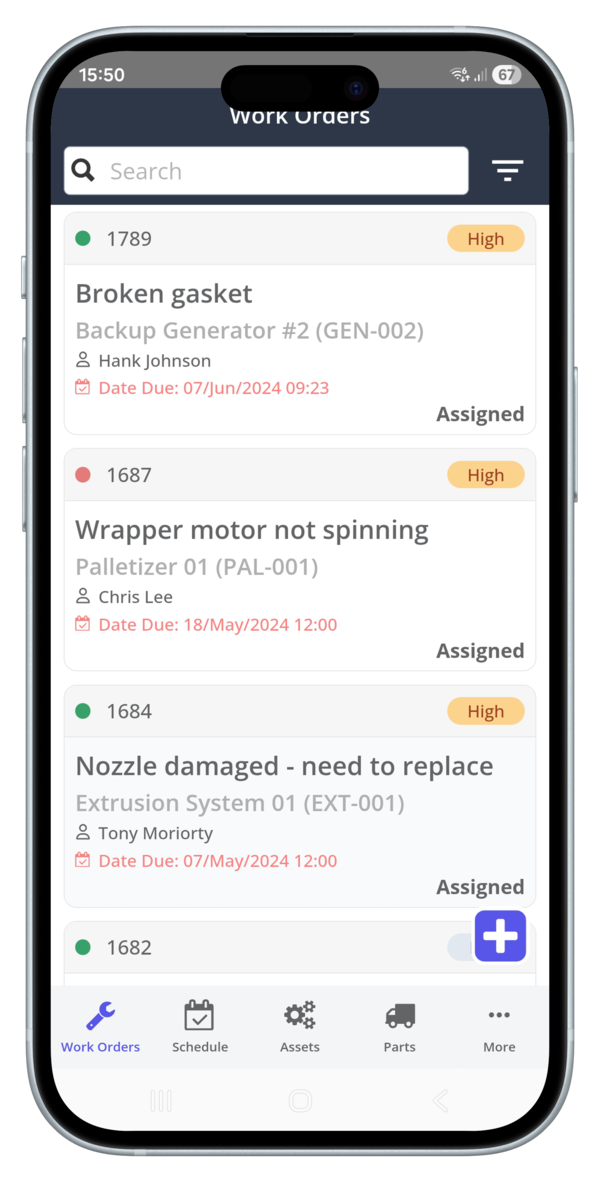
2. Mobile usability for technicians The best systems let welders or maintenance techs close work orders, attach photos, and scan parts from a phone—with minimal taps. (Independent roundups regularly highlight mobile experience as a key decision factor.)
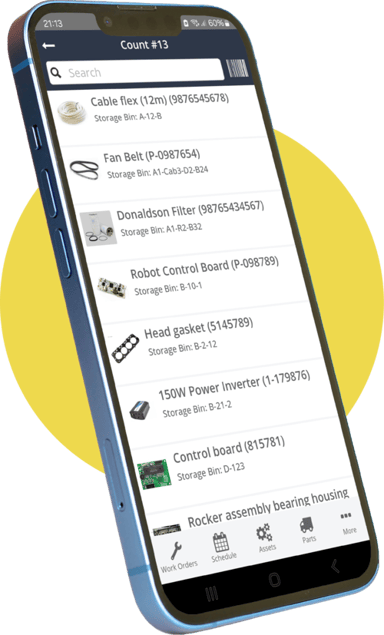
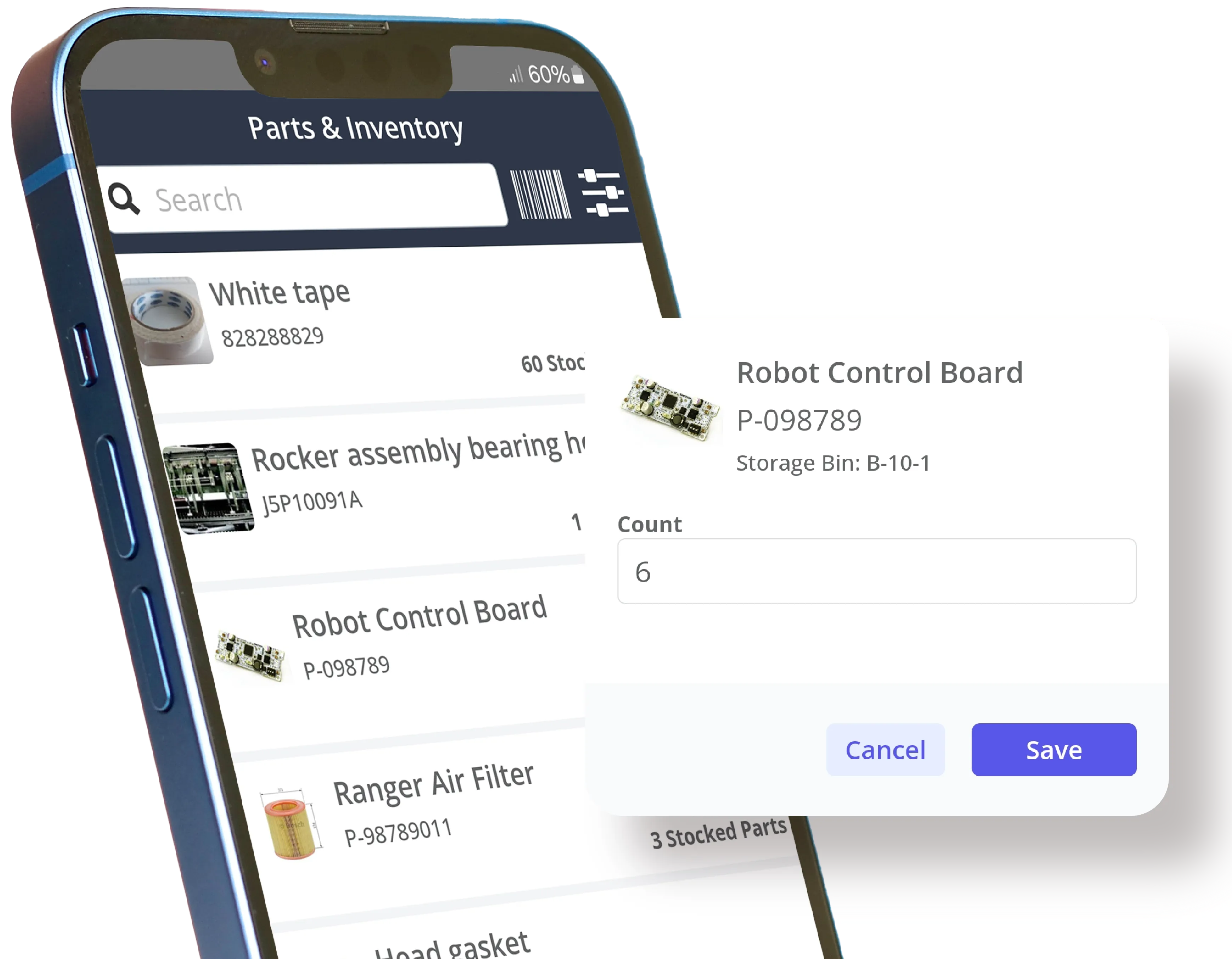
3. Parts/MRO management Minimums/maximums, multi-bin locations, vendor lead times, and kitting for common PMs.
4. Asset hierarchy & criticality Parent/child relationships (e.g., line → machine → subassembly → component), spare-part BOMs, and failure codes for real MTBF/MTTR analytics.
5. Integrations Open APIs, ERP connectors, and—critically for fabricators—machine-data integrations with platforms like MachineMetrics to automate work triggers based on alarms, cycle counts, or condition thresholds.
6. Quality & audit support Revision-controlled SOPs, electronic sign-offs, calibration modules, and exportable logs aligned to ISO 9001 evidence needs.
7. Reporting & downtime analysis OEE-adjacent metrics, top bad actors, and cost rollups for the CFO.
8. Time-to-value Data import tooling, asset cloning, templated PM libraries for CNC/press brake/laser, training content, and customer support. We also considered references in manufacturing buyer’s guides and roundups to benchmark market maturity and sentiment.
We also considered references in manufacturing buyer’s guides and roundups to benchmark market maturity and sentiment.
The short list: best CMMS options for metal fabricators
Below are the top platforms we see succeeding on fab floors, with recommended “best for” scenarios.
1. Fiix (by Rockwell Automation) - Best for data-driven fab shops with IIoT aspirations
Why does it fit metal fabrication?
- Deep machine-data integration: official connector with MachineMetrics lets you trigger Fiix work orders from alarms, cycle counts, or anomaly detection—ideal for CNCs and lasers that you already monitor.
- Mature API and marketplace for add-ons; enterprise features for multi-site.
Watch-outs: Implementation shines when you commit to meter/condition-based PMs (not just calendar-based) - budget time for integration and data mapping.
2. Zoidii - Best ultra-light CMMS for smaller fab shops
Why does it fit metal fabrication?
- Strong core CMMS with robust mobile and work-order flows.
- Recognized among the top mobile CMMS apps, which matters when welders and operators are closing WOs at the cell.
- Straightforward PM/work order setup, which can be attractive if you’re early in your CMMS journey.
Watch-outs: Confirm the exact integration path for your ERP and any machine-data platforms you use.
3. UpKeep - Best for fast mobile adoption across mixed assets
Why does it fit metal fabrication?
- Technician-first mobile experience; quick to roll out on the floor.
- MachineMetrics integration supports condition triggers without coding, making it realistic to move beyond calendar PMs.
- Clean parts inventory and purchasing flows; good for tracking consumables like filters, coolants, and PPE.
Watch-outs: Advanced analytics and multi-system data orchestration may require API work or higher-tier plans.
4. MaintainX - Best for frontline execution and SOP-driven compliance
Why does it fit metal fabrication?
- Excel at procedure checklists, photos, and signatures—useful for ISO evidence and safety/LOTO verifications.
- Strong work-request intake (QR codes) and communication threads per WO.
Watch-outs: If you need deep parts forecasting or advanced asset hierarchies, scope those modules early.
5. Limble - Best for organizations wanting depth with approachability
Why does it fit metal fabrication?
- Robust PM scheduling, asset hierarchies, parts inventory, and reporting—without feeling heavy to implement.
- Frequently cited in CMMS market comparisons for breadth and usability (useful signal if you want a single system for many asset types).
Watch-outs: Check manufacturing-specific reporting and integrations to avoid living in two systems.
6. eMaint (by Fluke Reliability) - Best for calibration-intensive environments
Why does it fit metal fabrication?
- Longstanding CMMS with strong calibration workflows and a reliability-engineering ecosystem (Fluke).
- Suitable if your customers or sector (aerospace/medical) are picky about calibration traceability for gauges, torque tools, and welding equipment.
Watch-outs: UI feels more “classic CMMS” than some newer mobile-native tools; plan change management accordingly.
7. Brightly Asset Essentials (formerly Dude Solutions) - Best for facilities-heavy shops
Why does it fit metal fabrication?
- If your maintenance scope spans large facilities and production equipment, Brightly’s facilities DNA can be helpful.
- Solid PMs, work orders, and asset tracking with a broad customer base in industrial facilities.
Watch-outs: As needs grow (multi-site, complex integrations), you may outgrow its depth.
8. LLumin - Best for rules-driven automation in manufacturing
Why does it fit metal fabrication?
- Positioning and product depth aimed squarely at manufacturing (not just general facilities).
- Emphasis on building plain-English rules for maintenance automation—a good fit if you have predictable triggers on CNC/robot cells.
Watch-outs: Ensure your shop’s specific triggers (e.g., spindle hours from brand X controller) are achievable via integration.
9. Hippo CMMS / Eptura - Best for simple, straightforward rollouts
Why does it fit metal fabrication?
- Known for a clean UI and straightforward PM/work order flows.
- Works well for small to mid-size shops that don’t need complex configuration.
Watch-outs: Validate advanced needs (multi-site, complex hierarchies, API-driven integrations) before committing.
10. Fracttal - Best for analytics-focused teams with Latin American operations
Why does it fit metal fabrication?
- Modern cloud CMMS with strong dashboards and mobility; available in multiple languages and with a footprint across the Americas.
- Useful content and tooling around ISO compliance and audit readiness.
Watch-outs: Confirm localized support and integration strategy for your ERP stack.
Don’t overlook your ERP: two patterns that work
Many fabrication shops already run an ERP such as Epicor Kinetic, JobBOSS², Global Shop Solutions, ProShop ERP, or SYSPRO. You don’t have to choose between ERP and CMMS—use the right tool for the job and integrate where it counts.
Pattern A: ERP + best-of-breed CMMS Keep job costing, purchasing, and scheduling inside ERP; use a CMMS for maintenance execution, parts, and asset histories. For example, fabricators on Epicor Kinetic often use external CMMS for modern mobile workflows and condition-based PMs while Kinetic handles production planning. (Epicor itself focuses heavily on fabricated metals workflows on the ERP side.)
Pattern B: ERP with built-in maintenance features Some ERPs (notably ProShop ERP) embed maintenance/CMMS-like functionality directly, giving you a single system of record and paperless audits—handy for regulated industries. If you want a single database for QMS/MES/CMMS/ERP, that’s a compelling option.
Bottom line: Unless your ERP’s maintenance module is truly best-in-class for your needs, a dedicated CMMS, along with tight integration, usually yields better technician adoption and analytics.
Buyer’s checklist for fab shops
When you demo vendors, pressure-test these real fab-floor scenarios:
1. Meter-based PMs from machine data Can the system automatically create a work order when a CNC’s spindle crosses 250 hours or when a fiber laser reports an alarm spike? Does it support counters that reset after completion?
2. Coolant, lube, and consumables tracking Can you template PMs (e.g., “Check concentration to 8–10%,” “Skim tramp oil,” “Change filter element”) with checklist sign-offs and auto-add common parts?
3 Calibration traceability Show how you would control and record calibration for torque wrenches, gauges, and welding equipment, with alerts for due dates and audit-friendly records. Calibration traceability is where ISO 9001 evidence comes into play.
4. Weld and LOTO procedures Can you attach SOPs, LOTO diagrams, or inspection photos to WOs? Are there electronic sign-offs?
5. Parts/MRO and vendor management How do min/max levels, lead times, and multi-location bins work? Can receiving transactions update on-hand balances at the crib?
6. Downtime categorization & analytics Can technicians pick standardized reasons (e.g., “laser chiller,” “tool probe,” “hydraulic leak”), and can you trend MTBF/MTTR by asset family?
7. Mobile experience Hand your phone to a skeptical technician and watch them complete a PM with photos and a parts issue. (The best CMMS make this effortless, and several CMMS’ are consistently praised for mobile UX.)
Scenario-based recommendations
Small single-site fab shop (under ~75 people)
- Pick: UpKeep, Limble, MaintainX, or Zoidii
- Why: Quick time-to-value, strong mobile, simple admin.
- Nice-to-haves: QR code requests, parts min/max, simple dashboards.
- Avoid: Over-engineering integrations before you stabilize your basic PM program.
- Pick: Fiix, Limble, Zoidii
- Why: You’ll want meter-based PMs and machine-data triggers, plus better analytics as asset variety explodes.
- Pick: eMaint, Fiix, LLumin
- Why: Calibration traceability, change control, and audit-friendly exports are crucial.
- Pick: Brightly Asset Essentials, eMaint
- Why: Facilities lineage and robust PM execution.
- Pick: ProShop ERP (if you embrace its all-in-one model) or ERP + a CMMS via API.
Implementation playbook for a fab shop CMMS
1) Start with a cell, not the entire plant Pick a representative area (e.g., laser → press brake → deburr → weld cell) and assign a champion. Aim to cut unplanned downtime by 20–30% there before you scale.
2) Build an asset master you’ll actually maintain
- Create asset hierarchies (Line → Machine → Subassembly → Component).
- Capture make/model/serial, controller type, network address (if monitored), critical spares, and safety notes.
- Add QR code labels to every asset.
4) Wire up meters and data
- If you have MachineMetrics (or a similar solution), connect it so cycle counts/hours/alarms can auto-trigger work orders in your CMMS. This is the leap from “calendar PMs” to condition-based maintenance.
- If you don’t, start with manual meter readings (operators enter hours) while you evaluate monitoring.
6) Train for the fewest taps possible Measure technician effort: number of taps to start/complete a WO, attach a photo, or issue a part. Cut steps until adoption is natural. (This is where mobile-strong CMMS shines.)
7) Make audits boring Enable electronic sign-offs; attach SOPs and calibration certs to assets and WOs. Schedule periodic exports of maintenance logs. That ISO 9001 audit should be a show-and-tell, not a scramble.
Cost & ROI expectations
- Licensing: Most modern CMMS platforms charge per-user and/or per-site/feature tiers - budget realistically for technicians, planners, and a few view-only seats for supervisors.
- Integration & setup: Expect a one-time cost (time or services) to clean asset lists, import PMs, and connect data sources (ERP, machine monitoring).
- Savings: Common early wins include fewer emergency breakdowns (from calendar-to-meter PMs), lower expedite fees on parts (by enforcing min/max), and faster technician wrench time (less paperwork, better kitting). Independent and vendor case studies often report double-digit reductions in downtime when moving to condition-based triggers. (This aligns with the broader quality/maintenance literature that links proactive maintenance to higher uptime.)
Real-world integration examples to emulate
Fiix + MachineMetrics Shop monitors CNCs and lasers; when alarms/cycle thresholds hit, MachineMetrics automatically creates work orders in Fiix. Maintenance keeps up with failures without flooding the backlog with calendar PMs.
ERP + CMMS Keep purchasing in ERP (e.g., Epicor Kinetic, JobBOSS²) and sync parts issues and labor back for job costing. Your ERP continues handling scheduling and customer commitments; CMMS handles maintenance execution. (Epicor documents a specific focus on the fabricated metals sector for production workflows, so you’re not fighting the system.)
All-in-one ERP approach Some fabricators choose ProShop ERP, which combines ERP/MES/QMS/CMMS capabilities in a paperless system—appealing if you want single-system audits and tight process control.
Metal-fab-specific PM ideas you can reuse on day one
1. CNC spindle/axis service
- Trigger: 250 spindle hours or 50k cycles
- Tasks: Inspect way lube levels, grease linear rails per OEM spec, check backlash, run ballbar test, replace filters, and verify probe calibration.
- Evidence: Photos of filters and a signed checklist.
- Trigger: Calendar weekly + alarm-based events
- Tasks: Clean lenses/nozzles, inspect assist gas lines, change chiller filter, check coolant conductivity.
- Evidence: Log conductivity values and trends.
- Trigger: 100k strokes
- Tasks: Inspect hydraulic fluid and leaks, check backgauge alignment, and verify safety light curtains.
- Evidence: Alignment readings attached.
- Trigger: 40 hours arc-on time
- Tasks: Replace contact tips/liners, verify gas flow, inspect ground, check wire guides, and confirm calibration on power source.
- Evidence: Calibration sticker update.
- Trigger: Calendar + meter
- Tasks: Booth filter replacements, conveyor lubrication, burner tune-up, and cure profile check.
- Evidence: Temperature profile screenshot.
- Trigger: Compressor hours, pressure alarms
- Tasks: Service compressor/filters, drain receivers, check dew point, and verify leak rate audits.
Common pitfalls (and how to avoid them)
- Over-customizing before adoption: Start with out-of-the-box flows. Nail technician usage first; then refine fields and workflows.
- Parts in the wild: If your techs can’t find the right filter, your PM won’t happen. Kitting and min/max are non-negotiable.
- No single source of truth for assets: Pick one system (CMMS) as the asset record and integrate outward to ERP, monitoring, and BI.
- Treating implementation like IT, not operations: The maintenance manager and lead tech must be the product owners. IT is a partner, not the driver.
Frequently asked questions:
Do I really need machine data integration? No—but it’s the biggest unlock. When alarms, hours, or cycles automatically trigger work, you cut both over-maintenance and surprise failures. Platforms like MachineMetrics publish and support integrations for several CMMS, so you don’t have to build from scratch.
What about ISO 9001—what exactly does a CMMS help with? ISO doesn’t prescribe a specific tool, but it requires you to maintain infrastructure/equipment to ensure product conformity and to keep documented evidence. A CMMS gives you procedures, schedules, and proof (who did what, when).
Where does ERP stop and CMMS start? ERP owns orders, inventory accounting, and customer commitments. CMMS owns maintenance execution and asset health. Many metal-fab ERPs (e.g., Epicor Kinetic) are excellent at production but still benefit from a dedicated CMMS for mobile WO flows and condition-based PMs.
We’re small—won’t a CMMS slow us down? Pick a light tool and start with your constraint machines (laser, bottleneck CNC). The moment you can predictably plan PM windows and find parts when you need them, you’ll wonder how you managed without one.
The takeaway
Choosing a CMMS isn’t about a generic “top 10” - it’s about fit for a fab floor:
- If you’re serious about condition-based maintenance and want to automate work orders using real machine signals, go with Fiix or UpKeep and connect your machine-monitoring platform.
- If you want mobile-first execution and clean SOPs for ISO and customer audits, Zoidii is hard to beat.
- If you need breadth with approachability as you scale, Limble is a strong, balanced choice.
- If calibration and audit traceability rule your world, shortlist eMaint and LLumin.
- If you prefer an all-in-one (ERP + MES + QMS + CMMS) to simplify audits and training, evaluate ProShop ERP.