
Understanding how long equipment will likely operate before it fails is critical to optimizing performance, minimizing downtime, and managing costs. One of the most essential metrics to quantify this reliability is Mean Time to Failure (MTTF).
MTTF is a statistical measure that estimates the average time non-repairable systems or components function before experiencing failure.
This article delves into the fundamentals of MTTF, explaining its significance in maintenance management, how it differs from related metrics like Mean Time Between Failures (MTBF), and how businesses can use it to enhance operational efficiency.
What is Mean Time to Failure (MTTF)?
Mean Time to Failure (MTTF) is a key performance indicator (KPI) used to measure the reliability of non-repairable systems or components. Non-repairable systems are items that, once they fail, cannot be restored to a working condition and are typically replaced. Examples include o-rings, light bulbs, sensors, belts, and semiconductor chips.
MTTF is the average operational time of a system or component from when it is placed into service until it experiences a failure. It provides valuable insights into a product or component's expected reliability over its life cycle.
In simple terms, MTTF represents a product's expected lifespan. The higher the MTTF, the longer the system or component is expected to function before failing.
MTTF vs. MTBF: What's the Difference?
One common source of confusion in maintenance metrics is the distinction between MTTF and Mean Time Between Failures (MTBF). Although both measure system reliability, durability, or dependability, they apply in different contexts.
- MTTF refers to the mean operating time of non-repairable systems or components replaced after failure, such as fuses, bearings, or bulbs.
- MTBF is the average time between breakdowns of repairable systems or components, where, after a failure, the system is repaired and placed back into operation. MTBF measures the time between two consecutive failures in a repairable system. MTBF is a vital maintenance KPI for measuring performance, safety, and equipment design, particularly for critical or complex assets such as generators or aircraft.
Significance of MTTF in Maintenance
Understanding MTTF is essential in several areas of asset management and operational reliability:
1. Predicting Component Lifespan
MTTF helps organizations estimate how long a non-repairable part will last under normal operating conditions. Expected lifespan data is crucial for planning maintenance activities, scheduling replacements, and minimizing the risk of unexpected failures.2. Improving Inventory Management
By understanding the expected lifespan of critical components, businesses can manage spare parts inventories more effectively. Effective inventory management prevents overstocking or understocking of spare parts, optimizing capital investment and reducing storage costs.3. Design and Quality Assurance
Manufacturers use component MTTF data when designing new systems to ensure the final product meets quality and reliability standards. By testing products and calculating MTTF, they can identify design weaknesses, improve product durability, and enhance customer satisfaction.4. Risk Management and Safety
In industries where equipment failure could have safety or environmental consequences, such as aviation, healthcare, or oil and gas, MTTF plays a crucial role in risk assessment. A low MTTF value can signal potential reliability risks that could impact safety.5. Cost Management
Equipment failures can lead to significant operational downtime, lost productivity, and expensive repairs. By using MTTF to predict failure rates, organizations can optimize maintenance schedules and reduce the cost of downtime.How is MTTF Calculated?
The formula for calculating MTTF is straightforward:
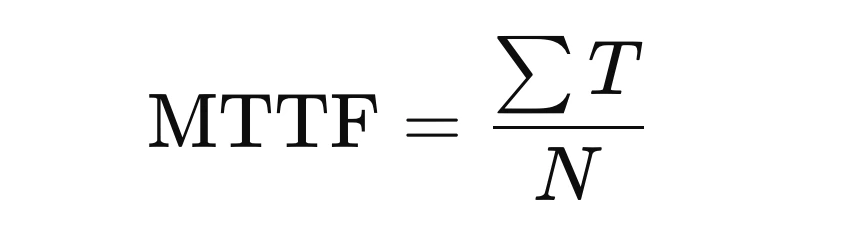
Where:
- ∑T is the total operational time of all systems or components before failure.
- N is the number of systems or components tested.
MTTF = (100 + 150 + 200 + 120 + 180) / 5 = 150 hours
Factors That Affect MTTF
MTTF is influenced by several factors that can affect the longevity of non-repairable components:
1. Operating Conditions
Components operating in harsh environments, such as extreme temperatures, high humidity, or heavy loads, may experience shorter MTTF due to the stress placed on them. For instance, bearings in a high-heat environment may fail faster than those in a controlled environment.2. Material Quality
The quality of materials used in manufacturing a component will impact its MTTF. High-quality materials generally lead to longer operational life, while lower-quality materials may be more prone to early failure.3. Manufacturing Processes
Variations in manufacturing processes, such as defects or inconsistencies in production, can influence the MTTF of components. Manufacturers often perform quality testing to identify and mitigate defects that could reduce component life.4. Maintenance Practices
Although MTTF applies to non-repairable systems, the overall performance of the system in which the component is installed can affect its MTTF. For instance, inadequate bearings lubrication can reduce their operational life, while proper maintenance practices can extend their lifespan.5. Design Complexity
Complex designs that introduce more failure points (e.g., moving parts) may exhibit lower MTTF. Simpler designs tend to have fewer failure points and, as a result, may demonstrate longer MTTF values.6. Usage Patterns
How frequently and intensively a component is used can also impact MTTF. Components subjected to heavy or continuous use may wear out more quickly than those used intermittently or under lighter loads.Applications of MTTF Across Industries
MTTF is used in various industries to improve maintenance strategies, manage risk, and ensure product reliability. Some key applications of MTTF include:
Manufacturing: In manufacturing, MTTF helps with proactive maintenance planning and minimizing downtime. For instance, understanding the MTTF of critical components like motors, belts, or sensors in a production line can inform when to schedule replacements to avoid unscheduled stops.
Aerospace and Aviation: Reliability is critical in aerospace for both safety and performance. MTTF estimates the lifespan of aircraft components like landing gear or avionics systems, ensuring timely replacements to prevent failures that could compromise safety.
Healthcare: MTTF predicts when components like imaging sensors or circuit boards might fail in medical equipment, such as MRI machines or ventilators. MTTF data helps medical facilities proactively maintain equipment to maximize availability and avoid disruptions in patient care.
Automotive Industry: MTTF plays an essential role in the automotive industry, where the reliability of parts like sensors, electronics, or mechanical components is crucial for vehicle performance. Manufacturers use MTTF data to design more durable parts and provide warranties based on expected component life.
Power Generation: In power plants, MTTF helps operators manage critical components like turbines, transformers, or control systems. Accurate MTTF data enables power plant managers to schedule replacements and minimize the risk of unexpected failures that could cause power outages.
Limitations of MTTF
While MTTF is a valuable metric, it has limitations as follows:
- Applies Only to Non-Repairable Systems: MTTF does not apply to non-repairable systems. For such systems, MTBF is a more appropriate measure of reliability.
- Does Not Predict Specific Failures: MTTF gives an average time to failure but does not predict when a specific component will fail. Some components may fail earlier or later than the calculated MTTF.
- Assumes Consistent Operating Conditions: MTTF is typically calculated under normal operating conditions. The real-world MTTF could be different if the actual conditions vary significantly from the test conditions.
- Does Not Consider Early Failures or Wear-Out Periods: MTTF assumes that failures occur randomly, following a typical failure distribution curve (e.g., exponential). However, components often experience early failures (infant mortality) or wear-out failures at the end of their life. MTTF may not fully capture these failure patterns.
Best Practices for Using MTTF
To maximize the benefits of MTTF in maintenance planning and asset management, consider these best practices:
- Use MTTF in Conjunction with Other Metrics: While MTTF is useful, it should not be the sole metric for maintenance decisions. Use it alongside other reliability metrics like MTBF, Mean Time to Repair (MTTR), and Failure Rate.
- Adjust MTTF Based on Operating Conditions: If the real-world operating conditions of a component differ significantly from those used to calculate its MTTF, adjust the MTTF estimate accordingly to avoid underestimating or overestimating its lifespan.
- Regularly Update MTTF Estimates: As new failure data becomes available, update MTTF calculations to reflect changes in operating conditions, material quality, or usage patterns.
- Incorporate MTTF in Preventive Maintenance: Use MTTF as a guide for planning preventive maintenance. Scheduling replacements before the estimated MTTF can help avoid unexpected failures and downtime.
Leverage MTTF to Improve Reliability
Mean Time to Failure (MTTF) is a critical metric in reliability engineering. It helps businesses understand the average lifespan of non-repairable components and informs maintenance strategies.
Whether applied in manufacturing, aerospace, healthcare, or other industries, MTTF provides valuable insights into component reliability, enhances inventory and cost management, and supports safety and risk mitigation efforts.
While MTTF has its limitations, when used correctly alongside other reliability metrics, it can significantly improve maintenance planning, reduce downtime, reduce costs, and extend the operational life of critical assets.
By leveraging MTTF with proactive maintenance practices, organizations can optimize performance, ensure operational reliability, and maintain competitive advantages in today's demanding business environment.