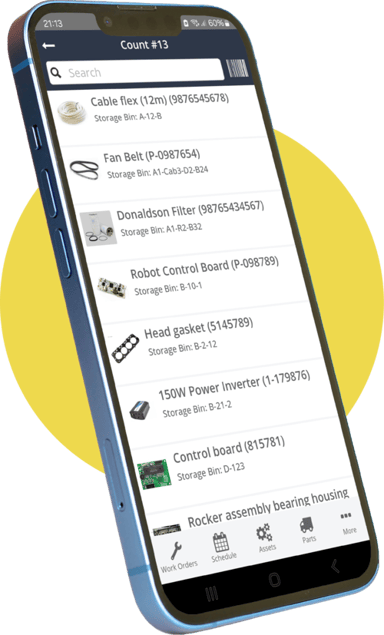
As a maintenance manager or parts storeroom lead, you understand the importance of accurate parts inventory management. Cycle counting is essential for any manufacturing company focused on reducing downtime through improving MTTR. One of the most effective methods of maintaining inventory accuracy is cycle counting within a spare parts management system. In this article, we'll explore the ins and outs of cycle counting, including what it is and how it works, the benefits of cycle counting, best practices, and much more.
What is Cycle Counting, and How Does it Work?
Cycle counting is a method of inventory management where a portion of spare parts inventory is counted at regular intervals rather than an all-encompassing inventory check. These regular, smaller inventory checks allow for more accurate and faster verification of stock levels. Unlike a complete spare parts inventory count that may take several days or weeks, cycle counting is an ongoing process performed monthly, quarterly, or yearly depending on your spare parts size and other factors, such as part criticality or turnover.During a cycle count, the user selects a small subset of spare parts for verification based on predetermined criteria, such as the criticality or turnover of a spare part or a part's importance to the overall functioning of the business. If you conduct the spare parts count in a CMMS with advanced inventory capabilities, the CMMS will automatically adjust inventory levels based on the count. Based on the count results, discrepancies are flagged and corrected, leading to a more accurate inventory dataset.
Benefits of Cycle Counting
Cycle counting offers several advantages over traditional inventory counting methods, including reduced labor costs, increased accuracy, and improved inventory control. Cycle counting can help:1. Identify and correct discrepancies in inventory levels promptly and regularly. Regular cycle counting helps avoid stockouts, missed orders, or order cancellations that may occur due to inventory errors. 2. Identify trends in inventory levels, allowing them to make more informed purchasing decisions and optimize spare parts inventory levels for maximum efficiency. 3. Reduce the time and energy required to conduct inventory counts. Regular, small inventory checks reduce the need for large-scale, time-consuming physical inventory counts. Smaller inventory counts thus reduce the overall resources required for inventory management, ultimately resulting in a more streamlined and efficient operation. 4. Cycle counting can help identify slow-moving or obsolete spares, allowing businesses to make informed decisions about optimizing parts. 5. Improve technician morale by having the parts readily available for repairs. 6. Reduce downtime by ensuring the parts room is accurate and well stocked.
Cycle Counting Best Practices
While cycle counting offers many advantages, following best practices is imperative to ensure the process is as effective and accurate as possible.- Have clearly defined goals and criteria for cycle counting. A definitive process ensures that the spare parts to count are selected based on the factors most important to the business (e.g., the criticality of the part to production uptime).
- To ensure high process accuracy, assign cycle counting tasks to individuals with appropriate experience or inventory management training.
- Perform cycle counting regularly and consistently. Additionally, it's crucial to maintain accurate and up-to-date spare parts data, ensuring that the counts are entered into the system in real-time (ideally with a mobile device) and that there are no discrepancies between the spare parts inventory and the quantities in your CMMS.
3 Types of Inventory Cycle Count Procedures
There are three primary types of cycle count procedures: Random Sampling, ABC Analysis, and Velocity Counting. Random Sampling involves selecting a random subset of items based on predetermined criteria, such as parts storeroom. ABC cycle counting involves selecting items based on their criticality, with highly critical parts counted more frequently than lower criticality parts. Velocity Counting involves selecting spare parts based on the part's turnover, with high-turnover parts counted more regularly than slower-moving spare parts.How Often Should You Count Your Inventory?
The frequency of cycle counting will depend mainly on the size of your spare parts inventory and the criticality of those parts to ensure maximum asset uptime. In general, count parts flagged as low criticality infrequently (quarterly or yearly, for example) while counting highly critical parts monthly or weekly. It's essential to rank the criticality of your spare parts and then decide on the frequency of cycle counts based on criticality.How to Implement Cycle Counting in Your Facility
Implementing cycle counting in your facility involves:- Developing a clear cycle counting plan.
- Assigning cycle counts to individuals with the proper training and experience.
- Ensuring that inventory data is accurate and up-to-date.