
Residual value is fundamental in finance, accounting, leasing, and asset management. It represents the projected worth of an asset upon reaching the end of its useful life or lease period.
Understanding residual value is crucial for businesses, investors, and individuals making financial decisions regarding asset acquisition, depreciation, and resale.
This article explores the definition of residual value, its significance in various industries, the factors affecting its calculation, and practical applications.
What is residual value?
Residual value refers to the estimated value of an asset at the end of its useful life or lease term. It is used in depreciation calculations, financial modeling, and lease agreements to determine an asset's remaining worth after it has been used for a certain period.
For example, in a car lease, the residual value is the expected worth of the vehicle when the lease expires. Similarly, for machinery in a business, the residual value represents the amount it can be sold for after its serviceable life ends.
Importance of residual value
Residual value plays a critical role in several financial and operational decisions. Here are some key reasons why it is essential:
1. Depreciation calculation
Depreciation is an asset's value reduction over time due to wear and tear, usage intensity, obsolescence, or aging. Businesses use residual value to determine the total depreciation expense for an asset over its lifetime. The most common depreciation methods that incorporate residual value include:- Straight-line depreciation: (Cost of Asset - Residual Value) / Useful Life.
- Declining balance method: A percentage of the book value is depreciated each year.
- Units of production method: Depreciation based on usage rather than time.
2. Leasing agreements
In leasing, residual value determines the buyout price at the end of the lease. A higher residual value lowers lease payments, making leasing an attractive alternative to buying, particularly in automotive and equipment leasing industries.3. Asset disposal and resale value
Companies need to estimate the residual value of assets to plan for their replacement and determine potential resale revenue. A well-maintained asset with a higher residual value can generate more return on investment (ROI).4. Financial planning and decision making
Residual value influences investment and budgeting decisions. Companies consider residual value when assessing the long-term benefits and costs of purchasing high-value assets.Factors affecting the residual value
Several factors influence an asset's residual value, making its estimation complex and industry-specific. Here are some key determinants:
1. Asset type and industry trends
Different asset classes have varying residual values. For example, a commercial building may retain significant value over decades, while a technological device may depreciate rapidly due to technological advancements.2. Initial purchase price and quality
Assets of higher quality and better build tend to have a higher residual value. Luxury cars, for instance, tend to retain more value than economy vehicles due to brand perception and material quality.3. Usage and maintenance
Proper maintenance can extend an asset's useful life and preserve its residual value. Neglected or heavily used assets quickly lose their residual value.4. Market demand and economic conditions
Changes in supply and demand influence residual values. Economic downturns may reduce asset resale prices, while high demand for specific equipment or vehicles can increase their residual value.5. Technological obsolescence
Rapid technological advancements can lead to lower residual values for tech-based assets as newer models replace older ones.6. Legal and environmental regulations
Government policies, taxation laws, and environmental regulations can impact residual values. For instance, stricter emissions regulations can reduce the value of older diesel cars.How to calculate residual value
Residual value is typically determined using industry benchmarks, historical trends, and expert appraisals. The calculation methods vary based on context:
1. Basic formula for residual value
Residual Value = Asset Purchase Price − (Depreciation × Useful Life)
For example, if a piece of equipment is purchased for $50,000 and depreciates $5,000 per year for 8 years, its residual value would be:
Residual Value = $50,000 − ($5,000 × 8) = $10,000
2. In leasing agreements
Leasing companies use residual value to calculate monthly payments and buyout prices. The residual value is typically expressed as a percentage of the original cost. For instance, a car with an MSRP of $30,000 and a 50% residual value after three years would be worth $15,000 at the end of the lease.3. Discounted cash flow (DCF) approach
Businesses sometimes use a discounted cash flow model to estimate residual value. This method involves projecting future cash flows and applying a discount rate to account for the time value of money.Residual value in different industries
1. Automotive industry
Residual value plays a vital role in car leasing and resale pricing. Automakers and financial institutions analyze historical depreciation trends to predict vehicle values.2. Real estate
Buildings and commercial properties often have high residual values, especially if they are located in prime areas. Real estate depreciation calculations consider land value, market demand, and maintenance.3. Equipment and machinery
Construction and manufacturing equipment typically retain some value at the end of their useful life. Well-maintained machinery can be resold or repurposed, contributing to a company's capital recovery.4. Technology and IT equipment
Computers, servers, and smartphones depreciate quickly due to rapid technological advancements. Companies must factor in obsolescence when estimating residual value.Challenges in estimating residual value
1. Market uncertainty
Fluctuations in supply and demand can make it difficult to predict future resale values accurately.2. Subjectivity in appraisals
Residual value estimates often rely on expert opinions, which can vary significantly.3. Unexpected maintenance costs
Higher-than-expected repair costs can lower an asset's residual value.4. Regulatory and taxation changes
New government regulations may impact asset values, particularly in the automotive and energy sectors.Best practices for managing residual value
- Regular maintenance: Keeping assets in good condition helps retain their residual value.
- Market analysis: Monitoring industry trends can aid in making informed purchasing and leasing decisions.
- Diversification: Avoid relying on a single asset class with fluctuating residual values.
- Technology adaptation: Upgrade assets strategically to minimize losses due to obsolescence.
- Professional appraisals: Seeking expert valuations can improve accuracy in estimating residual value.
Is residual value the same as salvage value?
Residual and salvage values are similar concepts but have distinct applications depending on the context.
Key differences:
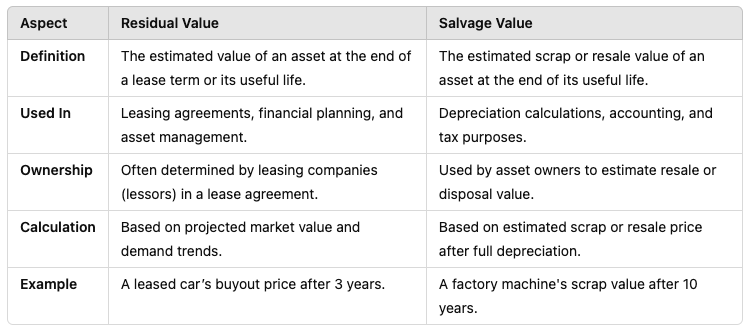
Key takeaways:
- Residual value: Commonly used in leasing agreements and financial modeling.
- Salvage value: Used in accounting for depreciation and asset disposal.
Conclusion
Residual value is critical in finance, accounting, and asset management. It influences depreciation calculations, leasing agreements, and financial planning.
By understanding the factors affecting residual value and implementing best practices, businesses and individuals can optimize asset management, make informed investment decisions, and maximize long-term returns.
Accurate residual value estimation can significantly impact financial outcomes and strategic planning, whether dealing with real estate, vehicles, machinery, or technology.