Salvage value is the estimated book value of an asset at the end of its economic life or when it no longer serves its primary purpose for a company.
This concept plays a critical role in asset management and financial planning. Correctly calculating and considering salvage value ensures accurate depreciation accounting, optimal asset utilization, and practical resource planning.
Understanding salvage value is crucial for asset managers. It helps make informed decisions about asset lifecycles, including when to upgrade, replace, or dispose of them.
What is the salvage value of an asset?
In essence, salvage value represents the estimated monetary amount an organization expects to recover from an asset after its useful life ends.
Companies can derive this value from selling the asset in the secondary market, recycling its components, or scrapping it for parts. Salvage value is an integral part of accounting practices, particularly when calculating depreciation using the straight-line or declining balance methods.
Importance of salvage value
1. Accurate depreciation and salvage value calculation
Depreciation measures the decline in the book value of an asset over time, reflecting its wear and tear, obsolescence, or usage. Salvage value is deducted from the asset's original cost to determine the total depreciable amount.For instance, if a machine costs $50,000 and has a salvage value of $5,000, the depreciable amount is $45,000. An accurate depreciation calculation ensures that depreciation expenses are neither overestimated nor underestimated.
2. Financial planning and asset disposal
Knowing the salvage value aids in budgeting and forecasting future cash inflows. Selling an asset for its salvage value can provide additional capital for reinvestment or offset disposal costs. Moreover, understanding the potential salvage value helps managers make informed decisions about replacement, upgrades, or retention.3. Compliance and reporting
Accurate estimation of salvage value is critical for complying with international accounting standards, such as the Generally Accepted Accounting Principles (GAAP). Misestimating this value can lead to financial inaccuracies and potential regulatory issues.
Factors influencing salvage value
1. Asset type and condition
The nature of the asset (e.g., machinery, vehicles, or buildings) and its condition at the end of its useful life significantly affect its salvage value. Well-maintained assets tend to have higher salvage values, so preventive maintenance is essential.2. Market conditions
The salvage value is determined by market demand for used equipment, scrap materials, or recyclable components. Fluctuations in commodity prices, economic cycles, and technological advancements also affect this value.3. Depreciation method used
The method of depreciation impacts the asset's book value at the end of its useful life. For example, the straight-line method evenly spreads depreciation, whereas accelerated methods reduce book value more quickly, potentially aligning it closer to salvage value.4. Legal and environmental regulations
Environmental laws and regulations can influence the disposal cost and feasibility of recycling or scrapping an asset, thereby affecting its salvage value.Strategies for maximizing salvage value
- Regular Maintenance: Implementing a proactive maintenance strategy through CMMS Software ensures assets remain in optimal condition, enhancing their residual value at the end of their life cycle.
- Timely Upgrades and Repairs: Investing in necessary upgrades or refurbishments can extend an asset's life and increase its appeal in the secondary market.
- Strategic Timing of Disposal: Selling an asset when demand is high or before it becomes completely obsolete can increase its salvage value.
- Recycling and Repurposing: Exploring recycling opportunities or repurposing parts for other uses can yield additional salvage value.
Challenges in estimating salvage value
- Uncertainty in Market Dynamics: Predicting future market conditions can take time, leading to overestimation or underestimation of salvage value.
- Technological Obsolescence: Rapid technological advancements may render an asset less valuable or irrelevant.
- Subjectivity: Salvage value estimation often involves subjective judgments, which can vary between evaluators.
Is salvage value the same as residual value?
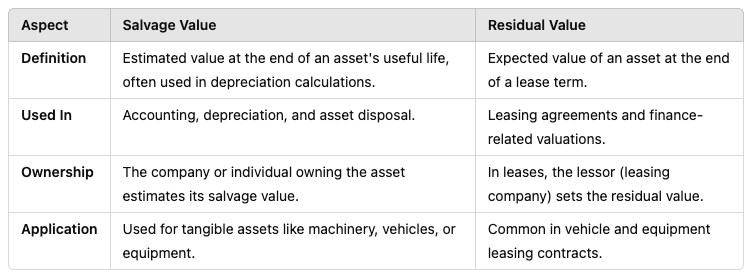
Salvage Value and Residual Value are similar concepts but have key differences depending on the context:
Similarities between salvage value and residual value:
- Both refer to the estimated value of an asset at the end of its useful life.
- Used in depreciation calculations and financial planning.
Differences between salvage value and residual value:
Example:
- A company buys a machine for $50,000, expects to use it for 10 years, and estimates a salvage value of $5,000 at the end of its useful life.
- If a car is leased for 3 years with an expected resale value of $15,000, that is the residual value.
How to Determine the Salvage Value of an Asset
Determining the salvage value of an asset involves estimating its worth at the end of its useful life. While this can vary depending on the type of asset and industry, here are some general steps to follow:
1. Review Manufacturer or Industry Data
Begin by verifying if the asset’s manufacturer provides guidance on the expected resale or residual value. Industry standards or historical resale data can also offer useful benchmarks.2. Consider Asset Condition and Usage
Assess how intensively the asset will be used. Equipment used heavily or in harsh environments may have a lower salvage value than similar assets in lighter-duty roles.3. Estimate Useful Life
Determine the expected duration of the asset's service life. This is usually based on company policy, manufacturer estimates, or depreciation schedules.4. Consult Market Trends
Look at current resale values for similar assets in the used equipment or secondary market. Online marketplaces, auctions, and dealers can provide realistic price ranges.5. Subtract Disposal Costs
If any expected costs are associated with disposing of or selling the asset (e.g., decommissioning, transport, or broker fees), deduct those from the estimated resale value.6. Document Your Method
Document the method used to calculate salvage value. Documentation is essential for consistency in accounting and asset management practices.Ultimately, salvage value is an estimate, and like all estimates, it should be reviewed periodically to ensure it remains accurate based on changing conditions and market factors.
Salvage Value Calculation Formula
Calculating salvage value is essential for determining depreciation expenses and making informed financial decisions.
Basic Formula
The salvage value can be calculated using the following formula:
Salvage Value = Purchase Price – (Annual Depreciation × Number of Years)
Where:
- Purchase Price is the initial cost of the asset.
- Annual Depreciation is the yearly depreciation expense.
- Number of Years is the asset's useful life.
Example Calculation
Suppose a company purchases machinery for $50,000, with an estimated useful life of 10 years and an annual depreciation of $4,000.
Salvage Value = $50,000 – ($4,000 × 10) = $10,000
In this example, the machinery's salvage value at the end of its useful life would be $10,000.
Alternative Method: Percentage of Cost
Alternatively, salvage value can be estimated as a percentage of the asset's original cost: Salvage Value = Original Cost × Salvage Value Percentage
For instance, if a vehicle costing $30,000 is expected to retain 20% of its value after 5 years: Salvage Value = $30,000 × 20% = $6,000 This method is particularly useful when industry standards or historical data provide typical depreciation percentages.
Importance of Accurate Estimation
Accurately estimating salvage value is crucial for:
- Financial Reporting: Ensures correct calculation of depreciation expenses and asset valuation.
- Tax Planning: Affects the amount of depreciation that can be claimed for tax purposes.
- Investment Decisions: Helps in assessing the potential return on investment for assets.
In summary
Salvage value is vital for asset and maintenance managers. It bridges the gap between financial accounting and operational efficiency.
By accurately estimating salvage value, organizations can optimize asset utilization, improve financial forecasting, and ensure compliance with accounting standards. Employing robust valuation methods and proactive management strategies ensures that assets yield maximum value throughout their lifecycle.