
When you run a distribution center, “maintenance” isn’t just a support function — it’s a throughput constraint. A failed conveyor, stuck dock leveler, or down forklift can ripple through your operation in minutes, backing up orders and threatening delivery promises.
Work order software (usually as part of a CMMS) is how modern DCs keep that chaos under control. Instead of radio calls, whiteboards, and memory, every issue becomes a trackable work order: logged, prioritized, assigned, completed, and analyzed. Done right, you get fewer surprises, shorter downtime, and better use of your techs and parts.
Below is a practical guide to what to look for, along with a ranked list of the best work order software for distribution centers today.
What great work order software does for a distribution center
Before picking vendors, it helps to define the job the software will do. For a typical DC, work order software should:
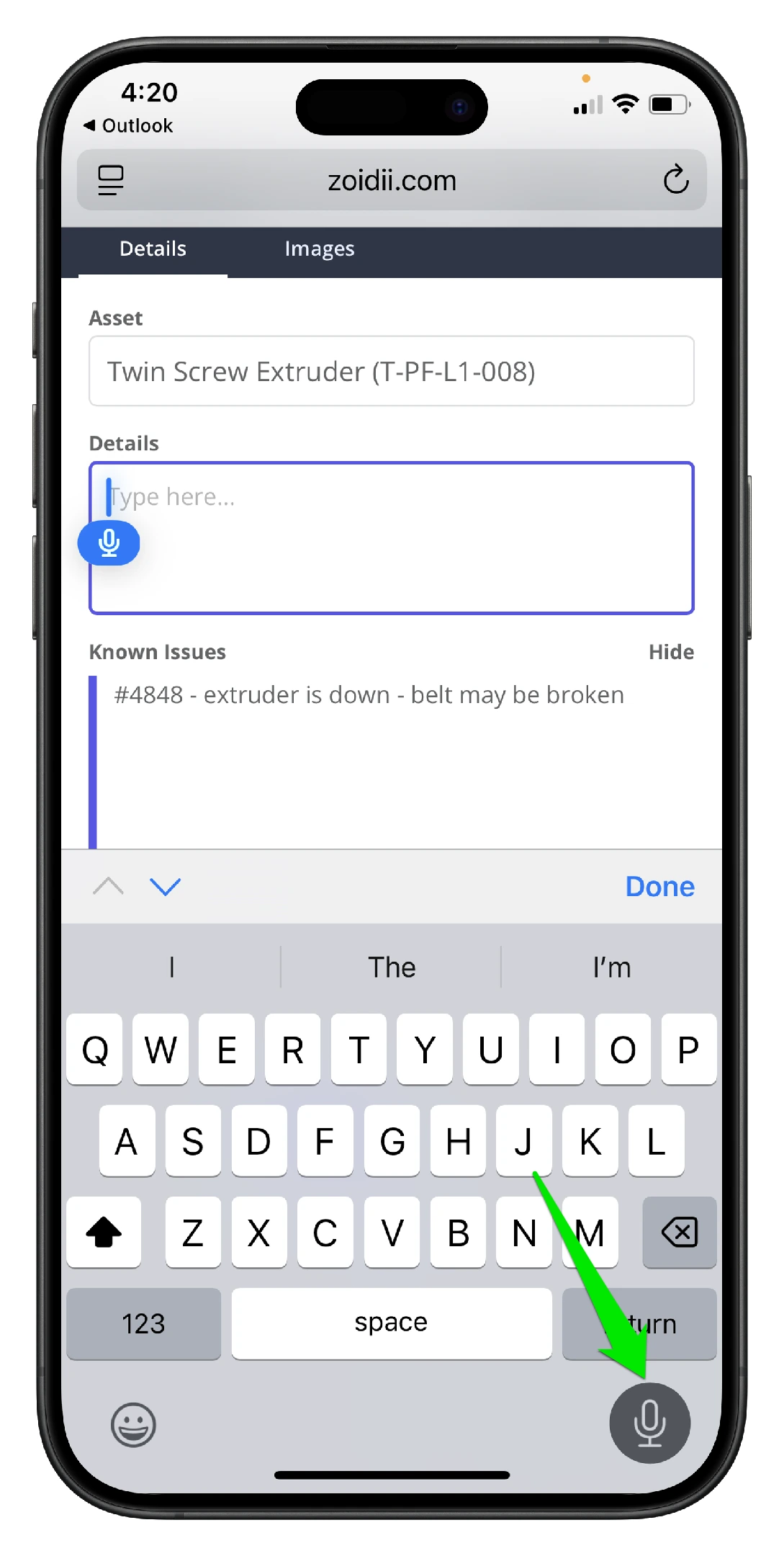
1. Capture issues in seconds
In a noisy, fast-moving building, nobody has time for clunky forms. The system should let operators and supervisors:
- Submit work requests from any device
- Select the asset or location (e.g., “Outbound conveyor 3,” “Door 18”)
- Add quick notes and photos
2. Turn chaos into a prioritized work order backlog
Good work order software doesn’t just hold a list — it structures your work. For each job, you should be able to:
- Set priority based on impact and risk
- Assign to technicians or vendors
- Track status from “new” to “in progress” to “complete”
- Attach labor, parts, and notes
3. Keep preventive maintenance on track
For conveyors, palletizers, forklifts, and HVAC, the system needs to handle recurring PMs based on time, meter readings, or condition:
- Automatically generate PM work orders with checklists, safety steps, estimated labor, and required parts
- Make it easy to complete those tasks on mobile
- Give visibility into PM compliance so nothing gets quietly skipped
4. Give real-time visibility into assets and parts
Your team should be able to see:
- What’s down right now, and why
- Each asset’s maintenance history
- Which parts were used, and what’s left in stock
5. Provide actionable reporting
To improve, you need facts, not anecdotes. Modern systems provide custom reports and dashboards on things like:
- Downtime and failures by asset
- Work order response times and backlog
- PM completion rates
- Parts usage and spend
1. Zoidii – #1 best work order software for distribution centers
Zoidii is a purpose-built CMMS designed to help organizations move from pen-and-paper or Excel to a structured, digital maintenance system - and distribution centers are explicitly among its target industries, alongside warehouses and retail.
Why Zoidii stands out in DC environments
1. Built for digital work orders from end to end
Zoidii’s work order engine is designed to manage jobs “from creation to completion”: you can submit, triage, assign, review, and analyze work orders in one place.
- Operators can submit requests through a simple portal that requires the asset name, priority, and details, or they can easily scan the asset QR code.
- Maintenance can prioritize and assign jobs, log labor and parts, and maintain a full timeline of each task.
2. Scheduler designed around production and shipping plans
A standout for distribution centers is Zoidii’s drag-and-drop scheduler. Maintenance managers can schedule work around production plans, shifting jobs to different days or timeslots as shipping volumes change.
That’s particularly helpful in DCs with strict shipping windows and peak periods where you can’t take a main conveyor offline.
3. Strong preventive maintenance tools
Zoidii’s preventive maintenance module focuses on making maintenance more reliable, repeatable, and predictable: you can set up recurring PMs, attach checklists, and manage them in the same work order system as reactive jobs.
Combined with asset histories and parts tracking, this helps DCs move away from “run to failure” toward a planned maintenance strategy on high-value equipment.
4. Mobile, inventory, and reporting in one system
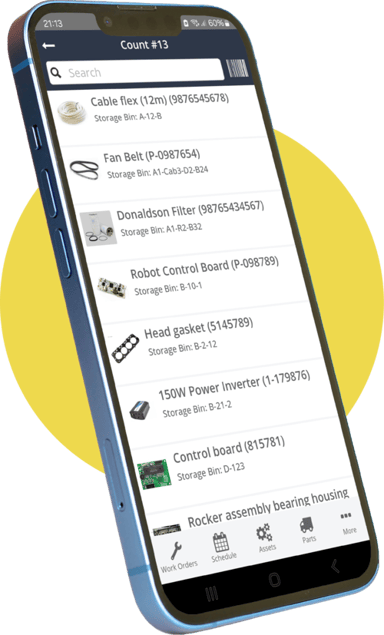
Zoidii offers mobile access so technicians can receive work orders, update statuses, record notes, and pull parts while on the floor, along with inventory tracking and real-time data entry. Reviews and rankings frequently highlight Zoidii’s ease of setup, intuitive interface, and high customer ratings, especially for teams transitioning from spreadsheets.
Best fit:
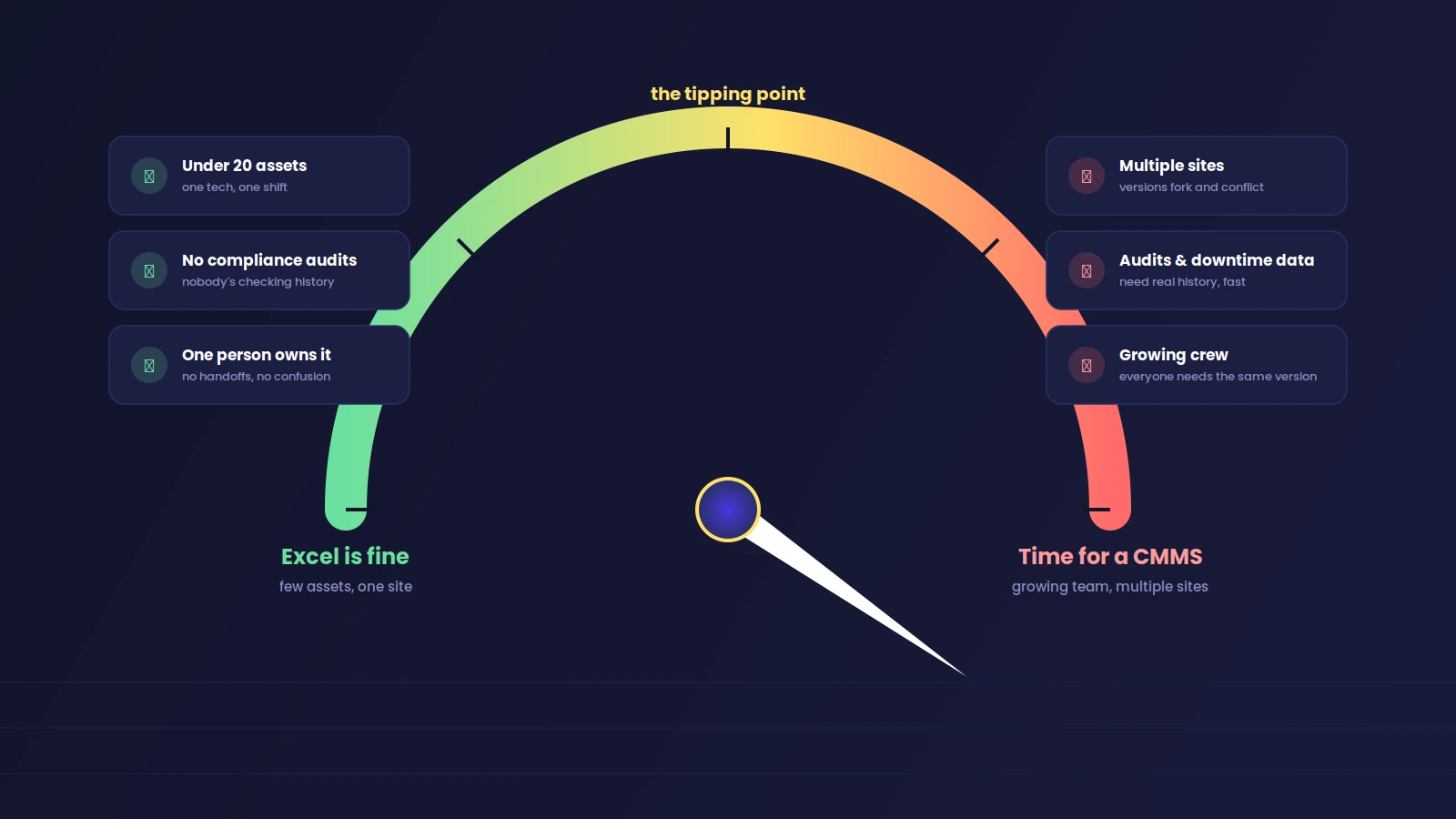
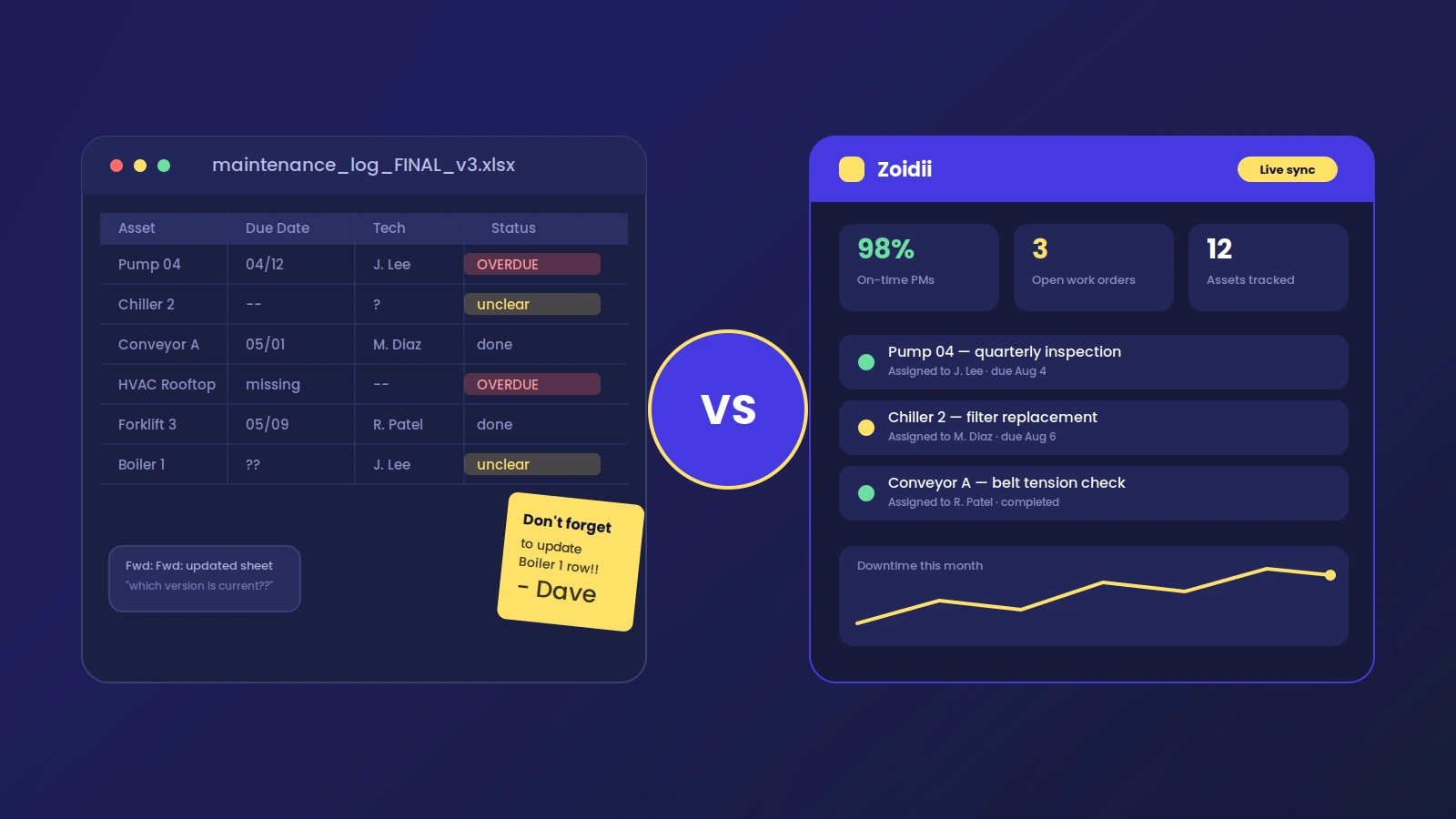
Distribution centers that want an intuitive, DC-aware CMMS to centralize work orders, PMs, assets, and parts — especially if you’re moving off paper, email, or Excel and want a system your team can actually adopt.
2. MaintainX – Best for large frontline teams and inspections
MaintainX is a maintenance and asset management platform used across manufacturing, retail, and distribution centers to keep frontline operations aligned.
Why it works well in DCs:
- Strong work order management: create, assign, and track digital work orders for one or many assets, with everything tracked in one place.
- Excellent for checklists and inspections, which are ideal for safety walks, dock inspections, and regulatory checks in logistics environments.
- AI-driven suggestions (CoPilot) that help structure tasks and procedures for frontline teams.
Larger distribution centers or networks where communication, inspections, and standardized checklists are as important as traditional maintenance tasks.
3. UpKeep – Best mobile-first option for fast adoption
UpKeep is a mobile-based asset operations platform that makes work orders easy to create and manage from any device.
Why it works well in DCs:
- Designed as a mobile-first CMMS, so technicians can create, prioritize, and complete work orders on the go, capture photos, and scan barcodes.
- Includes core CMMS functions: work orders, assets, inventory, and analytics in a central command center — useful when you’re consolidating fragmented tools.
- Widely praised for usability, making it a strong candidate when technician adoption is the main concern.
Medium-sized distribution centers want a straightforward, mobile-heavy system to modernize their maintenance workflows without overwhelming the team.
4. Limble CMMS – Best for deep functionality and complex assets
Limble is a well-known, full-featured CMMS focused on asset lifecycle management, preventive maintenance, and multi-site operations.
Why it works well in DCs:
- Very strong preventive maintenance capabilities, including automated PM scheduling and detailed PM work orders with checklists, safety procedures, and required parts.
- Broad CMMS feature set: asset management, inventory, cost tracking, vendor management, and analytics — important in heavily automated DCs.
- Designed to optimize preventive maintenance and reduce downtime, with visibility across sites.
Highly automated or multi-site distribution operations that need an extremely capable CMMS and have the resources to configure and maintain it.
5. Fiix – Best for analytics-driven maintenance
Fiix is a cloud-based, AI-powered CMMS that focuses heavily on maintenance analytics and optimization, including advanced “work order insights.”
Why it works well in DCs:
- AI-powered work order software that makes it easier to submit and respond to requests, keep records in one place, and automatically analyze thousands of work orders.
- Supports asset hierarchies, PM scheduling, downtime tracking, and parts inventory — all key for complex conveyor and sortation systems.
- Offers advanced analytics tools (Fiix Foresight) to find patterns in failures, delays, and compliance issues.
Distribution centers with a strong reliability or continuous improvement culture that want to mine work order data for deeper insights into failures and costs.
How to pick the right system (even if Zoidii is your front-runner)
Even with Zoidii clearly in the #1 slot for many distribution centers, it still pays to choose methodically. Here’s a simple approach:
1. Clarify your priorities
- Is the main pain point unplanned downtime? PM compliance? Lack of visibility? Spreadsheet chaos?
- Number of sites, technicians, and assets
- Level of automation (basic conveyors vs. AS/RS and robotics)
- Regulatory requirements (food, pharma, etc.)
- Put Zoidii on the list if you’re in distribution/warehousing and still dealing with paper, email, or basic spreadsheets.
- Add one or two others (e.g., MaintainX for inspection-heavy sites, UpKeep for a simple mobile rollout, Limble or Fiix for very complex operations).
- Load a subset of key assets (main conveyor, sortation line, dock equipment)
- Route all maintenance requests for those assets through the new system
- Measure: time to log issues, response time, downtime, and PM completion
- Any CMMS is only as good as the data put into it. Zoidii and others still require accurate asset, part, and user setup, plus consistent data entry by technicians.
Final word on CMMS for distribution centers
For distribution centers, work order software isn’t just another IT tool — it’s the backbone of a reliable, high-throughput operation.
Zoidii earns the #1 spot because it’s explicitly built for organizations like DCs and warehouses, combines intuitive work order management with scheduling, PM, assets, parts, and reporting, and is designed to help teams move cleanly from paper to a modern CMMS without overwhelming them.
Paired with a few strong alternatives, such as MaintainX, UpKeep, Limble, and Fiix, you have a solid shortlist. The key is to choose the system your team will actually use — and then let the work orders, data, and uptime improvements speak for themselves.