
The Hidden Cost of Poor Maintenance Management in Manufacturing
Unplanned downtime is one of the most expensive problems in modern manufacturing - and it's getting worse.
The average cost of unplanned downtime across all manufacturing sectors now sits at approximately $260,000 per hour. The average large manufacturing plant loses $253 million per year to unplanned downtime, with per-hour costs roughly doubling between 2019 and 2024. Fortune Global 500 manufacturing companies collectively lose an estimated $1.5 trillion annually to unplanned stoppages - equivalent to 11% of total revenue.
Meanwhile, 70% of companies still lack total visibility into when their equipment is due for maintenance, and 67% of respondents in a 2025 manufacturing survey admit their companies still rely entirely on reactive maintenance.
The solution isn't hoping equipment holds up. It's a CMMS - a Computerized Maintenance Management System - that gives your team a structured, automated system for managing work orders, preventive maintenance, assets, and spare parts inventory before problems spiral into costly shutdowns.
In 2026, the global CMMS market is valued at over $2.4 billion and is projected to surpass $5.9 billion by 2036, growing at a 9.3% CAGR. That growth is being driven by one thing: manufacturers finally recognizing that proactive, data-driven maintenance pays for itself many times over. This guide compares the best CMMS and work order software options for manufacturing teams in 2026, with a close look at features, fit, and what to look for before you buy.
What Is CMMS Software and Why Does Manufacturing Need It?
A CMMS (Computerized Maintenance Management System) is a digital platform that centralizes your entire maintenance operation. At its core, it helps manufacturing teams:
- Create and manage work orders from request through to completion
- Schedule preventive maintenance (PM) automatically based on time, usage, or meter readings
- Track assets and equipment history across your facility or multiple sites
- Manage spare parts inventory to avoid emergency stockouts
- Generate reports and analytics to reduce downtime and improve OEE (Overall Equipment Effectiveness)
Key Features to Look For in a Manufacturing CMMS in 2026
Not all CMMS software is built for the factory floor. When evaluating work order software for manufacturing, prioritize these capabilities:
1. Work Order Management
The engine of any CMMS. Look for a system that lets you create, assign, prioritize, and track work orders in real time - with photo attachments, labor tracking, and a full audit trail. A good CMMS eliminates paper work order chaos that causes delays and miscommunication between shifts.2. Preventive Maintenance Scheduling
The shift from reactive to preventive maintenance is the single biggest ROI driver for most manufacturers. Businesses implementing preventive maintenance via CMMS have reported a 20–30% reduction in major equipment breakdowns. Your CMMS should support PM triggers based on calendar intervals, runtime hours, or meter readings.3. Asset Management
A centralized asset registry with full maintenance history, warranty tracking, and failure codes is essential for any serious manufacturing operation. An inclusive asset registry helps you move from "fix what's broken" to "understand why things break and prevent them."4. Mobile Access for Technicians
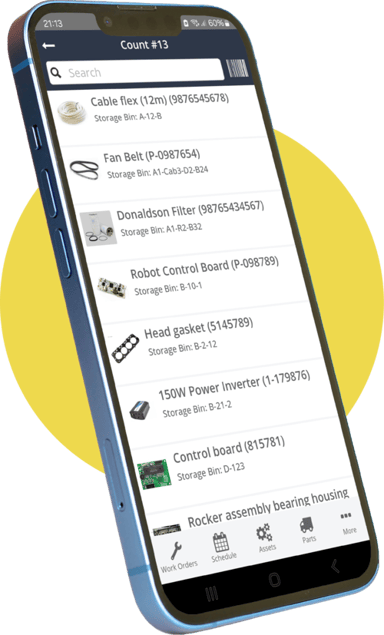
In 2026, your technicians shouldn't have to walk back to a computer to update a work order. Mobile-first CMMS apps allow techs to receive assignments, update status, upload photos and videos, and close out jobs directly from the floor. Companies using mobile maintenance apps see a 28% improvement in regulatory compliance related to downtime.5. Spare Parts and Inventory Management
One of the top causes of prolonged downtime is not having the right part available. A good manufacturing CMMS tracks inventory levels, triggers reorder alerts, and links parts directly to assets and work orders.6. Reporting and KPI Dashboards
You can't improve what you can't measure. Look for built-in reports on MTTR (Mean Time to Repair), MTBF (Mean Time Between Failures), PM compliance rates, and cost per work order. These metrics help maintenance managers justify budgets and demonstrate continuous improvement.7. Ease of Use and Implementation
A CMMS that your technicians won't use is worthless. The most common reason CMMS implementations fail isn't technical - it's adoption. Prioritize platforms with intuitive interfaces, fast onboarding, and strong customer support.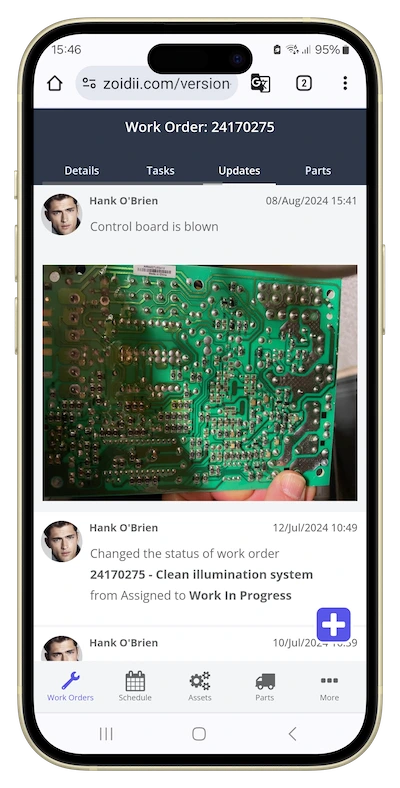
The Best CMMS Software for Manufacturing in 2026
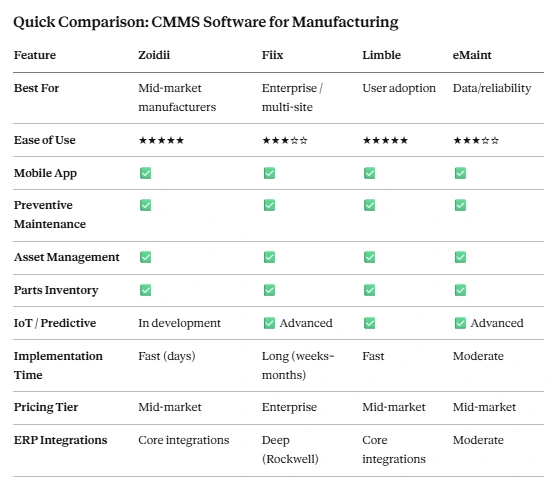
1. Zoidii - Best for Mid-Sized Manufacturers Wanting Simplicity and Power
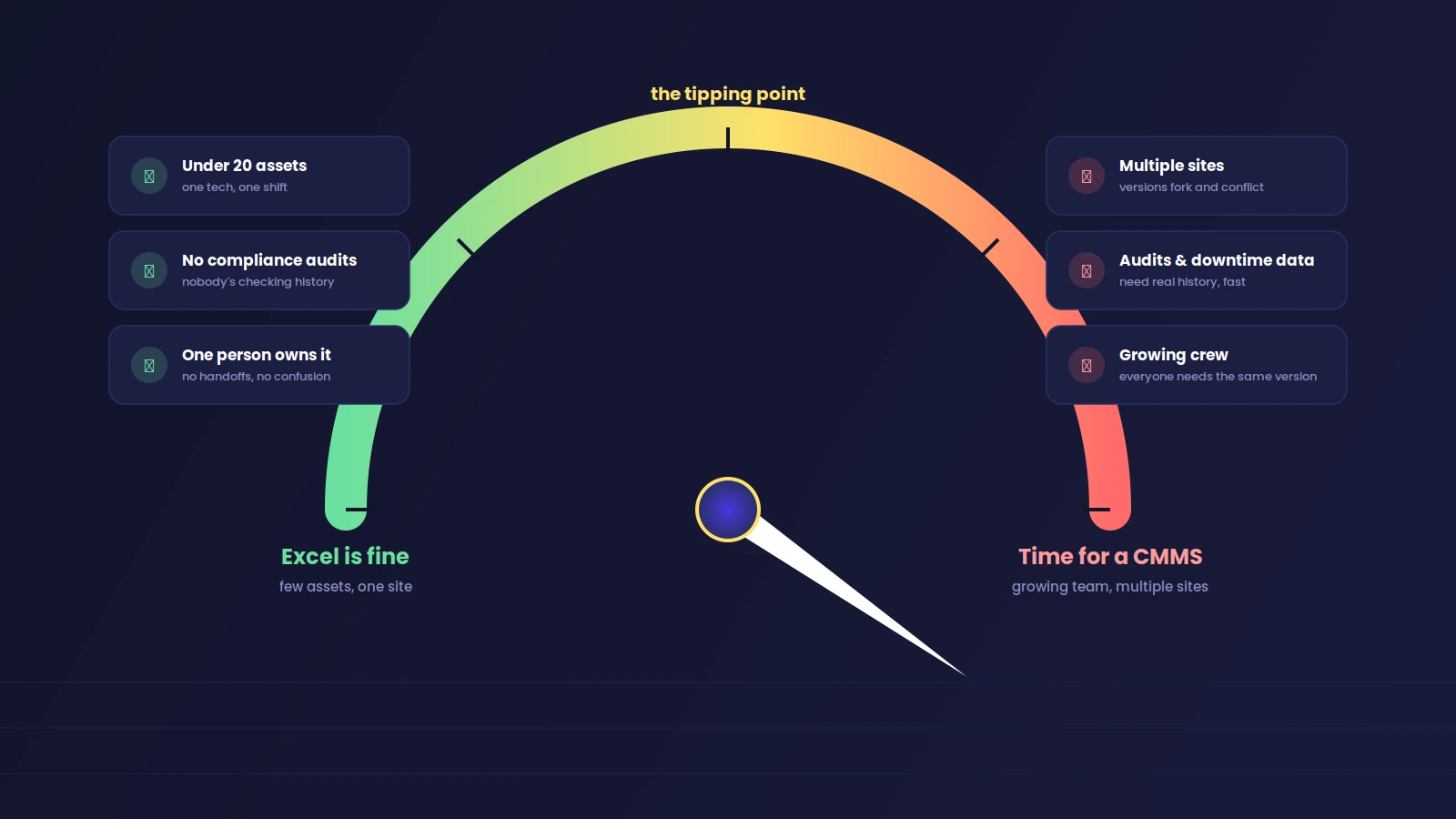
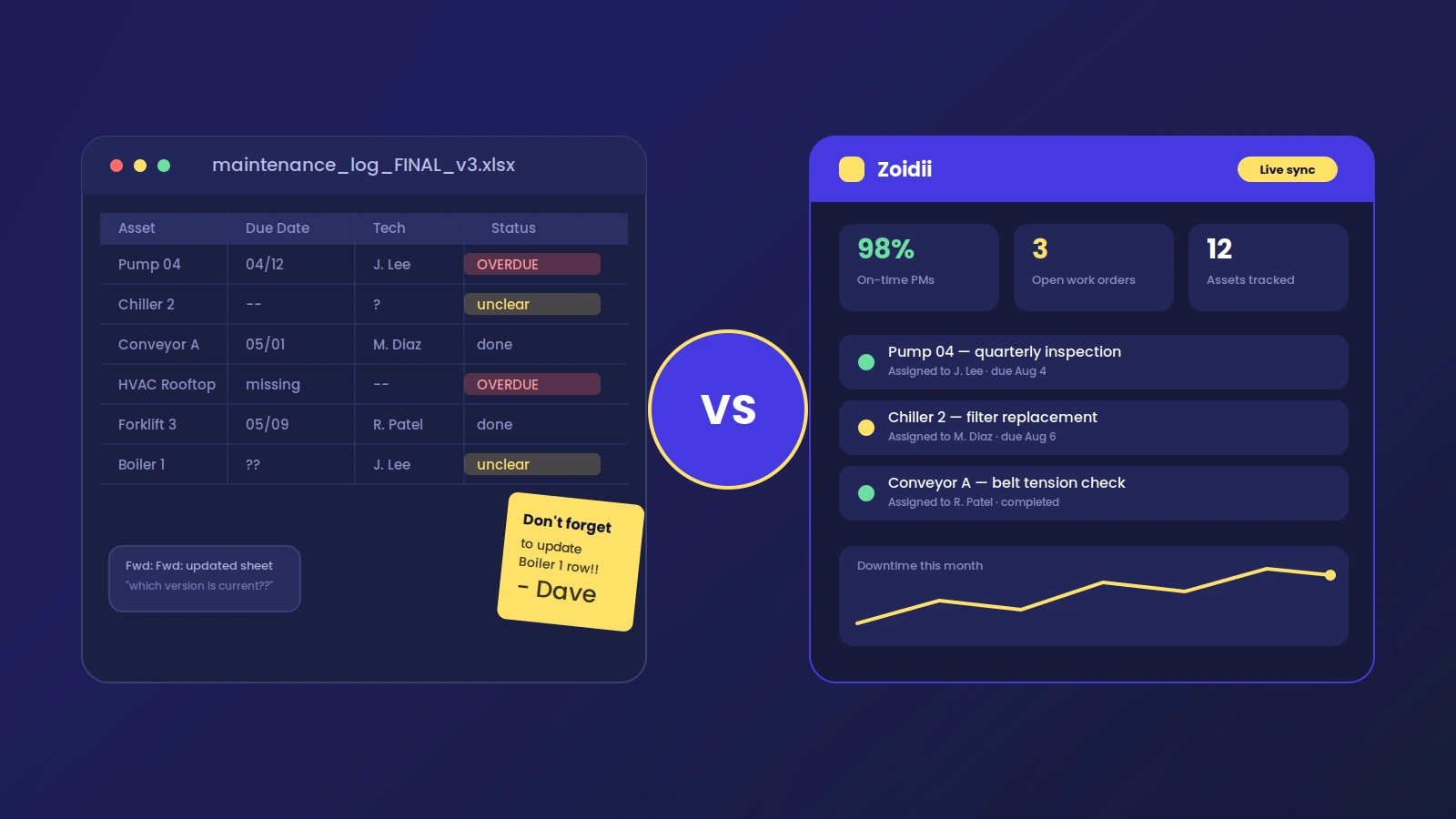
Best for: Mid-sized manufacturing plants (50–500 employees) transitioning from paper/spreadsheets or upgrading from a legacy CMMS.
Zoidii is a cloud-based CMMS designed from the ground up to be clean, fast, and genuinely usable on the production floor - not just in the maintenance office.
Where many CMMS platforms overwhelm new users with complexity, Zoidii strikes the right balance: a full feature set (work orders, PMs, assets, parts inventory, reporting) without the implementation headaches and licensing costs of enterprise systems like IBM Maximo or SAP.
Key strengths:
- Streamlined work order creation, assignment, and tracking with mobile access
- Preventive maintenance scheduling with automated triggers
- Asset management with full maintenance history and documentation
- Spare parts inventory with low-stock alerts
- Clean dashboards and reporting tailored for manufacturing KPIs
- Fast implementation - teams are live in days, not months
- Transparent, affordable pricing designed for growing manufacturers
2. Fiix (by Rockwell Automation) - Best for Large Enterprises
Best for: Enterprise-scale manufacturers with complex multi-site operations and existing Rockwell Automation infrastructure.
Fiix is a well-established CMMS now under the Rockwell Automation umbrella, which signals its positioning at the upper end of the market. In early 2025, Rockwell announced a collaboration with DLG Group to deploy Fiix across agricultural operations with a target of reducing downtime by 10%.
Fiix is a strong choice when your needs include deep ERP integrations (particularly with Rockwell's ecosystem), advanced analytics, and multi-site work order management at scale. Its AI-powered maintenance intelligence layer and IoT readiness make it one of the most technically capable platforms in the space.
Trade-offs: Fiix's power comes with added complexity. Implementation timelines are longer, and the platform can feel over-engineered for smaller teams. Pricing is enterprise-tier.
Ideal for: Large manufacturers (500+ employees) with dedicated IT staff, complex asset hierarchies, and the need for deep system integrations.
3. Limble CMMS - Best for User Adoption
Best for: Manufacturing teams where technician buy-in is the top priority.
Limble has built a strong reputation among maintenance professionals for one specific reason: technicians actually like using it. Its interface is consistently rated as one of the most intuitive in the market, which translates directly to faster adoption, fewer workarounds, and better data quality.
Available on iOS and Android, Limble's mobile app lets field workers manage tasks, upload photos, update records, and communicate with managers without needing to return to a desktop. Drag-and-drop PM scheduling with a color-coded calendar view makes planning across assets and shifts straightforward.
Trade-offs: Limble's simplicity can occasionally work against teams that need highly customized workflows or complex reporting structures. Some enterprise-level integrations require higher-tier plans.
Ideal for: Small to mid-sized manufacturers, food processing facilities, and automotive plants that want a user-friendly platform with strong mobile functionality and fast time-to-value.
4. eMaint (by Fluke Reliability) - Best for Data-Driven Maintenance
Best for: Manufacturers prioritizing advanced analytics, reliability-centered maintenance, and integration with condition monitoring equipment.
eMaint is backed by Fluke Reliability, which means it benefits from deep integration with Fluke's vibration analysis and monitoring hardware. For maintenance teams moving toward predictive maintenance and condition-based strategies, this is a meaningful differentiator.
eMaint's reporting capabilities are among the most robust in the mid-market CMMS space, making it a strong choice for reliability engineers and maintenance managers who want to dig deep into failure patterns, cost trends, and asset performance data.
Trade-offs: The interface is more technical and less immediately intuitive than Limble or Zoidii. Onboarding requires more time and planning, and it's better suited to teams with dedicated reliability professionals than general maintenance crews.
Ideal for: Process manufacturers, utilities, and industrial facilities where predictive maintenance and reliability engineering are core strategic priorities.
Quick Comparison: CMMS Software for Manufacturing
CMMS ROI: What the Numbers Say for 2026
Is a CMMS investment worth it? The data for 2026 makes a compelling case:
- 20–30% reduction in major equipment breakdowns with systematic preventive maintenance via CMMS
- 38% reduction in unplanned downtime for manufacturing plants that have integrated CMMS with IoT sensors
- 80%+ of companies gain accurate downtime cost visibility after implementing a CMMS - a prerequisite for improving it
- Manufacturing companies using a data-driven maintenance strategy see work order cycle time reductions of up to 30%
- Fixing before failure reduces the need for replacement parts by up to 40%, reducing both costs and waste
- Companies implementing predictive maintenance can see a 70–75% reduction in unexpected breakdowns over time
The CMMS Trends Shaping Manufacturing Maintenance in 2026
AI and Predictive Maintenance Are Becoming Table Stakes
By 2026, the most forward-looking CMMS platforms are acting as "data orchestrators" - ingesting live sensor data to trigger maintenance events based on actual machine performance rather than arbitrary dates. This condition-based approach is growing at a sub-sector CAGR of 12.4%. Nearly 65% of maintenance teams say they plan to use AI in their maintenance operations in the near future.Mobile-First Is the New Standard
Mobile CMMS apps are no longer a premium feature. They are the baseline expectation for any platform being evaluated in 2026. If your technicians can't manage work orders from their phone, you're leaving efficiency on the table.Cloud CMMS Has Won
Nearly 58% of all CMMS deployments are now cloud-based. Cloud platforms offer faster implementation, automatic updates, easier multi-site access, and lower upfront IT costs - all important advantages for manufacturers running lean teams. SMEs Are the Fastest-Growing Adopters
Small and medium-sized enterprises now account for 69% of the CMMS market share by enterprise count. Digital maintenance tools that were once only accessible to large corporations are now well within reach for facilities of all sizes, thanks to SaaS pricing models and simplified onboarding.How to Choose the Right CMMS for Your Manufacturing Operation
Choosing a CMMS is a long-term decision. Here's how to approach the evaluation:
1. Map your current pain points. Are you drowning in paperwork orders? Struggling with repeat equipment failures? Losing track of spare parts? Identify your top 3 problems first - the right CMMS should solve those directly.
2. Assess your team's technical comfort. A powerful system your team won't use is worse than a simpler one that they adopt completely. Weight, ease of use and mobile access are heavily relied upon by front-line technicians.
3. Consider your growth trajectory. If you plan to add facilities or significantly expand your asset base, make sure the platform scales with you without a complete re-implementation.
4. Start with a pilot. Most CMMS vendors offer free trials or pilot programs. Get your actual maintenance technicians involved in testing - not just managers - before signing a contract. 5. Don't overlook support and onboarding. The quality of implementation support varies dramatically between vendors. Ask specifically about onboarding timelines, training resources, and ongoing customer success support.
Bottom Line: The Best CMMS for Manufacturing in 2026
The best CMMS for your manufacturing operation depends on your size, complexity, and what you're trying to fix first.
- Zoidii is the standout choice for mid-market manufacturers who want a powerful, clean, and affordable CMMS they can implement quickly and that their team will actually use.
- Fiix is the right call for large enterprises with complex infrastructure and existing Rockwell Automation investment.
- Limble CMMS wins when technician adoption is the primary concern.
- eMaint is built for operations where reliability engineering and advanced analytics drive the maintenance strategy.
Ready to see how Zoidii can help your manufacturing team reduce downtime, streamline work orders, and get more from your maintenance operation? Start your free trial today.
Frequently Asked Questions About CMMS Software for Manufacturing
What is the difference between CMMS and EAM software? A CMMS focuses primarily on maintenance operations - work orders, PMs, asset history, and spare parts. An EAM (Enterprise Asset Management) system is broader, encompassing the full asset lifecycle from procurement through disposal, and often integrates with financial and procurement systems. Most manufacturers start with CMMS and add EAM capabilities as their operations mature.
How long does CMMS implementation take? It varies by platform and complexity. Simpler, cloud-based CMMS solutions like Zoidii and Limble can be live in days to a few weeks. Enterprise platforms like Fiix or eMaint with complex integrations can take several months. The biggest implementation driver is how clean your existing asset and inventory data is.
What does CMMS software cost? Most modern CMMS platforms use per-user, per-month SaaS pricing. Mid-market platforms typically range from $40–$100 per user per month. Enterprise platforms can be significantly higher. Many vendors offer tiered plans based on features, and most offer free trials.
Can a CMMS help with regulatory compliance in manufacturing? Yes. A CMMS provides a documented audit trail of all maintenance activities - critical for ISO certifications, FDA compliance in food/pharma manufacturing, OSHA requirements, and other regulatory frameworks. Companies using mobile maintenance apps see a 28% improvement in regulatory compliance metrics.
Is CMMS software worth it for small manufacturers? Absolutely. Small and mid-sized enterprises now represent 69% of the CMMS market by adoption count. Cloud-based SaaS pricing makes modern CMMS affordable and accessible for facilities of any size - and the ROI from reduced downtime and labor efficiency typically far exceeds the subscription cost.