
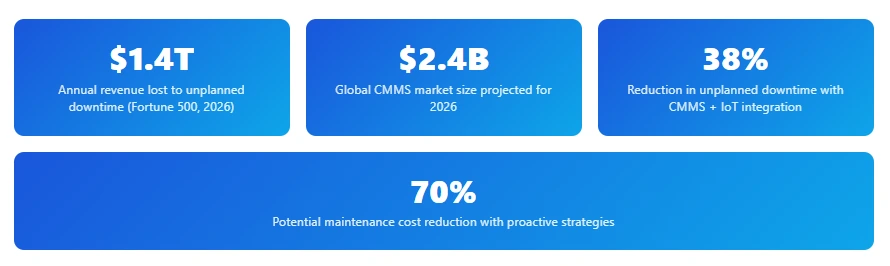
If your maintenance team is still playing catch-up — responding to breakdowns as they happen, scrambling for parts, and firefighting instead of planning — you're not alone. But in 2026, the cost of staying reactive has never been higher. Unplanned downtime in the automotive sector now costs $2.3 million per hour, and across the world's 500 largest companies, unplanned failures drain an estimated $1.4 trillion in annual revenue. The good news? A structured transition to proactive maintenance, powered by a modern CMMS (Computerized Maintenance Management System), can systematically eliminate that waste.
This guide walks you through 9 proven steps to move from reactive chaos to proactive control — and explains exactly how a CMMS is the central tool that makes it possible.
Key Takeaways
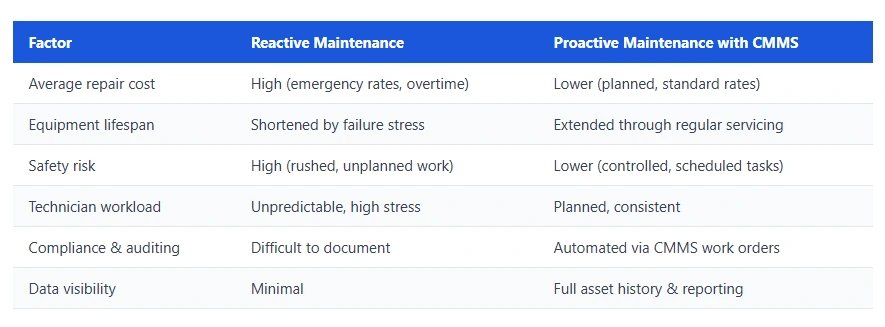
- ✦Reactive maintenance is a growing financial risk in 2026. Unplanned downtime now costs some industries over $2.3M per hour, and the world's largest companies collectively lose $1.4 trillion annually — making the shift to proactive maintenance a financial imperative, not just best practice.
- ✦A CMMS is the engine behind the transition. From auto-generating PM work orders to tracking asset history and managing spare parts inventory, a modern CMMS replaces manual, reactive processes with automated, data-driven ones — and is now used by 65% of large facilities worldwide.
- ✦Start with your most critical assets, not everything at once. A phased approach — prioritizing high-impact equipment first, proving ROI, then expanding — is more sustainable and builds the internal momentum needed for lasting cultural change.
- ✦IoT and condition-based maintenance are now mainstream. Over 52% of manufacturing plants have integrated sensors with their CMMS, cutting unplanned downtime by 38%+. Even teams without sensors can start capturing condition data manually through technician inspection notes.
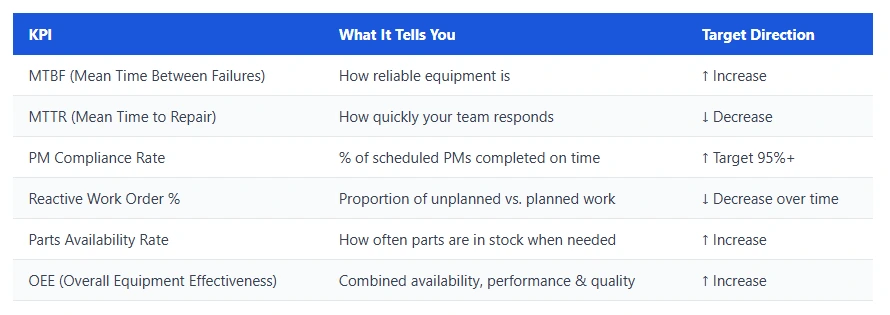
- ✦Data quality and team buy-in are what separate good intentions from real results. Tracking KPIs like MTBF, MTTR, and PM compliance rate — and involving your technicians in the process — is what turns a CMMS implementation into a genuine operational transformation.
Why Reactive Maintenance Is a 2026 Business Risk
Reactive maintenance — sometimes called "run-to-failure" or breakdown maintenance — means waiting until equipment fails before taking action. On the surface, it seems low-effort. In practice, it is one of the most expensive operating decisions a facility can make.
The 2026 maintenance landscape has changed dramatically. While the number of downtime incidents has actually declined over the past five years (facilities now average 25 downtime events per month, down from 42 in 2019), the cost per incident has skyrocketed. Aging infrastructure, supply chain volatility, and a growing skilled-labor shortage mean that when something breaks, it takes longer and costs more to fix. Meanwhile, the CMMS software market is projected to reach $2.4 billion in 2026 and grow to $5.9 billion by 2036 at a 9.3% CAGR — a signal that organizations worldwide are investing in tools to shift from reactive to proactive. Nearly 65% of large facilities now rely on CMMS tools to streamline asset operations, and adoption among mid-sized enterprises has climbed past 48%.
9 Steps to Transition from Reactive to Proactive Maintenance
1. Audit Your Current Maintenance State
Before you can improve, you need a clear baseline. Conduct a full audit of your maintenance operations: How much of your team's time is spent on reactive vs. planned work? What percentage of work orders are emergency? What assets fail most often, and what do those failures cost?
This audit reveals where reactive maintenance is hurting your performance most — and where proactive changes will have the biggest impact. If you already use a CMMS, mine your work order history. If not, even a simple spreadsheet audit will surface patterns that justify the investment.
2026 Insight: A majority of maintenance professionals say preventive maintenance is their primary strategy in theory — yet most facilities still spend the majority of their time on unplanned maintenance in practice. The gap between strategy and execution is where a CMMS closes the loop.
2. Build an Asset Register in Your CMMS
A CMMS is only as powerful as the asset data inside it. The first technical step in any transition is creating a comprehensive asset register — a centralized inventory of every piece of equipment, including its location, age, manufacturer specs, warranty status, and criticality rating.
The asset register is the foundation of everything else: PM schedules, spare parts planning, failure analysis, and reporting. Without it, you're still managing maintenance from memory and whiteboards. With it, your CMMS becomes a living record of your entire asset base.
- Record asset ID, make, model, serial number, and installation date
- Assign a criticality rating (high/medium/low) based on production impact
- Link manufacturer maintenance recommendations to each asset
- Upload manuals, warranties, and historical service records
3. Prioritize Critical Assets First
You don't need to transform your entire maintenance program on day one. Focusing on your most critical assets — those whose failure would cause the greatest production disruption, safety risk, or financial loss — lets you generate early wins and prove ROI before expanding.
In 2026, asset criticality prioritization is a defining practice of leading maintenance teams. Since the cost of a lost hour varies enormously (automotive: $2.3M vs. FMCG: $36K), directing your CMMS investment toward high-impact assets first maximizes return.
Pro tip: Use your CMMS to tag assets by criticality tier. Start building PM schedules only for Tier 1 assets. Once those are running smoothly and showing results, expand to Tier 2 and 3. This phased approach keeps the transition manageable and builds internal momentum.
4. Create Preventive Maintenance (PM) Schedules in Your CMMS
This is the core of proactive maintenance. Preventive maintenance (PM) involves scheduling routine tasks — inspections, lubrication, filter replacements, calibrations — based on time intervals or usage thresholds, before failures occur.
According to U.S. Department of Energy research, preventive maintenance programs deliver energy savings and operational efficiency gains in manufacturing facilities. Broader industry estimates put PM savings at 12–18% over reactive-only approaches — and up to 25% when PM is combined with condition-based strategies.
Your CMMS automates this entirely. Once a PM schedule is configured, the system generates work orders automatically, assigns them to technicians, and tracks completion. Nothing falls through the cracks because a reminder was missed or a manager was on leave.
- Set time-based triggers (e.g., monthly oil change) or usage-based triggers (e.g., every 500 hours)
- Attach standard operating procedures (SOPs) directly to each PM work order
- Auto-assign tasks to the right technician based on skills and availability
- Track compliance rates to spot recurring gaps in PM execution
5. Standardize Work Orders and Digital Documentation
One of the least glamorous — and most impactful — steps in the transition is moving from paper, whiteboards, and email chains to standardized digital work orders in your CMMS. Every maintenance task, whether reactive or planned, should be logged with consistent data fields: asset ID, work type, technician, parts used, time spent, and resolution notes.
This documentation isn't just record-keeping. It's the raw material for everything that follows: failure pattern analysis, parts forecasting, compliance audits, and eventually predictive maintenance. In 2026, 85% of facility operators still struggle with poor-quality maintenance data, which makes this step a competitive differentiator for organizations that get it right.
CMMS benefit: Nearly 48% of enterprises report improved asset tracking accuracy after implementing centralized CMMS systems, with 41% achieving faster maintenance turnaround times.
6. Optimize Spare Parts and Inventory Management
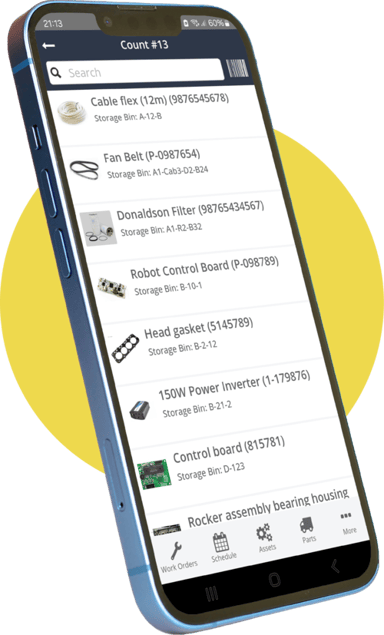
Reactive maintenance teams often hoard parts "just in case" or, conversely, run out at the worst possible moment. A CMMS transforms spare parts management from guesswork into a data-driven process.
Link your parts inventory to your asset register and PM schedules. When a PM work order is generated, the planner can check stock levels and trigger a purchase order if a required part is running low. This eliminates both excess inventory costs and the emergency procurement premiums that plague reactive shops.
- Set minimum stock levels for critical spare parts
- Link parts to specific assets and PM tasks
- Track part consumption to identify high-turnover components
- Reduce emergency rush orders by planning parts procurement ahead of scheduled maintenance
7. Integrate IoT Sensors for Condition-Based Maintenance
The next level beyond time-based PM is condition-based maintenance (CBM) — monitoring equipment in real time and triggering maintenance actions based on actual asset health, not just a calendar. In 2026, over 52% of manufacturing plants have integrated CMMS with IoT sensors, and facilities doing so are cutting unplanned downtime by more than 38%.
Sensors monitor variables like vibration, temperature, pressure, and runtime hours. When a reading crosses a threshold, your CMMS automatically generates a work order — letting your team intervene before a small anomaly becomes a catastrophic failure. Mobile-enabled CMMS adoption has now crossed 55%, meaning technicians can receive these alerts and respond from anywhere on the floor.
Don't have sensors yet? Start simple. Many teams build early predictive insight using manual technician inspection notes entered directly into the CMMS after walkarounds. Even this low-tech data collection surfaces patterns that time-based PM alone would miss.
2026 trend: More than a third of maintenance professionals now use sensors extensively, and over 50% of maintenance leaders believe predictive tools can boost equipment lifespan by more than 30%. AI is now crossing the mainstream adoption threshold — the top reported AI benefit in 2026 is knowledge capture and sharing, which directly supports smoother maintenance transitions.
8. Track KPIs and Measure Progress with CMMS Reporting
A data-based mindset is non-negotiable in 2026. You can't manage what you don't measure, and you can't justify continued investment in proactive maintenance without evidence of results. Your CMMS reporting dashboard should become a regular fixture in management reviews. Key maintenance metrics to track include Mean Time Between Failures (MTBF), Mean Time to Repair (MTTR), planned maintenance compliance rate, reactive vs. proactive maintenance ratio, and overall equipment effectiveness (OEE). Use these statistics from the last year to identify bottlenecks where machine downtime creates lost revenue — and use the improvement trends to tell the story of your transition.
9. Drive Team Buy-In and Build a Maintenance Culture
Technology alone won't make your transition stick. The shift from reactive to proactive maintenance is ultimately a cultural change — and the biggest obstacle is usually people, not systems. Technicians accustomed to the urgency and visibility of breakdown firefighting sometimes resist the quieter discipline of PM scheduling. Managers may question the upfront investment before results are visible.
The solution is communication, training, and visible wins. Use your CMMS data to show the team concrete improvements: fewer weekend callouts, reduced overtime, better-stocked parts rooms. Communicate the personal benefits — less stress, safer working conditions, and more predictable schedules. Involve technicians in configuring PM templates and SOPs; they have frontline knowledge that improves the quality of the data your CMMS captures.
In 2026, aging workforces and the skilled-labor shortage make knowledge capture especially critical. Your CMMS should be the repository where institutional knowledge lives — not in the heads of your most experienced technicians. Capturing tribal knowledge in standardized job plans and failure code libraries protects the organization when those veterans retire. Leadership note: Getting buy-in from leadership is essential to sustaining the transition. Use CMMS reporting to connect maintenance outcomes directly to production targets and margin improvements. When leadership sees maintenance as a margin driver — not just a cost center — the investment in proactive systems follows naturally.
How a CMMS Powers Every Step of the Transition
A Computerized Maintenance Management System isn't just one of the nine steps — it's the connective tissue that makes all nine work together. Without a CMMS, the transition from reactive to proactive maintenance requires heroic manual effort that few organizations can sustain. With the right CMMS, the processes described above run with minimal friction.
Here's what a modern CMMS like Zoidii brings to each phase of your transition:
- Asset management: A single source of truth for every asset, its history, and its scheduled maintenance
- Work order management: Auto-generated, assigned, and tracked work orders that close the loop from alert to repair
- PM scheduling: Time-based and usage-based preventive maintenance that never misses a trigger
- Inventory control: Real-time parts tracking with automatic reorder alerts
- Reporting & analytics: KPI dashboards that turn raw data into maintenance intelligence
- Mobile access: Technicians can receive, update, and close work orders from the shop floor in real time
- IoT integration: Connect sensor data to trigger condition-based work orders automatically
- Compliance documentation: Auditable maintenance records for regulatory requirements
The Bottom Line: Proactive Maintenance Pays for Itself
The transition from reactive to proactive maintenance is not a one-time project — it's a continuous evolution. But the financial and operational case is unambiguous. Organizations that make the shift see measurable returns within months: reduced emergency repair costs, fewer unplanned shutdowns, longer asset lifespans, safer working environments, and a maintenance team that operates with confidence rather than chaos.
In 2026, with downtime costs at record highs and the CMMS market growing at nearly 10% annually, the question is no longer whether to invest in proactive maintenance — it's how fast you can get there. Start with your most critical assets, get your data into a CMMS, build your first PM schedules, and measure everything. The results will speak for themselves.
Frequently Asked Questions
What is the difference between reactive and proactive maintenance? Reactive maintenance means waiting until equipment breaks down before taking action — also called "run-to-failure." Proactive maintenance uses scheduled inspections, preventive tasks, and real-time condition monitoring to catch and address issues before they cause failures. The core difference is control: proactive maintenance gives your team a plan; reactive maintenance forces your team to improvise.
How long does it take to transition from reactive to proactive maintenance? There's no single timeline — it depends on the size of your operation, the quality of your existing data, and how quickly your team adapts. Most facilities start seeing measurable improvements (fewer emergency work orders, better PM compliance) within 3–6 months of implementing a CMMS and launching their first preventive maintenance schedules. Full cultural and operational transformation typically takes 12–24 months. The key is to start with your most critical assets and expand gradually rather than trying to overhaul everything at once. Is reactive maintenance ever appropriate? Yes — for some low-criticality assets, a run-to-failure approach makes financial sense. If a piece of equipment is inexpensive to replace, has no impact on production, and poses no safety risk when it fails, scheduling preventive maintenance for it may cost more than simply replacing it when needed. The goal isn't to eliminate all reactive maintenance, but to make it a deliberate, planned choice for the right assets — rather than the default response for everything.