In 2023, OSHA issued more than 2,500 citations for lockout-tagout violations, solidifying its spot as one of the most penalized safety failures in the industry. It's a heavy price to pay for a process that should be straightforward.
You probably feel the weight of overwhelming paperwork and the constant fear that a technician might skip a step on a manual loto log. It's exhausting to manage inconsistent safety practices while trying to prepare for the 2026 audit season.
We're here to fix that. This guide delivers the blunt truth about safety compliance with a practical, step-by-step checklist designed to protect your team and keep inspectors off your back.
You'll learn how to replace disorganized habits with a repeatable, stupid-simple safety workflow. We're breaking down the essential steps to ensure zero workplace injuries and total operational order, moving you away from manual chaos and toward a reliable, audit-ready facility.
Key Takeaways
- Learn the blunt truth about hazardous energy and why standard switches aren't enough to guarantee worker safety.
- Follow a foolproof 6-step execution checklist to ensure every machine shutdown is handled with total precision.
- Identify the specific hardware standards required for a compliant LOTO program, from standardized locks to mandatory tag details.
- Get a clear roadmap for authorized employee training and annual audits to keep your facility OSHA-ready and penalty-free.
- Discover how moving to a digital CMMS eliminates paper-log liabilities and makes 100% compliance stupid simple.

What is LOTO? Understanding the Blunt Truth of Hazardous Energy
LOTO stands for Lockout-Tagout. It is the physical isolation of energy sources during equipment maintenance or repair. Many maintenance teams make the mistake of thinking flipping a switch to the "off" position is enough. It isn't. A standard switch only interrupts the control circuit. It doesn't isolate the power.
Someone can accidentally flip that switch back on, or a short circuit can bypass it entirely. True Lockout/tagout procedures ensure that the energy source is physically blocked, disconnected, or bled off, making it impossible for the machine to start. This process protects workers from hazardous energy releases, such as electrical shocks, mechanical hazards, or the sudden release of stored energy in equipment.
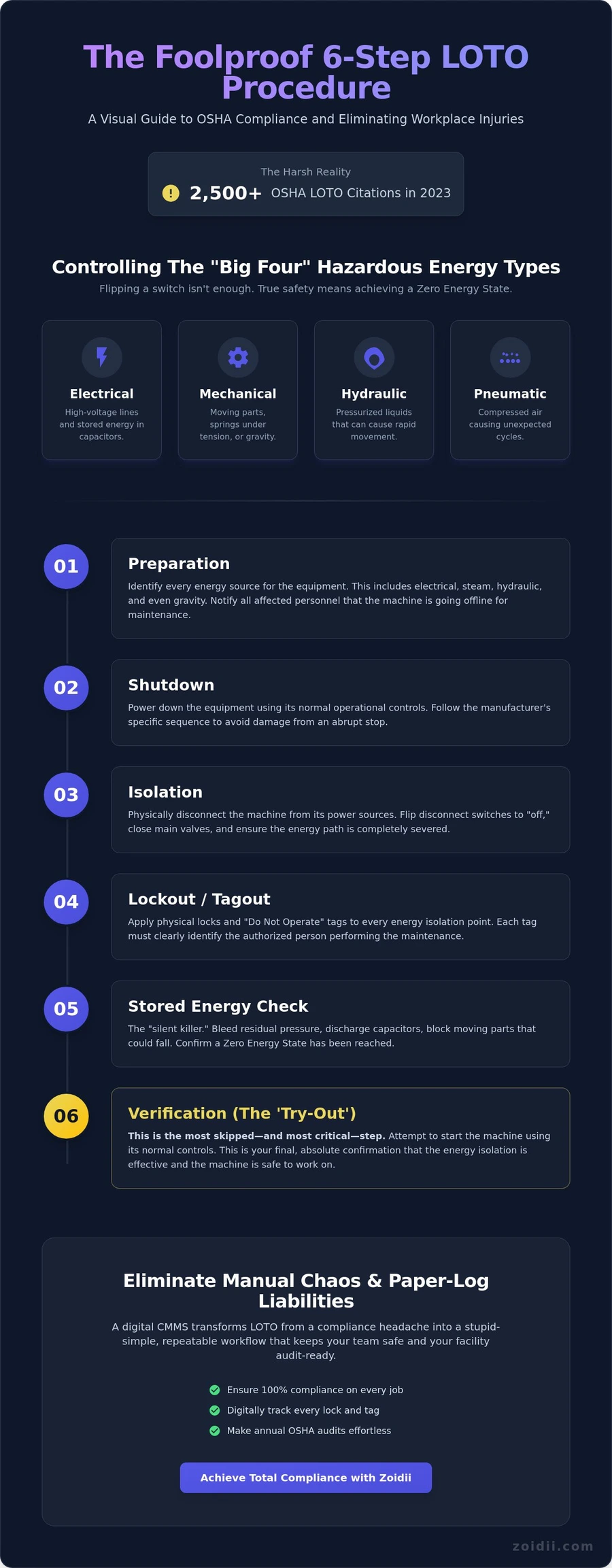
Hazardous energy comes in many forms. You must identify and control the "Big Four" types to keep your team safe:
- Electrical: The most common risk includes high-voltage lines and stored energy in capacitors.
- Mechanical: Energy from moving parts, springs under tension, or components held up by gravity.
- Hydraulic: Pressurized liquids that can cause rapid movement or high-pressure injection injuries.
- Pneumatic: Compressed air that can cause unexpected cycles or tool activation even when unplugged.
OSHA data moving into 2026 confirms that loto violations remain one of the most cited safety failures in the industrial sector. Proper compliance prevents an estimated 120 fatalities and 50,000 injuries annually. From a financial perspective, the cost of negligence is staggering.
As of 2025, OSHA increased the maximum penalty for a single "willful" violation to $161,323. One mistake can wipe out your maintenance budget for the entire year.
The Importance of LOTO
Lockout Tagout is critical because many machines have the potential to release energy unexpectedly, even when they appear to be off. Workers conducting maintenance tasks are often at risk of exposure to this hazardous energy if proper precautions are not taken. Failure to properly implement LOTO procedures can lead to severe consequences, including life-threatening injuries or fatalities.
Implementing LOTO ensures the safety of maintenance teams and others working close by. Without LOTO, machines can start unexpectedly, leading to crush injuries, electric shocks, or exposure to hazardous substances.
Accidents involving energy control failures are some of the most common and dangerous incidents in industrial settings, so regulatory agencies like OSHA (Occupational Safety and Health Administration) have stringent guidelines to ensure compliance.
OSHA Guidelines for LOTO
Why OSHA 1910.147 is Your Baseline
The OSHA 1910.147 standard isn't a suggestion; it's a mandatory framework for controlling hazardous energy. It requires every facility to have a written program, specific hardware, and rigorous training.You must distinguish between the two types of workers. "Authorized" employees are the trained technicians who perform the loto process. "Affected" employees are those who operate the machines or work in the area but don't perform maintenance.
Both need to understand why a lock is there. If you want to understand the organization behind these rules, read our guide on What Does OSHA Stand For? to get the full picture.
Employers must Protect Employees
According to OSHA’s regulation 29 CFR 1910.147, the control of hazardous energy (LOTO) standard outlines the steps employers must take to protect employees who perform maintenance and service tasks. The critical components of the OSHA guidelines include:- Energy Control Program: Employers must establish a written energy control program that outlines the steps necessary to disable machinery and prevent energy release.
- Employee Training: Workers must be trained to understand Lockout Tagout procedures, the importance of locking out equipment, and follow proper tagout systems.
- Periodic Inspections: Regular audits must ensure that lockout tagout procedures are followed correctly and address any issues or updates needed.
- Documentation: Detailed documentation of the machines, energy sources, and lockout tagout procedures must be maintained to ensure all relevant personnel understand their roles and responsibilities.
The Concept of Zero Energy State
A machine isn't safe just because it's unplugged. You must reach a "Zero Energy State." This means accounting for residual energy, which is the silent killer in many shops.This includes heat in a furnace, pressure in a line, or even a heavy press head held up by a hydraulic cylinder. If that cylinder fails, gravity takes over. You have to bleed the lines, block the rams, and discharge the capacitors. Zero Energy State is the complete absence of all energy types.
Steps Involved in Lockout Tagout - A Foolproof Execution Checklist
Safety isn't about checking boxes to please an auditor. It's about ensuring every technician goes home with the same number of fingers they started with. In 2023, OSHA cited 2,554 violations of OSHA's LOTO standard, making it one of the most penalized areas in industrial safety. Following a rigid, no-nonsense procedure is the only way to stay out of those statistics.Following a structured approach to LOTO is essential for ensuring its effectiveness. Below are the typical steps maintenance teams should follow:
1. Preparation: Authorized employees should identify all potential hazardous energy sources before initiating maintenance work. These sources include electrical circuits, hydraulic systems, and mechanical components that could store energy.
2. Shutdown: The machine or equipment should be properly shut down according to manufacturer instructions. This ensures that all operations cease before LOTO begins.
3. Isolation: After the shutdown, the next step is to isolate the equipment from its energy source. This involves disconnecting power for electrical machines, while for hydraulic or pneumatic systems, it means shutting off the valves.
4. Lockout & Tagout: The lockout devices are applied once isolation is confirmed. These devices physically lock the equipment in a safe position, preventing it from being re-energized. Each worker performing maintenance should attach their lock. A tagout involves attaching a label or tag to the lockout device, which communicates that the machine is locked out and should not be operated. The tag includes the name of the worker who applied it, the date, and the reason for the lockout.
5. Stored Energy Check. : Any residual or stored energy must be carefully released. For example, the technician must bleed off the hydraulic pressure, and compressed air systems should be safely vented to ensure no stored energy remains. This is where things get dangerous. You must bleed off residual pressure in lines, discharge capacitors, and block any moving parts that could fall. If the energy isn't at zero, you aren't safe.
6. Verification: Employees must verify that the equipment is properly locked out before maintenance begins. Verification involves testing the controls or attempting to start the machine to ensure it won’t power on.
Managing these steps across a facility gets messy without a plan. You can keep your LOTO procedures organized by using maintenance software that tracks every lock and ensures nothing is skipped.
Step 6: The 'Try-Out' (Verification)
The "Try-Out" is the most skipped step in maintenance, and that's a fatal mistake. Verification is the only way to prove your lockout actually worked. After you've applied your locks and bled the lines, attempt to restart the machine using the normal start button. If it moves, you missed an energy source. A common error is failing to return the start switch to the "off" position after the test; always reset the controls before you start turning wrenches.Group Lockout Procedures
When five technicians are working on one conveyor, you can't rely on a single lock. The "one person, one lock" rule is absolute. Each technician must attach their personal lock to a group lockout hasp or a lockbox.The machine stays dead until the very last person removes their lock. During shift changes, the incoming supervisor must apply their lock before the outgoing one removes theirs. This ensures the safety chain is never broken, keeping the asset loto compliant through the entire project.
Managing LOTO Compliance: Training, Audits, and Objections
Safety isn't a binder that sits on a shelf collecting dust. It's a culture that lives on the factory floor. If your team views safety as a roadblock to production, you have a culture problem, not a gear problem.
According to OSHA's 2023 data, lockout-tagout violations consistently rank in the top 10 most-cited workplace safety issues. Most of these fines don't come from a lack of locks. They come from a lack of discipline and poor training.
The Three Types of LOTO Training
You can't just give a generic safety speech and call it a day. OSHA requires specific training tiers to ensure everyone stays alive. Keep your training records organized and accessible so you aren't scrambling during an inspection.It's about making sure the right people have the right knowledge at the right time.
- Authorized Employees: These are the people actually doing the maintenance. They must know how to recognize hazardous energy sources, the magnitude of that energy, and the exact methods for isolation.
- Affected Employees: These workers operate the machines or work in the area. They don't touch the locks, but they must understand that a tag means "hands off" for their own protection.
- Retraining Triggers: This isn't a one-and-done deal. You must retrain if there's a change in job assignments, a machine swap, or if an audit reveals that an employee's knowledge is slipping.
Conducting the Annual LOTO Audit
OSHA standard 1910.147(c)(6) mandates a periodic inspection at least every 12 months. This isn't a paperwork exercise. It's a performance review. An authorized employee other than the one using the loto procedure must observe the process.They need to verify that the written procedure matches what is actually happening at the machine. If the documentation says "turn the red valve" but the valve was replaced with a blue one last June, your procedure is a failure. Fix those gaps immediately to keep your team safe and your facility compliant.
The most common pushback from maintenance techs is that safety takes too long. This objection usually stems from bad workflow design. If a tech has to walk across a 50,000 square foot facility just to find a paper checklist, they will be tempted to skip steps.
You need to make the right way the easy way. Use a digital system to put procedures right in their hands. When safety is stupid simple, compliance follows naturally. It's about realizing your safety goals without sacrificing the speed of your operations.
Stop wasting time on manual paperwork and start LOTO tracking the easy way. Chat with a Zoidii product expert today to see how we make compliance effortless.
Moving to Digital: Streamlining LOTO with CMMS
Paper LOTO logs are a massive liability in a modern facility. They get buried under grease, lost in filing cabinets, or completely ignored during a high-pressure shift change. If an OSHA inspector walks in today, can you prove every isolation point was secured in under five minutes? If you're still flipping through a dusty binder, the answer is likely no. Moving to a digital system isn't just about going green. It's about closing the gap between having a safety policy and actually following it every single time.
Digital systems eliminate the "I forgot" excuse. By centralizing your procedures, you ensure that every technician has the most current safety data. This shift reduces administrative time by approximately 25% and ensures that 100% of your safety documentation is searchable and secure. It turns a reactive safety culture into a proactive one where data drives decisions.
Digital Work Orders and Safety Triggers
Modern CMMS software keeps safety at the forefront by making it impossible to skip. You can set up safety triggers that force a technician to complete a loto checklist before they can even start a task. This keeps machine-specific manuals in their pocket, not stuck in an office across the plant. Technicians use mobile apps to snap photos of locked-out valves or breakers, providing visual proof that the energy source is dead. It's a stupid simple way to eliminate human error. Cloud storage ensures that even if a tablet breaks, your compliance records stay intact.Real-Time Visibility into Active Lockouts
Managers need to know what's happening on the floor without walking three miles a day. A digital Kanban board shows exactly which assets are under loto at any given second.This visibility helps you track "Time-to-Repair" while monitoring safety metrics simultaneously. If a lockout has been active for over 24 hours on a routine job, the system flags it for review. You'll generate real-time safety reports for management that are accurate to the second. This level of transparency is exactly what OSHA looks for during audits. You'll stop the paperwork headache and start running a tighter, safer shop.
- Instant Audits: Pull up a complete history of every lockout event in seconds.
- Photo Verification: Attach photos of specific isolation points to prevent confusion.
- Automated Alerts: Get notified if a lockout exceeds its expected duration.
Tracking Lockout Tagout Procedures in CMMS Software
Maintenance teams can track Lockout/Tagout (LOTO) procedures in a Computerized Maintenance Management System (CMMS). Many modern CMMS solutions are designed to manage and streamline safety procedures, including LOTO, to help organizations comply with regulations, prevent equipment accidents, and ensure worker safety.
1. Stored Files: CMMS can store detailed LOTO procedures as PDF or Word files, including step-by-step instructions, safety precautions, and diagrams. These files can be attached to specific assets, PMs, or work orders.
2. Checklists: Lockout/tagout procedures can be uploaded to maintenance checklists to ensure safe and compliant lockout/tagout procedures are followed during machine servicing and maintenance. This process helps prevent the accidental release of hazardous energy and potential injuries.
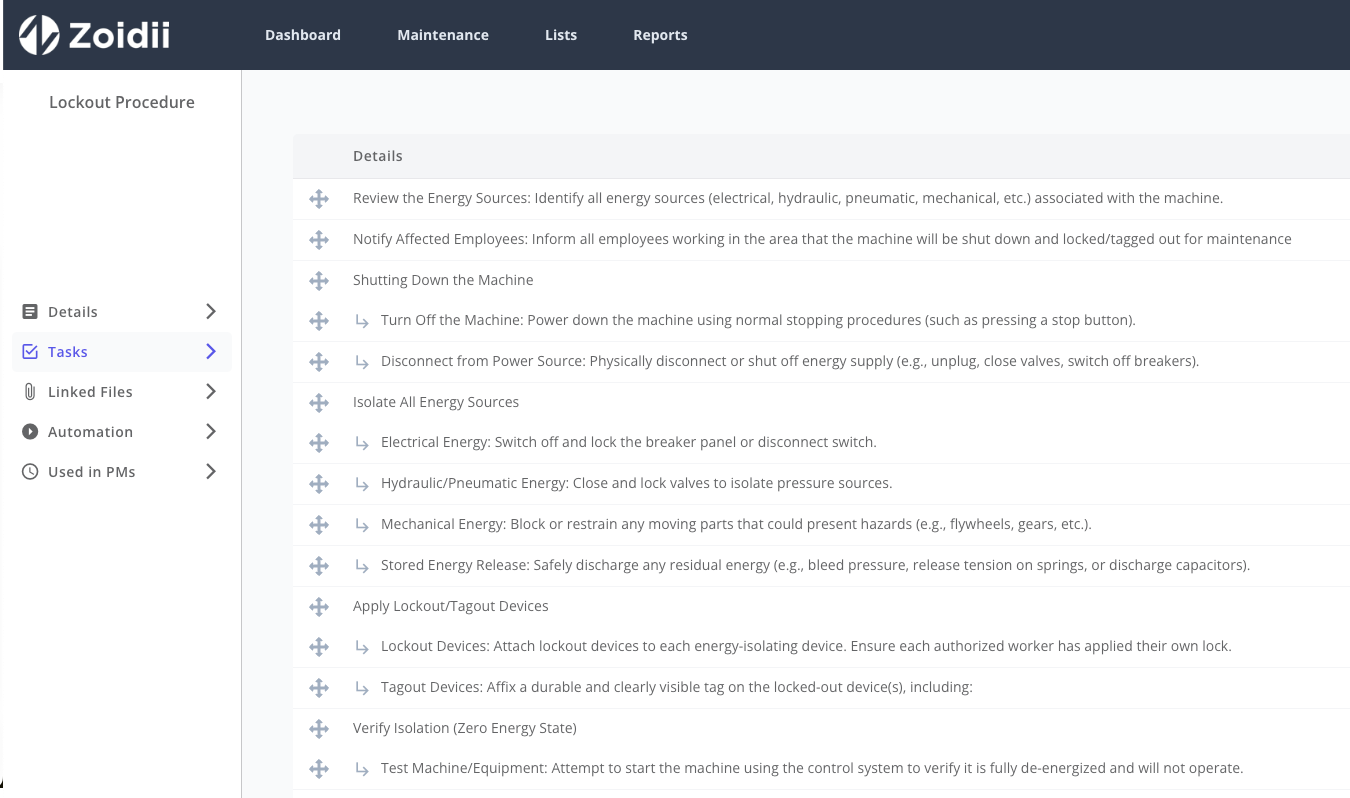
3. Automated checklists: The CMMS can automatically prompt or require LOTO procedures on predetermined machines automatically. Before any equipment service begins, the CMMS can automatically include LOTO steps as mandatory tasks.
4. Work Orders: CMMS systems can include LOTO procedures directly within work orders, ensuring anyone assigned to the work order will see the required safety procedures before starting the task.
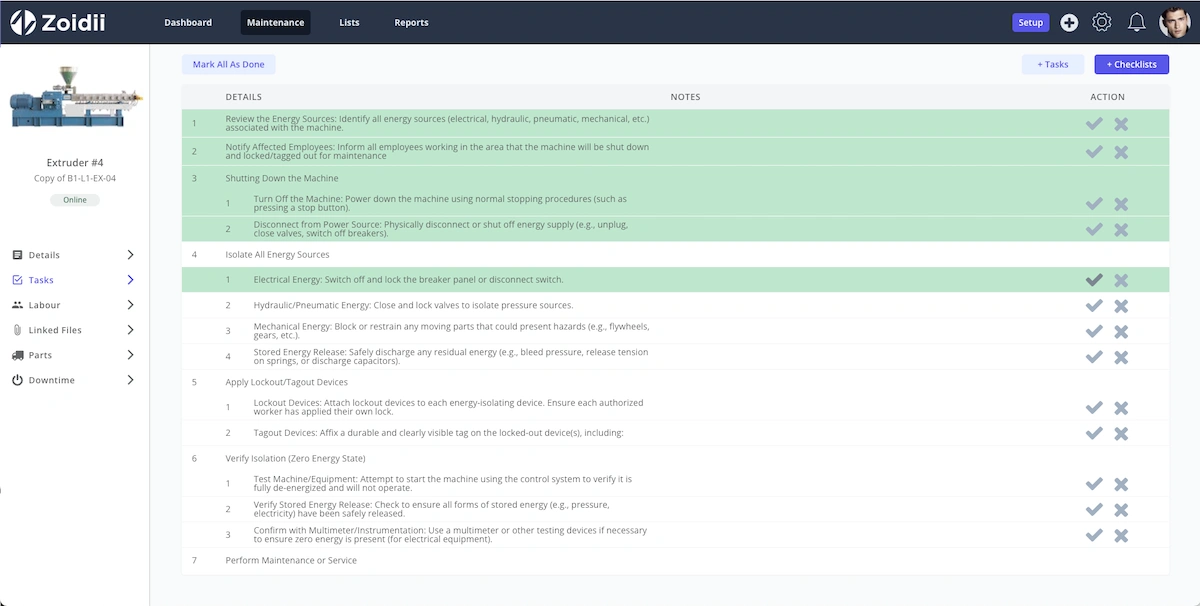
5. Compliance and Audit: CMMS software can ensure that all necessary LOTO steps are marked as complete before maintenance work can proceed, enhancing compliance and safety. CMMS tracks who performed LOTO procedures and when the steps were signed off, which can be used to verify compliance with OSHA or other safety regulations.
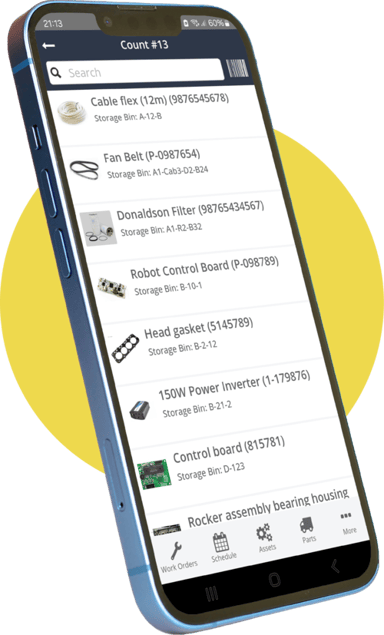
6. Mobile Apps: Many CMMS systems offer mobile apps, which allow technicians to sign off on LOTO procedures in real time, scan QR codes or barcodes on equipment, and mark equipment as locked out or tagged out directly from the field.
Organizations can use a CMMS to track LOTO procedures, increasing efficiency, reducing risk, and ensuring a safer working environment while staying compliant with industry regulations.
The Essential LOTO Equipment & Hardware Checklist
Safety equipment is the physical barrier between a technician and a lethal energy discharge. You can't just grab any old hardware store lock and call it a day. Every piece of hardware must be dedicated to safety.
OSHA 1910.147 requires that lockout and tagout devices be standardized within the facility in at least one of the following criteria: color, shape, or size. This means your LOTO gear is for life-saving only, not for securing your toolbox or a locker.
- Safety Padlocks: These must be durable and uniquely keyed. "Keyed different" is the gold standard. If one master key opens ten different locks, your system is compromised. Each worker needs their own lock that only they can open.
- LOTO Tags: Every tag needs a "Do Not Operate" warning. It must include the authorized employee’s name and the date of application. If the writing is smudged or the tag is ripped, it doesn't count as protection.
- Multi-Lock Hasps: When five people work on one machine, you need five locks. Hasps allow multiple workers to secure a single energy point. The machine stays dead until the last person removes their lock and goes home.
- Device-Specific Covers: You need the right tool for the job. This includes circuit breaker lockouts, ball valve covers, and plug lockouts. If the device doesn't fit tight, the energy isn't truly isolated.
Standardization and Identification
Consistency prevents confusion during high-pressure maintenance. Many facilities use color-coding to identify specific departments. For example, electrical teams might use red locks while mechanical teams use blue.This visual shorthand helps supervisors identify who is on-site at a single glance. It makes the entire LOTO process transparent and predictable. If you see a yellow lock, you know exactly which department is currently working on that asset.
Inspecting Your Safety Hardware
Don't wait for an accident to realize your gear is failing. Perform a quick check every time you issue equipment. A 2022 industry report suggested that nearly 15 percent of safety equipment in heavy manufacturing shows signs of environmental degradation that could compromise function. Keep your hardware in top shape with these steps:- Check for corrosion on padlock shackles and internal springs.
- Ensure keys turn smoothly without sticking or forcing.
- Verify tags aren't faded, grease-stained, or illegible.
- Confirm hasps aren't bent, cracked, or showing metal fatigue.
Create a Safer Workplace with Lockout Tagout
For maintenance teams, Lockout Tagout is a critical procedure that directly protects against hazardous energy releases, ensuring the health and safety of all personnel involved in machinery servicing.
Adherence to OSHA’s lockout tagout standards and following a clear, step-by-step process ensure that maintenance work can proceed without unnecessary risks.
By fully understanding and implementing lockout tagout procedures, maintenance teams help create a safer workplace, reduce downtime, and prevent avoidable accidents.
Stop Chasing Compliance and Start Locking In Safety
OSHA 1910.147 violations consistently rank in the top 10 most cited standards every year, proving that manual systems often fail under pressure. You now have the 6-step procedure and the hardware requirements needed to keep your team alive. The real challenge is maintaining that standard every single day without drowning in paperwork.
Paper checklists are a liability because they get lost or ignored; however, 100% audit-ready digital logs ensure you're always prepared for an inspector's surprise visit. Transitioning to a digital loto system isn't just about software. It's about protecting your people and your reputation with a system that won't let you down.
Maintenance managers worldwide trust Zoidii to handle the heavy lifting. Our mobile-first safety checklists put compliance right in your technicians' hands, so nothing gets skipped. It's time to ditch the binder and embrace a tool that's actually helpful.
Book a Demo of Zoidii's Stupid Simple Safety Tools today to see how easy organized maintenance can be. You've got the knowledge to lead a safer shop, and we've got the tools to help you get there.
Frequently Asked Questions
What is the difference between Lockout and Tagout?
Lockout uses a physical device like a padlock to keep energy isolated, while tagout is a prominent warning label that tells others not to operate the machine. Think of lockout as the physical barrier and tagout as the communication tool.OSHA 1910.147 requires you to use lockout whenever a machine is capable of being locked. It’s a stupid simple way to ensure nobody accidentally flips a switch while you’re working.
Can one employee remove another employee's LOTO lock?
Only the authorized employee who applied the lock can remove it under normal circumstances. If that person isn't available, the employer can remove the lock only after following a strict protocol defined in OSHA 1910.147(e)(3).This involves verifying the employee has left the facility and making all reasonable efforts to contact them. You must document this process to avoid a citation during your next loto audit.
Does LOTO apply to cord-and-plug connected equipment?
Lockout requirements don't apply to cord-and-plug equipment if the plug is under the exclusive control of the employee performing the service. If you can keep the plug in your pocket or within your immediate line of sight at all times, you're exempt under 1910.147(a)(2)(iii)(A).This exception keeps things efficient for small repairs. Just make sure the equipment doesn't have a secondary power source like a battery or capacitor.
How often should LOTO procedures be reviewed or updated?
You must review your energy control procedures at least once every 12 months. This annual inspection ensures your documentation matches the current state of your machinery.An authorized employee, other than the one currently using the procedure, must perform the review. It’s a critical step to catch errors before they cause an accident. Keep these records on hand to prove you’re staying compliant.
What are the most common OSHA citations for LOTO violations?
The most frequent citations involve failing to establish a written program and neglecting machine-specific procedures. In 2023, OSHA issued 2,554 citations for loto violations, making it the 6th most common safety infraction.Many facilities get caught because they use a "one size fits all" template instead of documenting the unique energy sources for each asset. Avoid these 2,500 plus mistakes by keeping your documentation organized and accurate.
Is a 'Tagout only' system ever acceptable?
A tagout-only system is acceptable only if the equipment is physically incapable of being locked out. In these rare cases, you must demonstrate that your tagout program provides the same level of safety as a physical lock.This usually involves additional safety measures like removing a circuit element or blocking a control switch. If the machine can be locked, OSHA expects a lock. Don't take shortcuts with this rule.
How do I handle LOTO for outside contractors?
You and the contractor must formally exchange information about your respective lockout procedures before work begins. OSHA 1910.147(f)(2) requires this mutual understanding so your employees and their crew don't accidentally endanger each other.Your staff must understand and comply with the contractor’s energy control methods. Clear communication prevents confusion when multiple teams are working on the same system. It's about keeping the site organized and safe.
Do I need a written LOTO procedure for every single machine?
Yes, you need a machine-specific loto procedure for every piece of equipment unless it meets 8 specific exemption criteria. These exemptions apply to simple machines with a single energy source that is easily identified and isolated.For most industrial assets, a written guide is mandatory. It must outline the exact steps to shut down, isolate, block, and dissipate all forms of energy. Having these steps documented makes training your team much easier.