
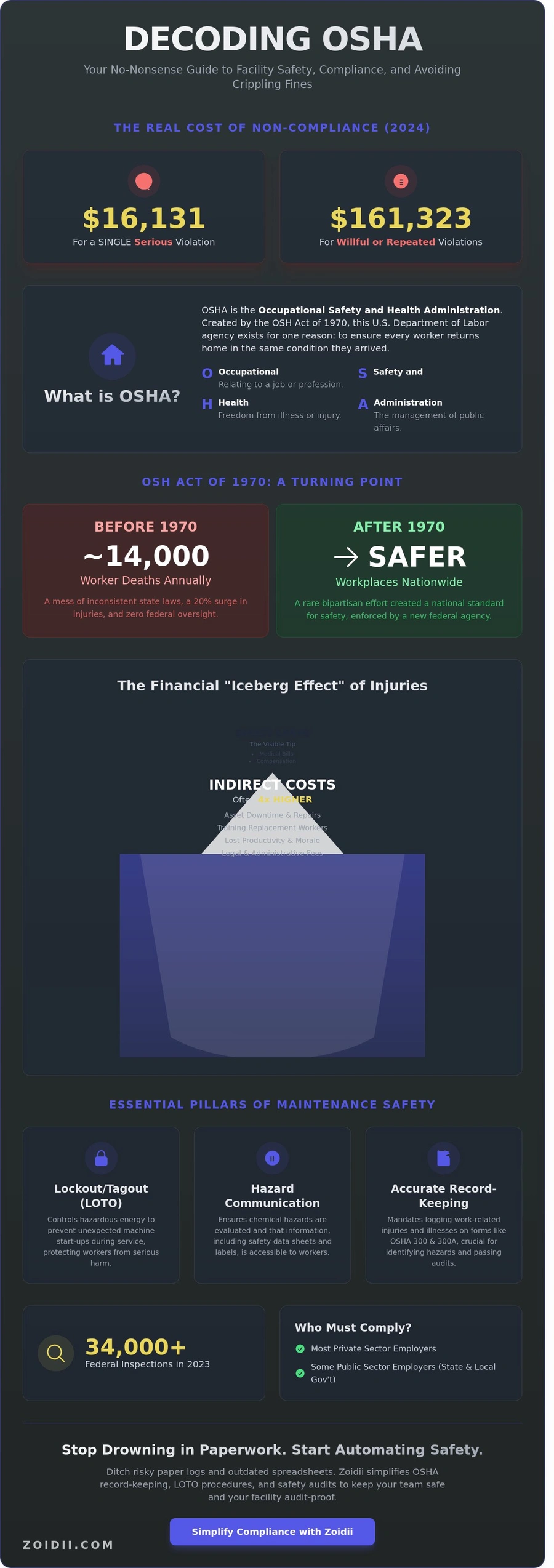
Most facility managers treat a knock at the door from a federal inspector like a death sentence, but the real killer is the $16,131 fine you’ll face for a single serious violation in 2024. It’s easy to feel overwhelmed when you’re buried under a mountain of technical manuals and legal jargon. You probably find yourself asking, "What does OSHA stand for?" while staring at a disorganized pile of safety records that would make a seasoned librarian weep. We know the frustration of trying to keep a facility running while looking over your shoulder for the next audit.
Compliance shouldn’t be a bureaucratic nightmare that halts your operations. We’re here to give you a blunt, no-nonsense breakdown of why this agency exists and how to handle it like a pro. You’ll get a clear understanding of their role, along with an actionable checklist to keep your record-keeping stupid simple. This guide strips away the fluff so you can focus on what matters: keeping your team safe and your assets running without the fear of heavy penalties.
Key Takeaways
- Beyond just learning what does osha stand for, get a blunt breakdown of the agency’s mission to protect your crew under the OSH Act.
- Discover why compliance is about more than dodging fines; it’s a direct way to boost employee morale and stop wasting money on downtime.
- Identify exactly who needs to comply across private and public sectors to ensure your facility stays on the right side of the law.
- Master the essential pillars of maintenance safety, including high-stakes Lockout/Tagout (LOTO) and HazCom labeling requirements.
- Learn how to ditch risky paper logs for a stupid simple way to automate OSHA Form 300 and 300A record-keeping.
What Does OSHA Stand For? Defining the Mission
If you are managing a facility or a maintenance crew, you need to know exactly what does osha stand for and why it dictates your daily workflow. OSHA stands for the Occupational Safety and Health Administration (OSHA). Created as a branch of the US Department of Labor, this agency exists for one reason: to ensure that every worker in the United States goes home in the same condition they arrived. It is not just a book of suggestions; it is a federal mandate that covers almost every private sector employer in the country.
OSHA functions as both a rule-maker and an enforcement agency. They research industrial hazards, set legal limits on chemical exposure, and define the technical requirements for everything from ladder safety to lockout/tagout procedures. Beyond writing the rules, they have the authority to walk into your facility and issue fines if you aren't following them. In 2023, the agency conducted over 34,000 inspections to verify that companies were meeting these benchmarks. For maintenance managers, staying compliant is about more than avoiding a penalty; it is about building a reliable, high-performing operation.
The History of the OSH Act of 1970
The landscape of American labor changed forever on December 29, 1970, when President Richard Nixon signed the Occupational Safety and Health Act. Before this, workplace safety was a mess of inconsistent state laws and zero federal oversight. During the 1960s, workplace injury rates surged by 20 percent. By the time the act was passed, roughly 14,000 workers were dying on the job every year. This crisis forced a rare bipartisan effort in Congress to create a national standard for safety.Since its inception, OSHA has evolved to meet the demands of a changing economy. While the early years focused on heavy manufacturing and construction, the agency is now adapting to 2026 industrial standards. This includes new focuses on warehouse automation, heat illness prevention, and the safe integration of robotics on the plant floor. As technology gets more complex, the agency’s mission remains the same: keep the human element safe.
The General Duty Clause: The Catch-All Rule
One of the most important tools in the agency’s belt is Section 5(a)(1) of the OSH Act, commonly known as the General Duty Clause. This clause states that every employer must provide a place of employment that is free from recognized hazards that are likely to cause death or serious physical harm. It is a "stupid simple" concept that carries massive legal weight. It means that even if there isn't a specific, word-for-word standard for a new piece of equipment in your shop, you are still responsible for keeping it safe.In modern maintenance environments, this clause is often applied to emerging risks. For example, if a maintenance team is working on a proprietary machine that doesn't have a dedicated OSHA subpart, the General Duty Clause still requires the employer to follow industry best practices. You can't claim ignorance just because a specific rule doesn't exist yet. If a hazard is known and you don't address it, you are in violation. Staying organized with a clear digital record of your preventive maintenance and safety checks is the best way to prove you are meeting this standard.
Why OSHA Matters: Beyond Legal Compliance
When people ask what does osha stand for, the literal answer is the Occupational Safety and Health Administration. However, for maintenance managers, it stands for the difference between a high-performing facility and one drowning in litigation. OSHA isn't just a set of rules to keep inspectors away. It's a framework for operational excellence. As of January 15, 2024, OSHA increased its maximum civil penalties to $16,131 for serious violations and $161,323 for willful or repeated ones. Writing a check for six figures because of a missing guardrail isn't just bad luck; it's a failure of asset management.
Transitioning from a mindset of avoiding fines to building a safety culture changes how your team views their work. Safe practices are directly linked to asset reliability. A technician who follows a lockout/tagout (LOTO) procedure isn't just staying safe. They're ensuring the asset is properly isolated, which prevents secondary damage to the machine itself.
You can find more details on the agency's mission and structure by visiting the About OSHA page. When safety becomes "stupid simple" through standardized workflows, morale improves because employees feel valued, not expendable.
The Financial Impact of Workplace Injuries
Workplace injuries follow the "iceberg effect." Direct costs like medical bills and workers' compensation are the visible tip. Indirect costs, which are often 4 times higher, lurk beneath the surface. These include downtime, equipment repair, and the cost of training a replacement worker.A single major accident can wipe out a facility's entire maintenance budget for the year. Insurance companies track this through your Experience Modification Rate (EMR). An EMR above 1.0 signals to the market that your business is a high risk, which sends your premiums skyrocketing and eats into your margins.
Safety as a Competitive Advantage
Safety record transparency is now a standard requirement for winning large-scale industrial contracts. If your Total Recordable Incident Rate (TRIR) is higher than the industry average of 2.7 per 100 workers, you'll likely lose the bid before you even show your pricing.In a tight labor market where 70% of maintenance managers struggle to find skilled technicians, a reputation for safety is your best recruiting tool. Top-tier talent won't work in a "cowboy shop" where risks are ignored.
By using a modern CMMS to organize safety protocols, you reduce unplanned downtime and prove to both clients and employees that your operation is world-class. Standardized safety checks ensure that every PM is done right the first time, protecting your people and your equipment simultaneously.
OSHA Standards & Coverage: Who Must Comply?
Safety isn't optional for most American businesses. If you're asking What Does OSHA Mean? for your specific facility, the answer is usually mandatory compliance. The Occupational Safety and Health Act covers most private sector employers in all 50 states, the District of Columbia, and U.S. territories.
Whether you run a small machine shop in Ohio or a massive distribution center in California, these rules apply to you. To understand what does osha stand for in a practical sense, you have to look at who they actually regulate and where the boundaries sit.
Federal agencies must follow safety standards similar to those in the private sector. While OSHA doesn't fine other federal agencies like the Department of Energy, it does conduct inspections and monitor their safety records. For state and local government workers, protection depends entirely on geography. Federal OSHA doesn't cover these employees directly. Instead, they're protected if they work in one of the 22 states that operate their own OSHA-approved state plans.
Not every worker falls under this umbrella. You're exempt if you're self-employed or if you're a farmer who only employs immediate family members. Some industries follow rules from different federal agencies. For instance, miners are regulated by the Mine Safety and Health Administration (MSHA), and some maritime workers follow Coast Guard regulations. Small farms with 10 or fewer employees are also generally excluded from programmed inspections, though they must still maintain a safe environment. It's a straightforward system designed to focus resources where the risks are highest.
General Industry vs. Construction Standards
Standard 1910 is the primary set of rules for manufacturing and facility maintenance. It's the "bible" for fixed facilities. Standard 1926 applies to construction, alteration, or repair work. Determining which rule applies to a specific work order depends on the nature of the task. If your team is replacing a motor on a conveyor, you're likely under 1910. If they're installing a new structural mezzanine, 1926 takes over. Mixing these up can lead to major fines during an inspection.The Role of State Plans
Currently, 22 states run their own OSHA-approved programs covering both private and public sectors. These plans cover roughly 40% of the American workforce. State rules must be at least as effective as federal rules, but they're often stricter. Washington and Oregon, for example, have much more aggressive requirements for fall protection than the federal baseline.You should always check with your local regulatory body to ensure your PMs and safety checks meet regional requirements. It's the only way to stay truly organized and avoid surprises.
The 5 Pillars of OSHA Compliance in Maintenance
Safety isn't a suggestion; it's a requirement that keeps your team alive and your facility open. Before you can build an effective safety program, you need to understand the basics of the agency in charge. So, what does OSHA stand for? It stands for the Occupational Safety and Health Administration.
For maintenance managers, however, those four letters represent a set of non-negotiable standards that prevent workplace injuries. Missing a single step can lead to fines of $16,131 per serious violation as of January 2024.
- Hazard Communication (HazCom): Every chemical on your floor needs a clear label and a Safety Data Sheet (SDS).
- Lockout/Tagout (LOTO): This pillar focuses on killing the power so the machine doesn't kill the technician.
- Personal Protective Equipment (PPE): You must assess specific job hazards and provide the gear that fits the risk.
- Machine Guarding: If a part spins, slides, or chops, it needs a physical barrier to protect the operator.
- Record-keeping: OSHA inspectors look for the paper trail. If you didn't document the training or the repair, it didn't happen.
Mastering LOTO and Machine Guarding
Unexpected machine startup causes roughly 10% of serious industrial accidents every year. It's the primary cause of maintenance fatalities. You can prevent these tragedies by following a stupid, simple rule in your handbook. Define LOTO for your team like this: Lockout/Tagout is the physical placement of a lock and tag on an energy-isolating device to ensure equipment cannot be energized until the lock is removed.Don't leave safety to memory. Integrate these steps directly into your PM schedules. When a technician opens a work order for a hydraulic press, the first three steps must be LOTO procedures. This makes safety an automated part of the workflow.
Hazard Communication and SDS
The days of hunting through a greasy yellow binder for a paper SDS are over. By 2026, updated OSHA Hazard Communication Standards require teams to be trained on new label elements and specific chemical classifications. You need to move your SDS library to a digital format that technicians can access on their mobile devices instantly.Clear, durable labeling is just as critical. Labels must survive oil, heat, and vibration on the shop floor. If a secondary container lacks a GHS-compliant label, your facility is at risk. Keep your chemicals organized and your labels legible to ensure every team member knows exactly what they're handling at all times.
Stop stressing over safety audits and start organizing your shop. Book a demo with a Zoidii product expert to see how we make compliance simple.

Simplifying OSHA Record-Keeping with Modern Tools
Paper logs are a liability. If an inspector walks into your facility today, you have minutes to produce accurate records. Relying on coffee-stained binders or handwritten notes is a gamble you'll likely lose. In 2023, OSHA increased maximum penalties for record-keeping violations to over $15,000 per instance. Digital records eliminate the risk of lost data and provide an unalterable trail of your safety efforts.
Many managers still find themselves asking, what does OSHA stand for when they're staring at a stack of confusing paperwork. It stands for the Occupational Safety and Health Administration. Their job is to ensure workplace safety, and your job is to prove you're doing it. The stupid simple way to handle this is through automation.
Instead of manually filling out Form 300 and 300A at the end of the year, a modern CMMS tracks incidents as they happen. It populates these forms automatically, ensuring your data is ready for submission before the February 1st deadline.
Digital Work Orders as Legal Proof
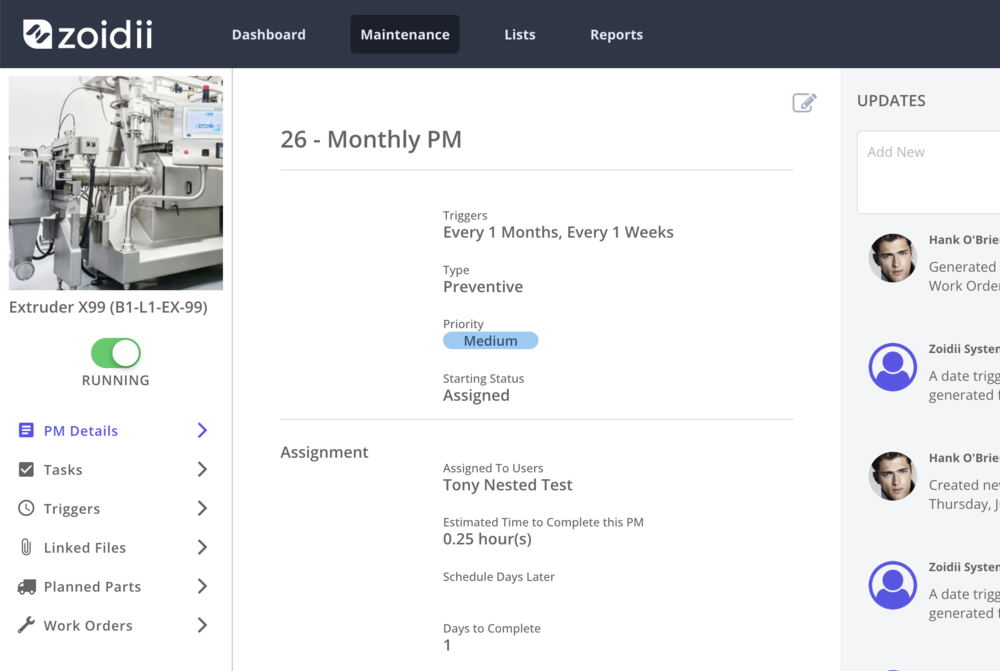
A digital work order is more than a task list; it's legal proof of due diligence. When you use Zoidii, every work order is time-stamped and linked to a specific asset. You can attach safety checklists to every high-risk task, forcing technicians to sign off on PPE and lockout/tagout procedures before they start.This creates 100% documentation with zero extra effort from management. If an accident occurs, you can show the exact minute a machine was last serviced and which safety protocols were followed. This level of detail turns a potential citation into a non-issue by proving a culture of preventive maintenance.
The Power of Instant Reporting
Safety audits shouldn't take hours of data mining. With instant reporting, you can generate a complete history of your safety training and equipment inspections in seconds. You can track critical KPIs like "Days Since Last Incident" or "PM Compliance Rate" on a live dashboard.This visibility allows you to catch safety gaps before they become injuries. Zoidii makes compliance a habit rather than a headache. It organizes your assets and PMs so you can realize your safety goals without the stress of manual tracking.
Ready to ditch the spreadsheets and protect your team? Stop stressing about OSHA-see how Zoidii makes safety simple.
Take Control of Your Workplace Safety Compliance
Understanding what does osha stand for is the baseline for any serious operation. Since the Occupational Safety and Health Act of 1970, the mission has been to protect 130 million workers across 8 million worksites. Compliance isn't about dodging fines; it's about building a culture where every technician returns home safely.
You need to master the 5 pillars of maintenance safety and keep records that actually hold up under scrutiny. Paper files and messy spreadsheets are a liability you don't need.
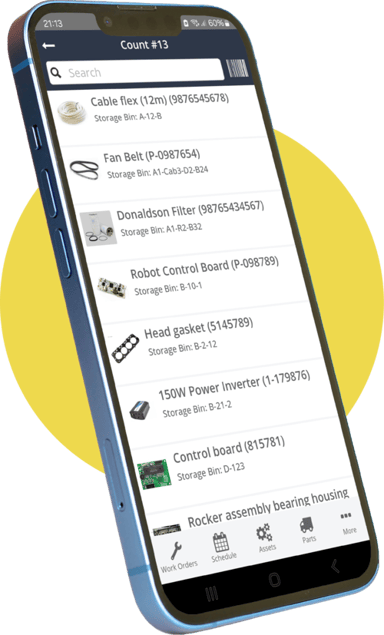
Stop over-complicating your safety protocols. Zoidii is the #1-rated Cloud CMMS for Ease of Use, trusted by maintenance teams worldwide to make compliance stupid simple. With SSO and a dedicated Mobile App included, your team gets maximum adoption without the usual headache.
It's time to realize your management goals and ditch the disorganized chaos. Book a demo with a Zoidii expert to automate your safety compliance. You've got this.