
Downtime is expensive. Whether you manage a manufacturing plant, a fleet of vehicles, a hospital, or a commercial facility, unplanned equipment failures don't just cost money — they cost productivity, morale, and in some industries, lives. The organizations that stay ahead of maintenance challenges aren't just lucky. They're using the right tools.
Maintenance Management Systems have evolved from simple work order logs into sophisticated, AI-assisted platforms that help teams predict failures before they happen, optimize labor scheduling, manage inventory, and generate compliance documentation — all from a single dashboard. In 2026, the market is more mature, more competitive, and more capable than ever.
This guide covers everything you need to know: what these systems are, how they work, why they matter, and — most importantly — which ones are worth your time and investment.
Key Takeaways
- Reactive maintenance is costing you more than you think. Organizations without a CMMS typically pay 2–5x more per maintenance task compared to planned maintenance, and unplanned downtime can cost anywhere from $10,000 to $250,000 per hour, depending on the operation — making the ROI case for a CMMS straightforward to build.
- The biggest implementation risk isn't technology — it's adoption. The most common reason CMMS projects fail is poor change management, not software limitations. Involving technicians early, phasing the rollout, and assigning an internal champion are the three practices most strongly correlated with long-term success.
- Modern CMMS platforms are faster to deploy than most organizations expect. Cloud-based solutions like Zoidii can be operationally live within days to weeks, require minimal IT involvement, and offer free trials — removing most of the traditional barriers to getting started.
- A CMMS is a long-term strategic asset, not just an operational tool. Over time, the data generated by a CMMS — on asset performance, failure patterns, maintenance costs, and technician productivity — becomes the foundation for smarter capital investment decisions, better staffing strategies, and measurable competitive advantage.
What is a Maintenance Management System?
A Maintenance Management System, most commonly implemented as a Computerized Maintenance Management System (CMMS), is a software platform designed to centralize, automate, and optimize all activities related to the upkeep of physical assets. At its core, it serves as a single source of truth for everything maintenance-related in an organization.
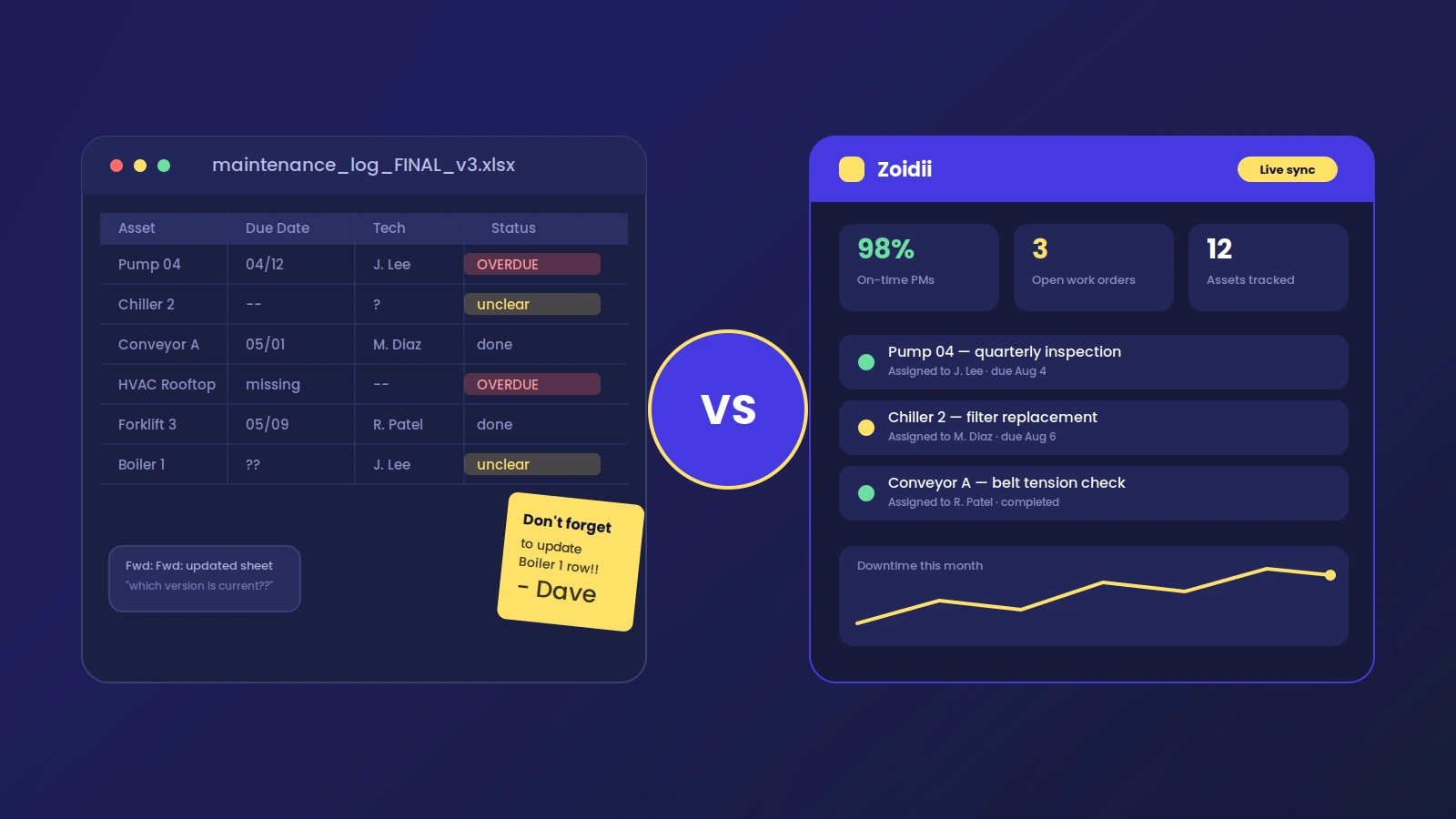
Before these systems existed, maintenance teams relied on clipboards, spreadsheets, whiteboards, and tribal knowledge. A senior technician retired, and suddenly no one knew the quirks of the aging compressor in Building C. A work order got lost in someone's email inbox. A critical part ran out of stock mid-repair because no one tracked inventory in real time.
A Maintenance Management System solves all of this by digitalizing and connecting:
Asset Management — Every piece of equipment is catalogued with specifications, documentation, warranty information, and a full service history. When something breaks down, technicians instantly know what they're dealing with.
Work Order Management — Maintenance requests are submitted, assigned, prioritized, tracked, and closed within the system. Nothing falls through the cracks.
Preventive Maintenance (PM) Scheduling — Recurring maintenance tasks are scheduled based on time intervals, usage hours, or sensor readings. The system generates work orders automatically, so technicians stay proactive rather than reactive.
Inventory and Parts Management — Spare parts are tracked in real time. Reorder points are set so critical components are always in stock without tying up excessive capital.
Reporting and Analytics — Leaders get dashboards showing key metrics like Mean Time Between Failures (MTBF), Mean Time to Repair (MTTR), planned vs. reactive maintenance ratios, technician productivity, and cost per asset.
The term "CMMS" is often used interchangeably with "EAM" (Enterprise Asset Management). However, EAM systems typically go broader — encompassing procurement, capital planning, and lifecycle management in addition to day-to-day maintenance. For this article, we'll use the terms broadly to cover both categories.
How Do Maintenance Management Systems Work?
Understanding the mechanics of a modern CMMS helps organizations appreciate both the value and the implementation requirements involved. Here's how these systems function in practice.
Asset Data Foundation
Everything begins with a digital asset registry. When you implement a CMMS, you build out an asset hierarchy — from locations (Site → Building → Floor → Room) down to individual assets (HVAC Unit #3, Pump 12A). Each asset record stores manufacturer details, model and serial numbers, installation dates, warranty information, attached manuals and drawings, and historical maintenance logs.
This structure allows the system to filter and report at any level. How much did you spend maintaining all the equipment in Facility B last year? Which specific pump has the worst failure rate? The asset hierarchy makes answering these questions trivial.
Work Order Lifecycle
The heartbeat of any CMMS is the work order. A work order can be triggered in several ways:
- Manually — A technician or operator submits a request through the system, a mobile app, or a QR code scan on a piece of equipment.
- Automatically via PM schedule — The system generates a work order when a scheduled maintenance interval is due.
- Automatically via sensor data — In more advanced deployments, IoT sensors feed data into the CMMS and trigger condition-based work orders when readings exceed thresholds.
Preventive Maintenance Engine
The PM module is where CMMS platforms deliver some of their most compelling value. Maintenance teams configure PM plans for each asset — for example, "inspect lubrication every 250 operating hours" or "replace air filters every 90 days." The system monitors these triggers and automatically creates and assigns work orders at the right time.
Advanced platforms now support predictive maintenance (PdM), integrating with vibration sensors, thermal cameras, oil analysis tools, and other condition-monitoring equipment. Instead of maintaining on a fixed calendar, PdM lets organizations maintain equipment based on actual condition — doing work only when needed, not arbitrarily.
Inventory Integration
Parts management is tightly integrated with work orders. When a technician records that they used two bearings to complete a repair, the system automatically decrements inventory. When stock falls below a minimum threshold, a purchase requisition or reorder alert is generated. This loop closes the gap between maintenance execution and supply chain management.
Reporting and Dashboards
Modern CMMS platforms come with robust reporting engines. Standard KPI dashboards track maintenance costs, downtime hours, work order backlogs, PM compliance rates, and more. Custom reports can be exported for audits, compliance documentation, or leadership reviews. The best platforms let users build their own dashboards without IT involvement.
Why Use a Maintenance Management System?
The question isn't really "why use one?" — it's "how can you afford not to?" Consider what's happening in organizations without a CMMS:
Reactive maintenance dominates. Without visibility into asset health and PM schedules, most maintenance is purely reactive. Teams fix things after they break, which is consistently more expensive than planned maintenance. Studies across industries show that reactive maintenance costs two to five times more than preventive maintenance for the same task.
Knowledge lives in people, not systems. When experienced technicians leave, they take critical asset knowledge with them. A CMMS institutionalizes that knowledge so it's accessible to everyone, forever.
Compliance is a constant scramble. Regulated industries — food and beverage, pharmaceuticals, healthcare, and aviation — require detailed maintenance records to satisfy audits and inspections. Without a system, teams spend an enormous amount of time compiling records manually. With a CMMS, audit-ready reports are generated in minutes.
Inventory is either over-stocked or chronically short. Without real-time visibility into parts usage, organizations either hoard safety stock (tying up capital) or run out of critical parts at the worst possible moment. Intelligent inventory management resolves both problems.
Leadership has no visibility. When maintenance data lives in spreadsheets or technicians' heads, management can't make informed decisions about asset replacement, staffing, or capital investment. A CMMS provides the data infrastructure for strategic decision-making. For organizations still on the fence, the question to ask is simple: What did unplanned downtime cost you last year? For most companies, the answer is far more than the annual cost of a CMMS.
Benefits of a Maintenance Management System
The benefits of implementing a CMMS extend well beyond "things break less often." Here's a comprehensive look at what organizations consistently report after successful deployment.
Reduced Equipment Downtime
Less downtime is the headline benefit. By enabling proactive PM scheduling and early fault detection, a CMMS directly reduces the frequency and duration of unplanned outages. Industry research consistently shows that organizations using CMMS platforms reduce unplanned downtime by 20–40% within the first year of implementation.
Extended Asset Lifespan
Equipment that is maintained on schedule lasts longer. A properly maintained asset can outlast a neglected equivalent by years, deferring capital expenditure on replacements. When organizations track maintenance compliance and failure rates through a CMMS, they gain evidence-based justification for both replacement timing and budget requests.
Lower Maintenance Costs
Preventive maintenance costs less than reactive maintenance. Parts replaced on schedule cost less than emergency parts sourced overnight. Labor that is planned and efficient costs less than a chaotic emergency response. CMMS users consistently report 10–25% reductions in overall maintenance spend after implementation.
Improved Technician Productivity
With work orders, procedures, asset history, and parts availability accessible from a mobile device, technicians spend more time doing maintenance and less time hunting for information, waiting on approvals, or searching for parts. Productivity gains of 20–30% are commonly reported. This related article outlines 6 ways a CMMS can help increase wrench time amongst technicians.
Better Inventory Control
Real-time parts tracking eliminates both stockouts and excess inventory. Organizations typically see significant reductions in parts spending after implementing a CMMS — both by eliminating redundant stock across multiple locations and by avoiding expensive emergency procurement.
Enhanced Safety and Compliance
A CMMS creates an auditable trail of all maintenance activity. For regulated industries, this is invaluable. Beyond compliance, well-maintained equipment is safer equipment. Organizations using CMMS platforms report fewer equipment-related safety incidents, which carry enormous liability and human value.
Data-Driven Decision Making
Perhaps the most transformative long-term benefit is the intelligence a CMMS generates. Over time, organizations accumulate rich datasets about asset performance, failure patterns, maintenance costs, and technician productivity. This data informs decisions about capital investment, staffing, outsourcing, and operational strategy in ways that were simply impossible with paper-based systems.
Increased Accountability
When every work order is logged, assigned, and tracked, there's no ambiguity about what was done, by whom, and when. This accountability improves team performance, supports performance reviews, and protects organizations in warranty disputes or insurance claims.
Frequent Objections to Maintenance Management Systems
Despite the compelling case for CMMS adoption, organizations frequently raise objections. Understanding and addressing these objections honestly is important.
"We're too small to need this"
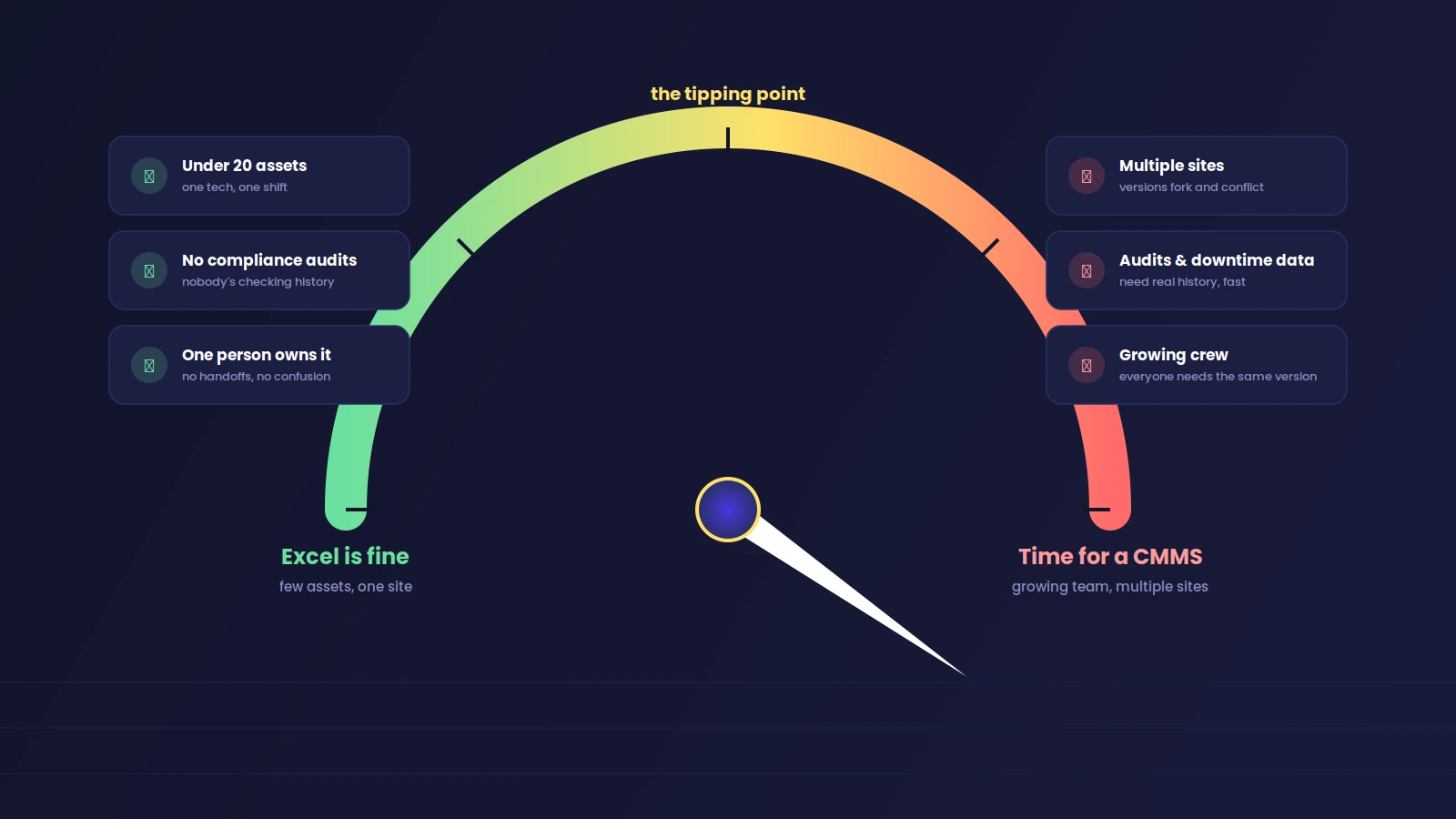
This objection is one of the most common misconceptions. CMMS platforms today are available at every price point, including free tiers and affordable small-business plans. The question isn't company size — it's asset count and maintenance complexity. If you have more than a dozen assets that require regular maintenance, a CMMS almost certainly pays for itself.
"Our team won't adopt new technology"
Change management is a real challenge, and technology adoption requires effort. However, modern CMMS platforms are designed with technician usability in mind. Mobile apps, QR code scanning, and intuitive interfaces have dramatically lowered the adoption barrier compared to legacy systems. The key is involving the maintenance team in the selection process so they feel ownership over the tool.
"Implementation is too complex and time-consuming"
Some enterprise CMMS platforms do require extensive implementation projects. But the market has diversified significantly. Cloud-based systems can be configured and operational within days to weeks. The best vendors provide onboarding support, data migration assistance, and training as part of their service offering.
"We already have spreadsheets that work fine"
Spreadsheets are a starting point, not a solution. They can't automatically generate work orders, send mobile notifications, track real-time inventory, integrate with sensors, or generate audit-ready compliance reports. What feels manageable at a small scale becomes a significant liability as asset portfolios and teams grow.
"We can't justify the cost"
This objection usually disappears when organizations actually calculate the cost of their current situation — reactive maintenance premiums, emergency parts procurement, unplanned downtime losses, compliance failures, and the labor hours spent managing maintenance through manual systems. The ROI calculation section later in this article provides a framework for making this case.
"We don't have IT resources to support it"
Modern cloud-based CMMS platforms require minimal IT involvement. The vendor manages infrastructure, updates are automatic, and operations or maintenance managers can typically handle configuration without specialized technical knowledge.
Implementation Tips for Success
A CMMS is only as good as its implementation. The technology is the easy part — the hard part is change management, data quality, and sustained adoption. Here are the practices that separate successful implementations from expensive abandoned projects.
Start with Why, Not How
Before configuring a single work order template, the implementation team should align on the specific outcomes they're pursuing. Is the primary goal reducing downtime? Improving PM compliance? Passing a regulatory audit? Reducing parts spend? Clear goals drive configuration decisions and provide benchmarks for measuring success.
Involve the Maintenance Team from Day One
Nothing kills CMMS adoption faster than a system designed by leadership and imposed on technicians. Involve the people who will actually use the platform in vendor selection, requirements gathering, and workflow design. Their buy-in is the single most important factor in long-term success.
Clean Your Asset Data Before You Import
Garbage in, garbage out. Take the time to audit and clean your asset list before migrating data into the new system. Remove retired equipment, correct naming inconsistencies, and gather key data points (model numbers, installation dates, serial numbers) for your highest-priority assets. You don't need to be perfect on day one, but starting with clean data saves enormous frustration later.
Phase the Rollout
Don't try to implement every feature at once. Start with asset registry and work order management. Add PM scheduling once work orders are flowing. Layer in inventory management next. Save advanced analytics and integrations for phase three or four. Phased implementation reduces change management burden and allows the team to build confidence incrementally.
Assign a CMMS Champion
Every successful implementation has an internal advocate — someone who owns the system, drives adoption, troubleshoots issues, and continuously looks for ways to extract more value. This role doesn't need to be full-time, but it needs to be someone with credibility on the maintenance team and genuine enthusiasm for the platform.
Define and Enforce Naming Conventions
Early decisions about how you name assets, work order categories, failure codes, and maintenance task types will govern your reporting forever. Take time to define consistent conventions and enforce them from day one. "HVAC-01" and "HVAC Unit 1" and "Rooftop AC #1" being three different records for the same asset is a data quality nightmare.
Measure from the Start
Establish baseline metrics before go-live — current PM compliance rate, reactive vs. planned maintenance ratio, average work order completion time, and downtime hours. Measuring these same metrics post-implementation is how you build the ROI case and sustain organizational support for the investment.
How to Evaluate Maintenance Management Systems
With dozens of credible options on the market, choosing the right CMMS requires a structured evaluation process. Here's a framework for making a well-informed decision.
Define Your Requirements
Start by documenting your specific requirements across key categories: asset types and volume, number of technicians, mobile requirements, regulatory and compliance needs, reporting requirements, and multi-site support. Weight each requirement by importance. This document becomes your evaluation rubric.
Assess Usability for Technicians
The most feature-rich platform fails if technicians don't use it. During demos and trials, have actual technicians (not just managers) try the platform. Evaluate the mobile app specifically — this is the primary interface for most field technicians. Assess how quickly someone new can create a work order, update a task, and find an asset's history.
Evaluate the Vendor, Not Just the Software
A CMMS is a long-term partnership. Investigate vendor stability, customer support quality, implementation resources, training availability, and the product roadmap. Read independent customer reviews on platforms like Capterra and Software Advice. Ask vendors for customer references in your industry and actually call them.
Consider Total Cost of Ownership
Look beyond the per-user subscription fee. Factor in implementation costs, training costs, data migration fees, ongoing support costs, and the cost of any required integrations or customizations. A cheaper platform with a difficult implementation and high ongoing support burden may cost more than a premium option with a smooth onboarding experience.
Run a Structured Pilot
The best way to evaluate a CMMS is to use it. Most vendors offer free trials. Run a structured pilot with a defined set of assets, a team of technicians, and specific use cases. Measure what matters to you. Use pilot results to pressure-test vendor claims.
How to Calculate ROI
One of the most important exercises before and after a CMMS implementation is calculating return on investment. This analysis justifies the budget request and measures success post-implementation.
Step 1: Quantify Current Costs
Downtime Cost: Calculate how many hours of unplanned downtime your operation experiences annually. Multiply by the cost per hour of downtime (lost production, idle labor, spoiled product, delayed service delivery). For manufacturing operations, this figure is often $10,000–$250,000 per hour. Even conservative estimates produce striking numbers.
Formula: Downtime Hours × Hourly Downtime Cost = Annual Downtime Loss
Reactive vs. Preventive Maintenance Premium: Research consistently shows that reactive maintenance costs 2–5x more than planned maintenance for equivalent tasks (emergency labor rates, expedited parts shipping, secondary damage from deferred repairs). Estimate what percentage of your current maintenance is reactive and apply a conservative 2x multiplier to calculate the premium.
Formula: (Reactive Maintenance Spend) − (Equivalent Planned Maintenance Cost) = Reactive Premium
Parts Inventory Carrying Cost: Over-stocked inventory ties up capital. Calculate the value of your current spare parts inventory and apply a carrying cost rate (typically 20–30% annually, accounting for capital cost, storage, obsolescence, and insurance).
Formula: Inventory Value × Carrying Cost Rate = Annual Inventory Cost
Compliance and Administrative Labor: Estimate the hours per year spent compiling maintenance records for audits, preparing compliance documentation, and managing maintenance data manually. Multiply by the fully-loaded labor cost.
Step 2: Project Post-CMMS Improvements
Apply conservative improvement assumptions based on documented industry benchmarks:
- Unplanned downtime reduction: 20–30%
- Reactive maintenance cost reduction: 15–25%
- Inventory reduction: 10–20%
- Administrative labor savings: 30–50%
- Technician productivity improvement: 15–25%
Step 3: Calculate Net Benefit
Annual Benefit = Sum of all projected savingsAnnual CMMS Cost = Subscription fees + Support + Training (annualized)Net Annual Benefit = Annual Benefit − Annual CMMS CostROI = (Net Annual Benefit ÷ Annual CMMS Cost) × 100Payback Period = Annual CMMS Cost ÷ Monthly Net Benefit Most organizations find payback periods of 6–18 months for mid-market CMMS implementations, with ROI figures of 200–500% over a three-year horizon being common in well-documented case studies.
You can also use a simple ROI calculator like this.
Step 4: Present the Case
When presenting to leadership, lead with the downtime cost number — it's typically the largest figure and the most viscerally impactful. Support it with the other cost categories. Show a conservative, base, and optimistic scenario. Include the payback period prominently. The goal is to invest so it does not look like a cost, but like a profit center.
The Best Maintenance Management Systems in 2026
The CMMS market in 2026 is rich with capable platforms. The following are the top options evaluated on usability, feature depth, customer support, value, and real-world performance data.
#1. Zoidii CMMS — Best Overall Maintenance Management System
Best for: Manufacturing, facilities management, food & beverage, and multi-site operations of all sizes.
Zoidii has earned the top position in 2026 by doing something rare in enterprise software: building a genuinely powerful platform that people actually want to use. It delivers the full feature set of a heavy enterprise CMMS with the usability of a modern consumer application. This combination has made it the fastest-growing platform in the market.
What Makes Zoidii Stand Out
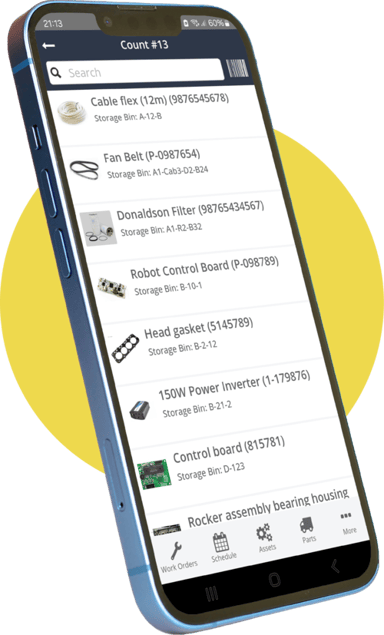
Zoidii's mobile experience is widely regarded as the best in the industry. Technicians can create and update work orders, scan QR codes on assets, attach photos AND videos, log labor and parts, and access complete asset histories.
The preventive maintenance engine is deeply configurable. Schedules can be built on fixed time intervals, floating intervals (triggered from last completion date), meter-based triggers (operating hours, cycles, units produced), and multi-variable combinations. Advanced users can configure seasonal PM plans and task dependencies without any coding.
Zoidii's work order management is fast, flexible, and genuinely easy for non-technical staff to navigate. Maintenance requestors submit requests through a simple web portal or QR code scan — no license required, no training needed. Requests are triaged, prioritized, and assigned within the platform. Technicians receive mobile push notifications, complete tasks with guided checklists, and close work orders in seconds.
The parts and inventory module is one of Zoidii's strongest features. Real-time stock levels, configurable reorder points, multi-location inventory tracking, and supplier catalog integration give maintenance teams and purchasing departments a shared view of parts availability. The system automatically links parts consumption to work orders, eliminating the manual reconciliation that plagues teams using disconnected spreadsheets.
Reporting and analytics in Zoidii are genuinely useful rather than decorative. Pre-built dashboards cover the KPIs that matter — PM compliance, reactive vs. planned ratio, downtime, cost per asset, technician utilization.
Zoidii for Compliance-Heavy Industries
Zoidii has made a particular mark in regulated industries. Food and beverage, pharmaceutical, and healthcare organizations consistently cite the platform's audit trail, calibration management, and procedure-enforcement features as differentiators. Every work order closes with a full activity log. Compliance reports are generated in minutes rather than days.
Implementation and Support
Zoidii's implementation experience is a key part of its value proposition. The onboarding team includes former maintenance professionals — people who speak the language of the customer and understand the practical challenges of CMMS adoption. Implementation timelines range from days for smaller operations to weeks for complex multi-site deployments, with guided data migration, on-site or virtual training, and ongoing success management included.
Customer support is available via live chat, phone, and email with response times that consistently beat the industry standard. The customer community and knowledge base are actively maintained.
Pricing
Zoidii offers transparent, scalable pricing appropriate for organizations from 10 to 10,000+ assets. Free trials are available. Pricing is based on the number of users, with no surprise fees for core features.
Verdict: Zoidii is the standout choice in 2026 — the rare platform that earns high marks from both the C-suite and the shop floor. If you're evaluating CMMS options, Zoidii should be your first call.
#2. UpKeep
Best for: Small to mid-sized organizations seeking a fast, easy-to-deploy solution.
UpKeep built its reputation on mobile-first simplicity and has continued to mature its feature set without sacrificing ease of use. It's an excellent option for organizations that need to go live quickly and have teams with limited technical sophistication.
UpKeep's mobile app is intuitive, and the request portal makes it easy for non-technical staff to report issues. The platform handles work orders, PM scheduling, and basic inventory well. Reporting is adequate for most small operations. Where UpKeep reaches its limits is in complex PM configurations, advanced analytics, and multi-site management at scale. Organizations that outgrow these constraints often find themselves shopping again within a few years.
Verdict: A strong choice for smaller operations; may require replacement as organizations scale.
#3. Fiix (Rockwell Automation)
Best for: Manufacturing organizations with existing Rockwell Automation ecosystems.
Fiix is a capable mid-market CMMS that gained significant momentum after its acquisition by Rockwell Automation. Its integration with Rockwell's broader industrial automation portfolio is a genuine differentiator for manufacturing environments already in that ecosystem. The platform covers work orders, PM scheduling, inventory, and reporting competently.
Fiix's user experience is functional but less polished than leading alternatives. Customer support quality has received mixed reviews in recent years. Organizations outside the Rockwell ecosystem will find less compelling reasons to select Fiix over alternatives with stronger standalone value propositions.
Verdict: A solid choice within Rockwell environments; competitive but not leading outside of it.
#4. IBM Maximo
Best for: Large enterprises with complex, multi-site asset portfolios and substantial IT resources.
IBM Maximo is the granddaddy of enterprise asset management — a platform with decades of history, enormous depth of functionality, and a correspondingly large implementation footprint. For global organizations managing tens of thousands of assets across multiple continents with complex regulatory requirements, Maximo's breadth is genuinely unmatched.
The trade-offs are significant. Maximo implementations are lengthy (often 6–18 months) and expensive. The user experience, while improved in recent versions, still lags far behind modern SaaS competitors. The platform demands substantial IT investment and ongoing administration. Total cost of ownership is among the highest in the market.
For the right organization — typically large enterprises, utilities, and defense contractors — Maximo remains a defensible choice. For anyone else, modern alternatives deliver comparable operational value at a fraction of the cost. Verdict: The right tool for very large, complex enterprises; overkill for most organizations.
#5. Limble CMMS
Best for: Mid-market organizations that prioritize reporting and analytics.
Limble has established a loyal customer base on the strength of its reporting capabilities and clean user interface. The platform covers the standard CMMS feature set well, and its out-of-the-box reporting is more flexible than many competitors in the mid-market.
Limble's implementation experience is generally positive, and customer support receives strong marks. The platform's inventory management module is less mature than its work order and PM capabilities. Organizations with complex parts management requirements may find it limiting. Verdict: A well-regarded mid-market option with strong reporting; worth evaluating alongside Zoidii for mid-market buyers.
#6. Maintenance Connection (Accruent)
Best for: Healthcare and higher education organizations.
Maintenance Connection has carved out a strong niche in healthcare and higher education, where regulatory compliance requirements are complex and asset diversity is high. The platform's compliance documentation features are robust, and it handles the wide variety of asset types found in hospital and campus environments well.
The user experience is dated by modern standards, and implementation can be complex. Organizations outside the healthcare and higher education verticals will find more modern alternatives with competitive feature sets. Verdict: A strong vertical play for healthcare and higher education; less compelling outside those sectors.
#7. MaintainX
Best for: Organizations prioritizing team communication and simplicity.
MaintainX differentiates itself with a strong emphasis on team communication — the platform incorporates messaging and collaboration features directly into the work order workflow. This makes it particularly appealing for organizations where coordination between shifts and between maintenance and operations teams is a pain point.
MaintainX's simplicity is both a strength and a limitation. It excels at the basics and gets teams up and running quickly. More advanced PM configurations, complex inventory management, and enterprise-grade analytics are areas where it trails the leading platforms. Verdict: A good choice for smaller teams that value simplicity and communication; may be outgrown as operations scale.
Frequently Asked Questions
What is the difference between a CMMS and an EAM? A CMMS (Computerized Maintenance Management System) focuses primarily on day-to-day maintenance operations — work orders, PM scheduling, inventory, and maintenance history. An EAM (Enterprise Asset Management) system goes broader, encompassing the full lifecycle of physical assets, including procurement, capital planning, depreciation accounting, and strategic asset optimization. In practice, the lines have blurred, and many modern CMMS platforms have incorporated EAM-level functionality. For most organizations, a well-featured CMMS is sufficient. Large enterprises with significant capital asset portfolios may benefit from a dedicated EAM.
How long does it take to implement a CMMS? It depends heavily on the platform, the size of the operation, and the quality of existing data. Cloud-based mid-market CMMS platforms like Zoidii can be operationally live in days to a few weeks for smaller organizations. Large, multi-site deployments with data migration and integrations typically take 4–12 weeks. Enterprise platforms like IBM Maximo can take 6–18 months. The phased approach — starting with core work order and asset management functionality, then layering in PM scheduling and inventory — reduces time to value significantly.
How much does a CMMS cost? Pricing varies enormously. Entry-level platforms for very small operations start at free or under $50/month. Mid-market platforms suitable for most organizations range from $75–$200 per month per user, or are priced on an asset or site basis. Enterprise platforms can run tens of thousands of dollars per month. When evaluating cost, always consider the total cost of ownership, including implementation, training, and ongoing support — not just the subscription fee.
Do technicians need to be technically savvy to use a CMMS? Not with modern platforms. The best CMMS systems in 2026 are designed specifically for technicians who are skilled at maintenance, not software. Mobile apps with QR code scanning, voice-to-text notes, and photo/video attachment have made the user experience far more accessible than legacy systems. The key is selecting a platform with a genuine focus on technician usability and investing in proper training during implementation.
Is a cloud-based CMMS secure? Leading cloud CMMS vendors invest heavily in security — typically far more than the average industrial organization can replicate on-premises. Look for SOC 2 Type II certification, data encryption at rest and in transit, role-based access control, and audit logging. Reputable vendors are transparent about their security practices and will provide documentation on request. For organizations with specific data residency requirements, verify where the vendor's servers are located and what compliance certifications they hold.
What is the typical ROI on a CMMS investment? ROI varies by industry, current maintenance maturity, and platform quality. Organizations that move from primarily paper-based or spreadsheet-based maintenance to a CMMS typically see the highest returns — often 300–500% over three years. Organizations upgrading from an older CMMS typically see more modest but still compelling returns of 100–200%. The primary value drivers are downtime reduction, reactive maintenance cost reduction, improved technician productivity, and inventory optimization. The ROI framework earlier in this article provides a structured approach to calculating your specific case.
What happens to our data if we switch vendors? This is an important question to ask during vendor selection. Request a clear statement of your data rights, the format in which data can be exported, and the process for data extraction if you choose to leave. Reputable vendors provide data portability as a standard commitment. Be cautious about platforms that make it difficult to export your historical data — this is a red flag about vendor practices more broadly.
Can a CMMS support predictive maintenance? Yes, increasingly so. Leading platforms now offer integrations with IoT sensor platforms that enable condition-based and predictive maintenance. Vibration sensors, thermal imaging, oil analysis, and other condition-monitoring tools feed data into the CMMS to trigger work orders based on actual asset condition rather than fixed schedules. Full predictive maintenance implementation requires both hardware investment and a sufficient volume of historical failure data to build reliable prediction models — it's typically a phase two or three capability rather than a day-one implementation priority. How do we build the business case for a CMMS? The most effective approach is to quantify what poor maintenance management is currently costing you. Calculate annual unplanned downtime costs, the premium you're paying for reactive vs. planned maintenance, inventory carrying costs, and the labor hours spent on administrative maintenance tasks. Apply conservative improvement assumptions from industry benchmarks and compare the resulting savings to the annual cost of the platform. Most organizations find that the payback period is well under two years — often under one. Adding a qualitative case around compliance risk, safety, and knowledge retention strengthens the argument further.
Final Thoughts
The best Maintenance Management System is the one your team will actually use — consistently, completely, and with confidence. In 2026, there is no longer any excuse for managing critical assets with spreadsheets, paper work orders, or institutional knowledge that walks out the door when experienced staff retire.
Zoidii CMMS leads the market because it has solved the hardest problem in maintenance software: building a platform that is genuinely powerful and genuinely usable at the same time. From the mobile app technicians reach for willingly, to the compliance reports that satisfy auditors in minutes, to the analytics dashboards that give maintenance managers a seat at the strategic table — Zoidii delivers on the promise of modern maintenance management. Whether you're implementing a CMMS for the first time or upgrading from a legacy system that no longer serves your needs, the investment pays back many times over. The data is clear. The technology is ready. The only question is when you'll start.