
Introduction: Why These Two Roles Matter More Than Ever in 2026
If you work in facilities management, manufacturing, or any asset-intensive operation, you've likely heard the terms maintenance planner and maintenance coordinator used interchangeably. But they are not the same role - and confusing them is one of the most common reasons maintenance departments fall short of their potential.
In 2026, the stakes are higher than ever. The global CMMS (Computerized Maintenance Management System) market is now valued at $1.45 billion and is projected to reach $3.56 billion by 2035, growing at a compound annual growth rate (CAGR) of 10.51%. Nearly 58% of companies have already shifted toward automated maintenance workflows, and over 52% prioritize predictive monitoring. Maintenance is no longer a back-office function - it is a strategic driver of uptime, profitability, and safety.
Whether you're building out your maintenance team, evaluating your CMMS, or trying to reduce your work order backlog, understanding the distinction between these two roles is essential. This guide breaks it all down.
What Is a Maintenance Planner?
A maintenance planner is responsible for the technical preparation of maintenance work before it happens. Their focus is on what needs to be done and how to do it - not when or by whom.
Think of the planner as the architect of your maintenance program. They develop the detailed procedures, estimate labor hours, identify parts and materials, and create work orders in your CMMS well in advance of execution.
Core Responsibilities of a Maintenance Planner
- Work order creation and management: Building detailed work orders in the CMMS, including job steps, required tools, materials, safety procedures, and estimated labor hours.
- Preventive maintenance (PM) planning: Developing and maintaining PM schedules based on OEM recommendations, equipment history, and criticality analysis.
- Parts and materials coordination: Confirming parts availability or initiating procurement before a job is scheduled, eliminating delays at execution time.
- Technical documentation: Maintaining up-to-date asset records, maintenance procedures, failure code libraries, and historical repair data in the CMMS.
- Backlog management: Prioritizing the work order backlog based on asset criticality, maintenance costs, and available resources.
- Resource estimation: Calculating the labor hours, skill sets, and specialty tools needed for each job so the scheduler can make accurate assignments.
Skills and Qualifications
A maintenance planner typically brings hands-on technical experience - often as a former maintenance technician - combined with strong analytical and organizational skills. In 2026, proficiency with CMMS software is considered a core competency, not an optional add-on.
Valued certifications include the Certified Maintenance and Reliability Professional (CMRP), CMMS-specific training, OSHA certifications, and Six Sigma credentials. The average annual salary for a maintenance planner is approximately $78,000–$85,000, varying by industry, location, and experience. Key insight: A good maintenance planner reduces "wrench time" waste. Organizations that implement proper planning report that technicians spend up to 35% more time on actual repairs versus administrative tasks and parts hunting.
What Is a Maintenance Coordinator?
A maintenance coordinator is responsible for the orchestration and execution of maintenance work on a day-to-day basis. Their focus is on scheduling, communication, and ensuring work flows smoothly from planning to completion.
If the planner is the architect, the coordinator is the site foreman - ensuring the right people, parts, and information come together at the right time. In smaller organizations, this role may be listed as a CMMS Coordinator, Maintenance Scheduler, or Maintenance Administrator.
Core Responsibilities of a Maintenance Coordinator
- Scheduling and dispatching: Assigning planned work orders to technicians based on priority, skill set, availability, and equipment downtime windows.
- CMMS administration: Serving as the primary steward of the CMMS - ensuring work orders are created, updated, and closed out correctly to maintain data integrity.
- Backlog coordination: Keeping the approved-but-unscheduled work backlog organized and preventing critical jobs from slipping through the cracks.
- Parts staging and kitting: Coordinating with the storeroom to ensure all parts and materials are gathered and ready before a technician arrives on-site.
- Cross-functional communication: Acting as the central hub between maintenance technicians, supervisors, operations managers, and procurement teams.
- Work order tracking: Monitoring open work orders through their lifecycle - from scheduled to in-progress to completed - and flagging delays or blockers.
- KPI reporting: Pulling reports from the CMMS to track key metrics such as Mean Time Between Failures (MTBF), Mean Time to Repair (MTTR), PM compliance rates, and backlog size.
Skills and Qualifications
Unlike the maintenance planner, the coordinator does not necessarily need deep technical knowledge of how to perform maintenance tasks. What they must have is exceptional organizational ability, communication skills, and proficiency with CMMS software. They are the glue that holds the entire maintenance operation together.
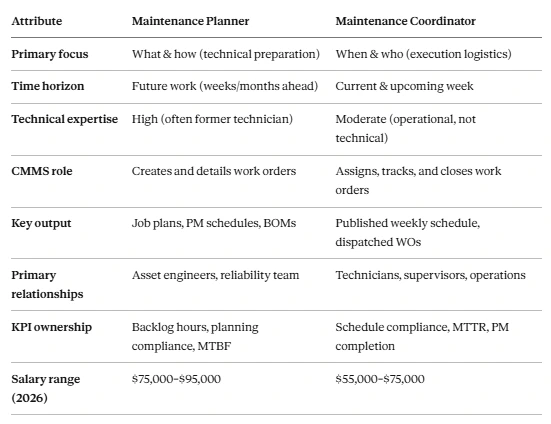
Maintenance Planner vs. Maintenance Coordinator: Side-by-Side Comparison
How CMMS Software Connects Both Roles
This is where modern CMMS software becomes the operational backbone that ties planners and coordinators together.
In 2026, over 68% of large enterprises use mobile-enabled CMMS platforms that give field technicians instant access to job plans, manuals, and asset history - dramatically reducing administrative lag. The most effective maintenance departments treat their CMMS not just as a work order system, but as a single source of truth for every asset, task, and resource in the organization.
Here's how both roles rely on CMMS daily:
The Maintenance Planner Uses CMMS to:
- Build detailed, template-based work orders with embedded job steps, safety notes, and parts lists.
- Create and manage preventive maintenance schedules tied to asset records.
- Track parts inventory and trigger reorder points automatically.
- Analyze asset failure history to refine PM frequencies and job plans.
- Manage the work order backlog and prioritize by asset criticality.
The Maintenance Coordinator Uses CMMS to:
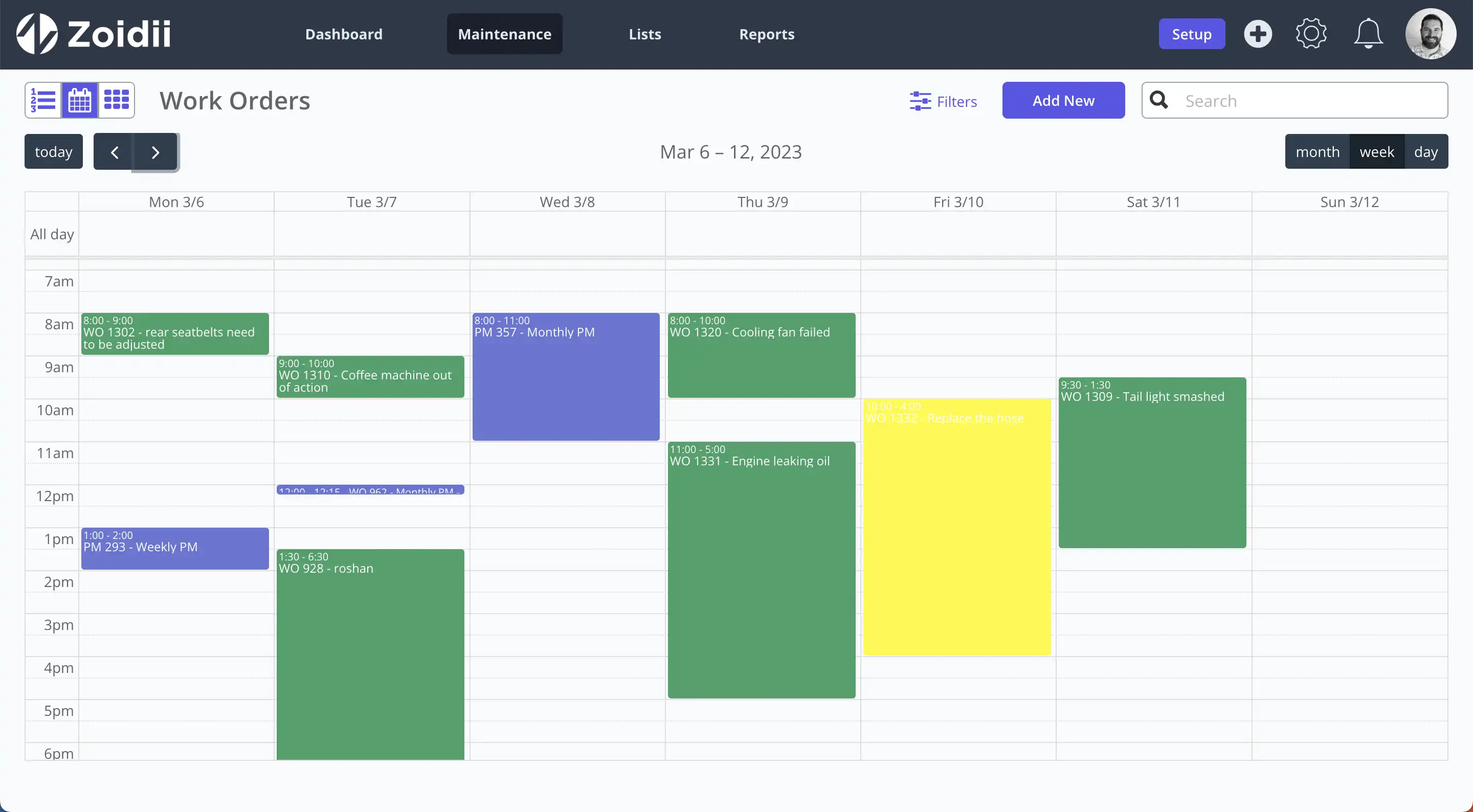
- Assign and dispatch work orders to available technicians.
- Monitor real-time work order status across the entire operation.
- Track schedule compliance and identify bottlenecks.
- Generate KPI reports for management - PM completion rates, backlog trends, MTTR.
- Ensure work orders are properly closed out with labor, parts, and failure codes recorded.
Do You Need Both Roles? (The Answer Depends on Your Team Size)
For many organizations, especially smaller ones, a single person may wear both hats. A practical industry benchmark: one dedicated maintenance planner per 20 maintenance technicians. Below that threshold, a combined planner-coordinator role often makes sense. Above it, separating the functions unlocks major efficiency gains.
Small Operations (1–5 Technicians)
A single coordinator-planner hybrid, supported by a solid CMMS, is typically sufficient. The focus should be on getting work orders into the system, building out basic PM schedules, and establishing data hygiene habits that will scale as the team grows.
Mid-Sized Operations (6–20 Technicians)
This is the inflection point. Separating planning from coordination typically yields measurable improvements in schedule compliance and wrench time. A CMMS becomes critical here for managing the volume of work orders and ensuring nothing falls through the cracks.
Large Operations (20+ Technicians)
Best-in-class organizations at this scale maintain distinct planner, scheduler/coordinator, and materials coordinator roles - all working within the same CMMS ecosystem. Planning is done weeks in advance; scheduling is done one week out; coordination happens daily. This model, supported by a fully integrated CMMS, is what drives world-class maintenance performance.
Common Mistakes When Defining These Roles
1. Asking the planner also to schedule the current week. Planners should be focused on future work. Pulling them into day-to-day scheduling erodes planning quality and creates a perpetual reactive cycle.
2. Treating the CMMS as optional. Without a CMMS, coordinators spend hours chasing paperwork orders and manually tracking parts. In 2026, there is no scalable maintenance operation without digital work order management.
3. Hiring coordinators without CMMS training. The coordinator is effectively the system's administrator and data quality guardian. Poor data entry habits upstream poison every KPI downstream. 4. Skipping the planning step entirely. When technicians show up to jobs without a plan, they spend time hunting for parts, interpreting incomplete instructions, or improvising procedures. Proper planning can reduce job execution time by 20–30%.
5. Confusing the coordinator with the supervisor. The coordinator orchestrates the schedule; the supervisor manages performance, personnel, and strategy. Both roles require the CMMS, but for different purposes.
The 2026 Maintenance Landscape: Why Getting This Right Is Critical
The pressure to optimize maintenance operations has never been greater. Consider these 2026 benchmarks:
- 62% of industrial facilities are shifting from reactive to predictive maintenance - a transition that only works when planning and coordination are properly structured.
- 45% of industrial facilities report improved equipment uptime following CMMS adoption.
- 79% of firms report that maintenance has a moderate-to-high impact on overall business success.
How Zoidii CMMS Supports Both Your Maintenance Planner and Coordinator
Zoidii is purpose-built to give both your maintenance planner and your coordinator the tools they need to work efficiently - without complexity getting in the way.
For Maintenance Planners:
- Build detailed, reusable work order templates with job steps, parts lists, and attached documents
- Create and manage preventive maintenance schedules with nested PM capabilities
- Track asset history, failure codes, and maintenance costs to refine future planning
- Manage parts inventory with real-time stock visibility
- Assign and dispatch work orders to technicians with a clear, visual interface (like a work order kanban view)
- Track work order status in real time across your entire operation
- Pull pre-built reports and KPIs - PM compliance, backlog trends, technician productivity
- Use QR code scanning to link physical assets to their digital records instantly
- A single CMMS platform that keeps planners and coordinators aligned on the same data
- Mobile accessibility so that work orders, plans, and updates are available anywhere, anytime
Conclusion
Maintenance planners and maintenance coordinators are both essential to a high-performing maintenance department - but they are not the same role. The planner prepares the work in technical detail; the coordinator ensures that the work gets executed efficiently.
In 2026, with the CMMS market expanding rapidly and organizations under increasing pressure to reduce downtime and control costs, having both functions clearly defined - and supported by the right CMMS software - is one of the highest-leverage investments a maintenance leader can make.
Whether you're formalizing these roles for the first time or optimizing an existing team structure, the foundation is the same: great planning, disciplined coordination, and a CMMS that connects them.
Frequently Asked Questions (FAQ)
Q: What is the main difference between a maintenance planner and a maintenance coordinator? A maintenance planner focuses on the technical preparation of work — building detailed job plans, estimating labor hours, identifying parts, and creating work orders in the CMMS before a job is scheduled. A maintenance coordinator focuses on execution logistics — assigning those work orders to the right technicians, staging materials, tracking progress, and ensuring jobs are completed and closed out correctly. The planner asks, "What needs to be done and how?" The coordinator asks, "When, by whom, and is everything in place?"
Q: Can one person do both jobs? Yes — in smaller maintenance teams, a single person often handles both planning and coordination. A common industry guideline is to hire a dedicated planner once you have 20 or more maintenance technicians. Below that threshold, a combined role supported by a CMMS is usually sufficient. The key is to ensure the planning function doesn't get crowded out by the urgency of day-to-day scheduling.
Q: Do maintenance planners and coordinators need CMMS experience? Absolutely. In 2026, CMMS proficiency is considered a core competency for both roles — not a nice-to-have. Planners use the CMMS to build work orders, manage PM schedules, and track asset history. Coordinators use it to dispatch work, monitor progress, and generate KPI reports. Without CMMS fluency, both roles are significantly less effective.
Q: What CMMS metrics should a maintenance coordinator track? Key KPIs for a maintenance coordinator include: Schedule Compliance (percentage of planned work completed on time), Mean Time to Repair (MTTR), PM Completion Rate, Backlog Size (in work orders and labor hours), and Work Order Aging (how long jobs have been open). These metrics are all trackable directly within a CMMS like Zoidii.
Q: What CMMS metrics should a maintenance planner track? Maintenance planners should monitor: Planning Compliance (percentage of work executed with a formal job plan), Mean Time Between Failures (MTBF), Backlog Growth or Reduction Rate, and Estimated vs. Actual Labor Hours. Tracking these over time helps planners continuously refine job plans and PM frequencies.
Q: Is a maintenance coordinator the same as a CMMS coordinator? They are closely related. A CMMS coordinator is often a specific title used for someone whose primary responsibility is administering and maintaining the CMMS — ensuring data accuracy, training users, managing work order workflows, and generating reports. A maintenance coordinator has a broader operational scope that includes scheduling and cross-functional communication. In many organizations, the maintenance coordinator effectively serves as the CMMS coordinator as well.
Q: How does CMMS software help reduce unplanned downtime? CMMS software reduces unplanned downtime by enabling structured preventive maintenance scheduling, giving planners visibility into asset history and failure patterns, and allowing coordinators to ensure PM work orders are completed on time. In 2026, organizations that have adopted CMMS report up to a 41% reduction in unplanned downtime, largely because they can catch and address equipment deterioration before it becomes a failure.
Q: What is the right ratio of maintenance planners to technicians? The widely accepted industry benchmark is one maintenance planner for every 15–20 maintenance technicians. In large, complex operations, you may also have dedicated schedulers and materials coordinators working alongside the planner. In smaller teams, one planner-coordinator can support up to 10–15 technicians effectively, especially when supported by a modern CMMS.
Q: Should a maintenance planner also act as a scheduler? Generally, no. Maintenance planning experts consistently advise keeping the two functions separate. When planners are pulled into daily scheduling, they lose the time needed to properly plan future work — creating a cycle where jobs get scheduled without adequate preparation, leading to delays, parts shortages, and rework. The planner should focus on work that is at least one week out; the coordinator or scheduler handles the current week.
Ready to support your maintenance planner and coordinator with a CMMS built for clarity and efficiency? Start your free trial with Zoidii today →