
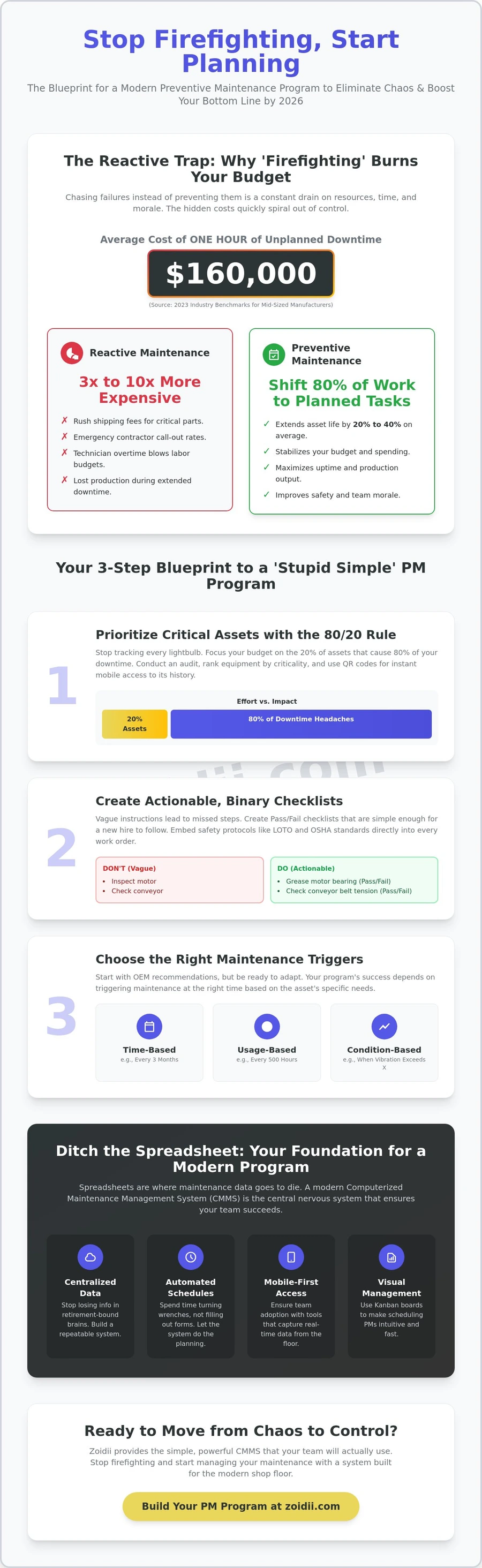
How much does a single hour of unplanned downtime actually cost your facility? For the average mid-sized manufacturer, that number hit $160,000 in 2023 according to industry benchmarks.
If you're still spending your shift chasing smoke and fire instead of following a schedule, you aren't just tired; you're losing money. It's time to stop the reactive cycle.
Building a preventive maintenance program doesn't require a degree in data science or a massive IT overhaul. You need a system that works as hard as your crew does without the unnecessary complexity of traditional enterprise software.
We agree that most maintenance software is too bloated for a busy shop floor to actually use. You want to see your assets last longer and your spare parts closet stay organized without fighting your team to log every bolt.
This guide provides a stupid-simple roadmap to eliminate the chaos and realize your operational goals by 2026.
We'll walk through the exact steps to transition from firefighting to a predictable schedule and give you the hard data needed to justify a budget increase to upper management.
Key Takeaways
- Escape the "reactive trap" and stop firefighting by learning why fixing equipment after it breaks costs up to 10x more than planning ahead.
- Build a preventive maintenance program that actually works by starting with a "stupid simple" audit of your most critical, high-risk assets.
- Master the "when" of maintenance by choosing the right triggers—time, usage, or condition—to keep your facility running at peak efficiency.
- Ensure team adoption with a mobile-first strategy that captures real-time data from the floor without the headache of over-engineered software.
- Modernize your operation with visual Kanban boards and cloud-based tools designed to make scheduling and managing PMs intuitive and fast.
Why Most Preventive Maintenance Programs Fail (And How to Start Right)
Stop waiting for things to explode. A preventive maintenance program is a scheduled routine of inspections, parts replacements, and repairs designed to kill equipment failure before it starts. It’s about taking control of your floor.
Most facilities fall into the reactive trap because they think they're saving time. They aren't. Fixing an asset after it fails is 3 to 10 times more expensive than scheduled preventive maintenance.
In 2026, data suggests unplanned downtime costs manufacturers $125,000 per hour on average. If your preventive maintenance program is too complex, your team will ignore it and go back to paper logs.
Keep it stupid simple, or it won't work.
The ROI of Planning vs. Firefighting
Firefighting feels productive, but it's a budget killer. You aren't just paying for the repair. You're paying for the hidden costs that eat your margins:- Rush shipping fees for "yesterday" delivery of critical parts.
- Emergency contractor call-out rates that double your hourly spend.
- Technician overtime that blows your annual labor budget by mid-year.
By shifting 80% of your work to planned tasks, you stabilize your budget and your sanity. You stop guessing and start knowing exactly what your spend will be next quarter.
CMMS: The Foundation of Modern Programs
Spreadsheets are where maintenance data goes to die. They're clunky, they aren't real-time, and nobody looks at them until something breaks. You need a modern CMMS software to act as the central nervous system for your PMs.This tech shifts your team from recording what already happened to planning what will happen next. It organizes your assets, automates your schedules, and ensures your experts spend their time turning wrenches rather than filling out forms.
When you centralize your data, you stop losing information in retirement-bound brains and start building a repeatable system that anyone can follow. It’s about moving from a culture of "fix it" to a culture of "manage it."
Step-by-Step: Building Your Preventive Maintenance Program from Scratch
Building a preventive maintenance program doesn't require a PhD in engineering. It requires a "stupid simple" approach to your asset list. Most facilities waste up to 40% of their maintenance budget on assets that don't actually impact production.
You don't need to track every lightbulb or office chair. Start by identifying the high-risk, high-value machines that would halt your entire production line if they failed. If a motor burns out and costs you $5,000 an hour in lost uptime, that's where you start.
Critical Asset Inventory & Prioritization
Don't let a massive spreadsheet overwhelm you. Focus on the 80/20 rule: 20% of your assets usually cause 80% of your downtime headaches. Conduct a fixed asset management audit to rank equipment by criticality. High-priority assets get PMs first; low-priority assets can wait. Once you've identified the "must-haves," label them with QR codes. This allows your team to scan a machine and get instant mobile access to its entire repair history. It's about getting the right data to the tech exactly when they're standing in front of the machine.Creating Actionable PM Checklists
Vague instructions are the enemy of efficiency. If a checklist says "inspect motor," your tech will probably just glance at it and walk away. Use clear, binary Pass/Fail steps instead. Every work order should include safety protocols like LOTO and OSHA standards directly in the digital document.This ensures compliance isn't an afterthought. Make your checklists simple enough for a new hire to follow without a supervisor hovering over their shoulder. If a step isn't actionable, delete it.
Set your initial triggers based on OEM recommendations. If the manufacturer suggests greasing a bearing every 500 hours of operation, start there. However, don't treat those numbers as gospel. The success of your preventive maintenance program depends on the feedback loop. Digitize your checklists so they're accessible on the plant floor, not stuck in a dusty binder in the foreman's office.
Once you launch, monitor the results. If a machine is still failing between scheduled services, shorten the interval. If a tech finds zero issues after ten consecutive inspections, you're likely over-maintaining and wasting resources.
Refining these schedules based on real-world data is how you move from reactive chaos to operational order. If you want to see how easy it is to organize your assets and ditch the paperwork, start with a digital-first mindset. Launch, listen to your techs, and adjust your plan every 30 days until the downtime numbers drop.
Choosing the Right Triggers: Time, Usage, or Condition?
Triggers are the "when" of your operation. They turn a plan into action. Without clear triggers, your preventive maintenance program is just a list of good intentions. You have three main ways to kick off a work order: time, usage, or condition. Choosing the wrong one leads to wasted labor or, worse, unexpected downtime.
Time-Based vs. Usage-Based Maintenance
Time-based triggers are the simplest to set up. These are calendar-driven events like "Every Monday" or "Every 6 months." They work best for non-critical items where wear and tear are predictable.Changing HVAC filters every 90 days or inspecting fire extinguishers annually are perfect examples. It's a "set it and forget it" approach that keeps the facility compliant without much effort.
The danger here is "Over-Maintenance." Industry data shows that up to 30% of time-based maintenance tasks are performed too frequently. You end up replacing parts that aren't worn out just because the calendar says so. This wastes money and increases the risk of "infant mortality," where a technician accidentally introduces a fault during an unnecessary repair.
Usage-based maintenance is a smarter play for heavy equipment. Instead of every month, you trigger work every 500 hours of run time or every 5,000 cycles. This reflects the actual stress on the machine.
To make this work, you need to sync meter readings from your equipment into your maintenance software. Modern CMMS tools automate this by pulling data directly from the machine's PLC, so you don't have to chase down odometers with a clipboard.
The Path to Predictive Maintenance
Condition-based triggers are the gold standard. Instead of guessing based on time or hours, you use sensors to detect heat, vibration, or oil quality. If a motor usually runs at 150 degrees but hits 180 degrees, the system triggers an immediate inspection. You only fix things when the data proves they're failing.Predictive maintenance takes this a step further by using data trends to see the future. By integrating IIoT (Industrial Internet of Things) sensors, you can spot a bearing failure 14 days before it actually happens. This gives you a massive window to order parts and schedule the repair during a planned shutdown.
Don't try to be a hero and go full predictive on day one. You should master the basics of your preventive maintenance program first. If your team can't close a basic time-based work order on schedule, adding complex sensors will only create more noise.
Get your schedules organized, get your team disciplined, and then look toward the tech-heavy future of IIoT.
Overcoming the #1 Hurdle: Team Adoption and Mobile Buy-in
The best software in the world fails if your techs won't use it. You can spend thousands on a preventive maintenance program, but if the interface is clunky, it becomes shelfware. Real success in 2026 depends on the people on the floor, not the managers in the office. If the tool doesn't make their lives easier, they'll find ways to bypass it. Adoption isn't about forcing compliance; it's about providing a tool that's actually useful.
Mobile-first isn't just a feature. It's the only way to get real-time data from the floor. When technicians have to walk back to a desktop to log a PM, they don't do it immediately. They wait until the end of the shift. Research shows that delayed data entry leads to a 35% decrease in record accuracy. You need a system that works exactly where the work happens. If it's not in their pocket, it's not part of their workflow.
Stop training your team on "how to use the buttons." That's a waste of energy. Instead, focus your training on how this tool stops the 2 AM emergency call.
When the preventive maintenance program is followed, equipment stays running, and the team gets their weekends back. Eliminate the "Double Entry" problem immediately. Techs should never write on paper only to type it into a computer later. That's a productivity killer that breeds resentment. Keep it stupid simple: one task, one entry, one time.
Mobile Maintenance: Tasks in Their Pocket
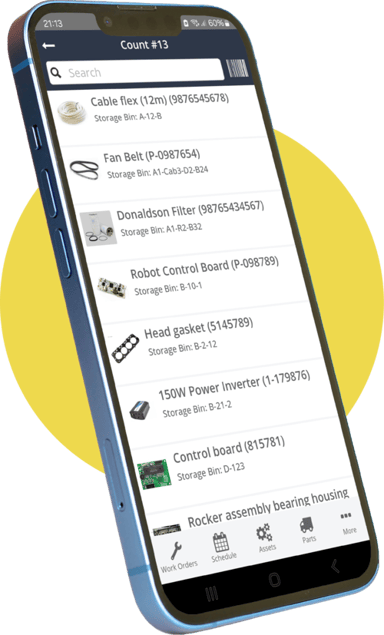
Modern maintenance happens on the move. Techs can snap a photo of a worn bearing and attach it to a work order in seconds. This provides visual proof that a text description can't match. Voice-to-text features allow for detailed notes without fumbling with a keyboard while wearing work gloves. Your program must have an offline mode. Wi-Fi dead zones in a 100,000 square foot facility shouldn't stop the workflow or cause the loss of data.Gamification and Proving Value to the Crew
Maintenance adoption depends on reducing friction between the tool and the technician’s daily workflow. Use visual tools like Kanban boards to give the team a sense of accomplishment. Seeing a "To Do" column shrink provides a psychological win.When the team sees that their PM work directly results in a 20% reduction in emergency repairs, they stop seeing the software as a chore and start seeing it as a shield against chaos.
Stop fighting with clunky systems and see how Zoidii makes maintenance simple for your entire team.
Modernizing with Zoidii: The Cloud-Based PM Advantage
Most maintenance teams hate their software. It is usually bloated, slow, and requires a month of training just to navigate the dashboard. Zoidii was built to be "stupid simple" for teams who want to get work done without the digital friction. It moves your preventive maintenance program from a messy binder or a confusing spreadsheet into a streamlined, cloud-based environment. You won't spend weeks in training; you will be up and running in hours, not days.
Simplifying the Schedule with Kanban
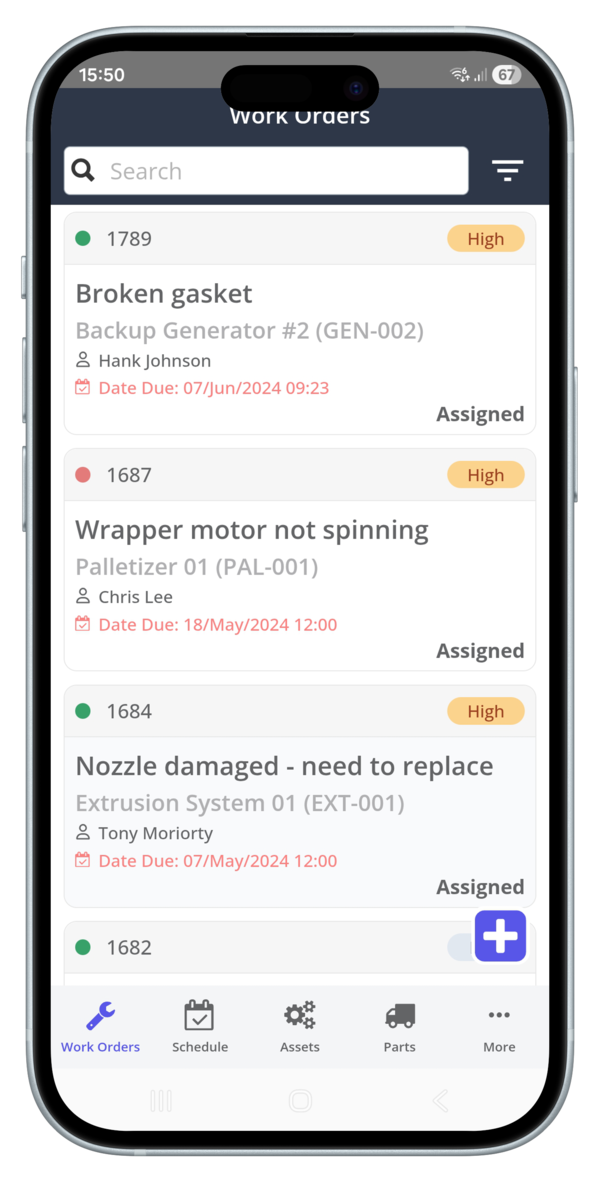
Stop wrestling with cluttered calendars that look like a game of Tetris. Zoidii uses a visual Kanban board to manage your workflow. It is a clear "To Do, Doing, Done" system that anyone on the floor can understand instantly.If a PM is overdue, the card turns red. You can reassign it to a different technician with a single click.
This visual clarity prevents technician burnout by ensuring no one is buried under a mountain of hidden tasks. You see the workload in real-time, you balance the resources, and you keep the facility running without the stress of the unknown.
Guest Work Orders and External Requests
Your preventive maintenance program shouldn't be a closed loop that ignores the rest of the facility. Critical issues often happen outside of your scheduled checks. Zoidii includes Guest Work Orders, allowing anyone in the building to report a problem without needing a login or a license. They simply scan a QR code on the asset, describe the issue, and hit send.This keeps your program agile. Zoidii then handles the communication, sending automated status updates to the requester so they don't have to call the maintenance office for updates every hour.
Chat with a Zoidii product expert to simplify your PM program today!
Automated Reporting and Proving ROI
The C-suite doesn't care about how many bolts your team tightened last Tuesday. They care about uptime, asset longevity, and cost savings. Zoidii’s automated reporting helps you realize your goals by translating raw maintenance data into business value. You can show exactly how your efforts changed the bottom line with concrete data points:- Downtime Reduction: Track how your PMs have reduced equipment failure by a specific percentage, such as a 20% drop in unplanned outages over six months.
- Asset Life Extension: Prove that regular servicing is pushing the replacement date of a $50,000 compressor back by three years.
- Labor Efficiency: Show that your team is spending 80% of their time on planned work rather than firefighting.
Take Control of Your Facility's Future Today
Building a world-class preventive maintenance program doesn't require a 500-page manual or a team of data scientists. In 2026, the difference between operational excellence and constant firefighting comes down to two factors: choosing the right triggers and ensuring your team actually uses the software.
Industry benchmarks suggest that 80% of your maintenance should be proactive to avoid the high costs of emergency repairs. Most programs fail because they're over-engineered, but successful facilities focus on 100% team adoption by putting mobile-first tools in every technician's pocket.
You've seen the roadmap for modernizing your assets. Now it's time to ditch the spreadsheets and the clunky legacy systems that slow you down. Zoidii provides the #1 Rated Cloud-Based CMMS with SSO integration for enterprise-grade security and a mobile-first design built for the shop floor. It's time to realize your goals without the headache of complex setups.
We've stripped away the fluff so you can focus on keeping your equipment running at peak performance.
Book a demo with Zoidii and see how "stupid simple" maintenance can be.
You've got the plan, and the tools are ready. Let's get to work and make your maintenance department the most organized part of your business.
Frequently Asked Questions
What is the first step in setting up a preventive maintenance program?
The first step is creating a complete asset registry. You can't maintain what you don't track, so you must list every piece of equipment along with its location and criticality. Start with your 20 most important machines to keep the initial data entry manageable.This list serves as the foundation for your entire preventive maintenance program and ensures no critical hardware is overlooked during the scheduling phase.
How many assets should I include in my initial PM program?
You should focus on your top 20% of critical assets during the first 90 days. This follows the Pareto principle, where 20% of your equipment usually causes 80% of your downtime and repair costs.Trying to log 500 machines at once leads to bad data and team burnout. Once these high-priority assets are stable, you can add 10 to 15 more assets per month until you reach full coverage.
Is preventive maintenance better than predictive maintenance?
Preventive maintenance is better for teams that need a reliable foundation without high upfront sensor costs. While predictive maintenance uses real-time data to guess when a part might fail, it requires a high level of technical maturity.Most successful facilities maintain an 80/20 split. They use a preventive maintenance program for 80% of their tasks and save expensive predictive tools for their most complex, high-value machinery.
How much does it cost to implement a preventive maintenance program?
Implementation costs depend on your facility size, but the 2023 Plant Engineering Maintenance Survey shows that facilities typically spend about 20% of their budget on maintenance software and staff training.You'll need to account for labor hours spent on data collection and the cost of a CMMS subscription. Most operations realize a full return on investment within 6 to 12 months by reducing emergency repair expenses and extending equipment life.
How do I know if my preventive maintenance program is actually working?
You know it's working when your PM compliance rate stays above 90%, and your emergency work orders drop by at least 25%. Track your Mean Time Between Failures (MTBF) over a 6-month period to see if the time between breakdowns is increasing.If you're still firefighting every week, your tasks are either too infrequent or your team isn't performing the inspections correctly. Numbers don't lie.
Can I use Excel for a preventive maintenance program?
You can use Excel for a basic list, but it's a mistake if you want to scale your operations. Spreadsheets lack automated reminders, photo attachments, and real-time updates for your team.Research indicates that 88% of spreadsheets contain errors, which leads to missed inspections and broken machines. A cloud-based CMMS keeps things stupid simple by putting the schedule on a mobile phone instead of a hidden desktop file.
What is the most common reason preventive maintenance programs fail?
The most common reason for failure is over-complication during the setup phase. Managers often try to track 50 different variables for every asset, which overwhelms the technicians.When a system feels like a burden, people stop using it. Keep your checklists short and focused on high-impact actions. Success comes from consistency and keeping the process stupid simple, not from having the most complex data points in the industry.