
Spending $500,000 on high-end predictive maintenance software won't save your facility if your team finds the interface impossible to use. It's a common trap in 2026.
While the global market for these tools has climbed to $13.36 billion, many managers are still drowning in complex IoT data and "Agentic AI" alerts they can't act on. You want to reduce downtime, not add another layer of technical debt to your daily workflow.
We agree that maintenance should be about fixing assets, not fighting with your computer. You're likely looking for a way to stop unexpected failures without paying an expensive "integration tax" or spending six months on implementation.
This guide is designed to be stupid simple. You'll learn exactly what this software does, how it compares to your existing preventive schedules, and how to realize your goals without the over-engineered headache.
We're stripping away the fluff to provide a clear ROI path for the C-suite and a system your team will actually use. From understanding real-time sensors to setting up a reliable CMMS backbone, here is your straight-shooting guide to operational order.
Key Takeaways
- Learn how predictive maintenance software uses real-time sensor data to catch failure patterns before they cause a total plant shutdown.
- Discover why 2026 is the year of the "Hybrid Approach," combining time-based schedules with condition-based triggers to balance your budget and risk.
- Identify the common complexity traps that make most advanced systems fail and learn how to choose software your team will actually use.
- Follow a simple two-step implementation plan that starts with organizing your assets and focuses on a pilot study for your most critical equipment.
- See how visual management tools like Kanban boards can turn technical data into clear, actionable work orders that reduce stress for everyone.
What is Predictive Maintenance Software? (PdM Explained)
Think of your machinery as a high-performance athlete. You wouldn't wait for a heart attack to visit a doctor. You'd monitor heart rate and recovery to spot trouble early.
Predictive maintenance software does exactly that for your factory. It acts as a data-driven early warning system for industrial assets. Using real-time info, it tells you when a component is about to fail. It's a massive step up from reactive maintenance. You stop fixing things after they break. Instead, you fix them because the data says it's time.
The core goal is stupid simple. You want to maximize asset life while minimizing unnecessary maintenance tasks. Why replace a bearing every six months if it's running perfectly?
On the flip side, why wait for it to seize and stop production for eight hours? Predictive maintenance (PdM) helps you find the sweet spot. You fix things only when necessary, but always before a disaster.
In 2026, with the solutions segment leading the market with a 73.9% share, this technology is no longer a futuristic experiment. It's a practical tool for keeping your floor organized.
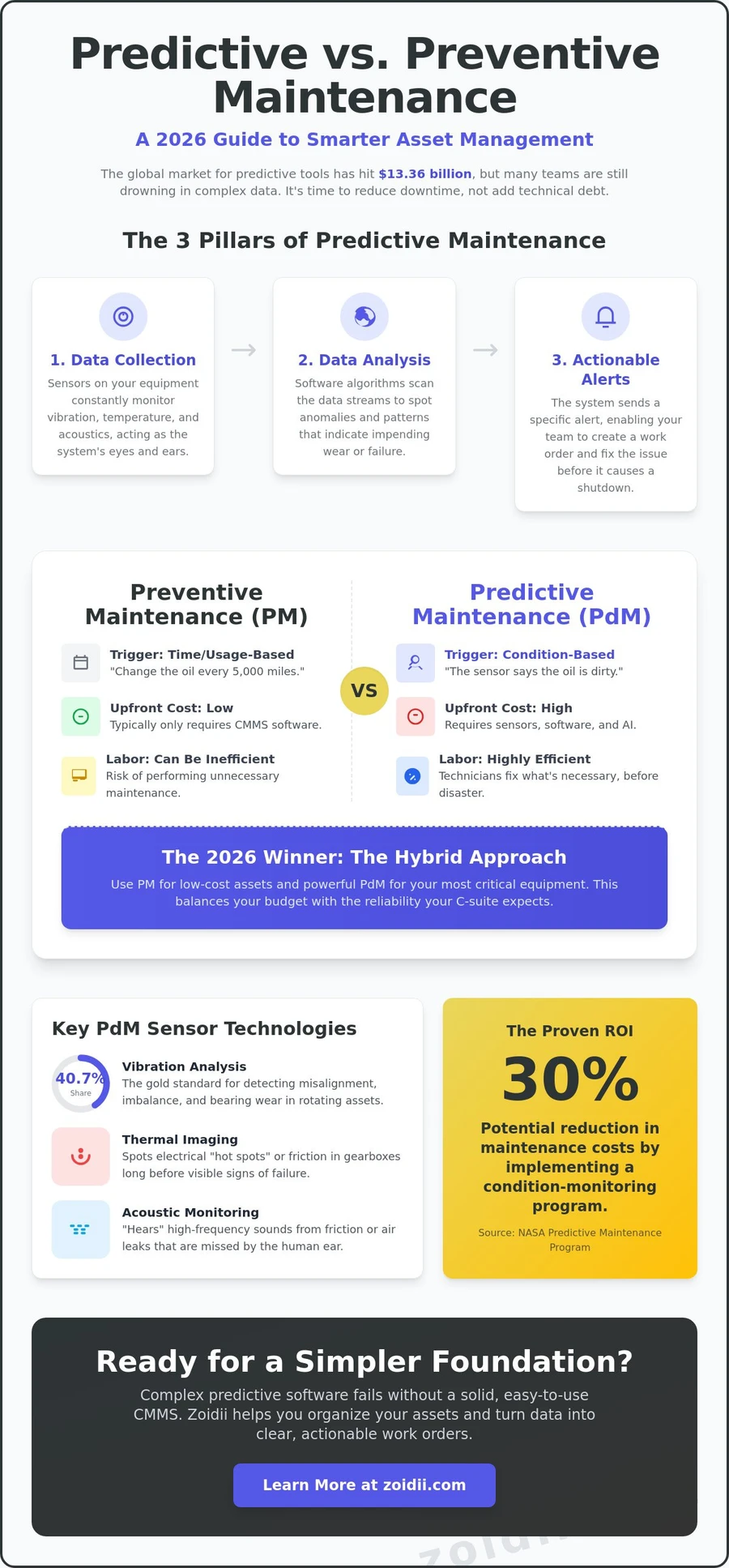
The 3 Pillars of Predictive Maintenance
Implementation doesn't need to be a headache. It boils down to three steps that turn raw noise into organized action. We call this the path to operational order.- Data Collection: Sensors attached to your equipment act as the eyes and ears. They constantly feed information like vibration levels, temperature, and acoustic signatures into the system.
- Data Analysis: This is where the predictive maintenance software earns its keep. Algorithms scan the data to spot "anomalies." These are tiny changes in equipment behavior that suggest wear or misalignment.
- Actionable Alerts: The system doesn't just give you a pretty graph. It sends a specific alert to your team. You can turn this into a work order before a catastrophic breakdown occurs.
Common Sensors Used in PdM
You don't need to monitor every single bolt. Focus on the sensors that give you the clearest picture of health. As of 2026, vibration monitoring holds a 40.7% share of the market because it's incredibly effective for rotating assets.- Vibration analysis: This is the gold standard for detecting misalignments, loose bolts, or bearing wear in motors and pumps.
- Thermal imaging: These sensors spot "hot spots" in electrical panels or gearboxes. These heat spikes often indicate friction or electrical resistance before smoke appears.
- Acoustic monitoring: These tools "hear" high-frequency friction or air leaks that the human ear misses. It catches problems in their earliest stages.
Predictive vs. Preventive Maintenance: A 2026 Comparison
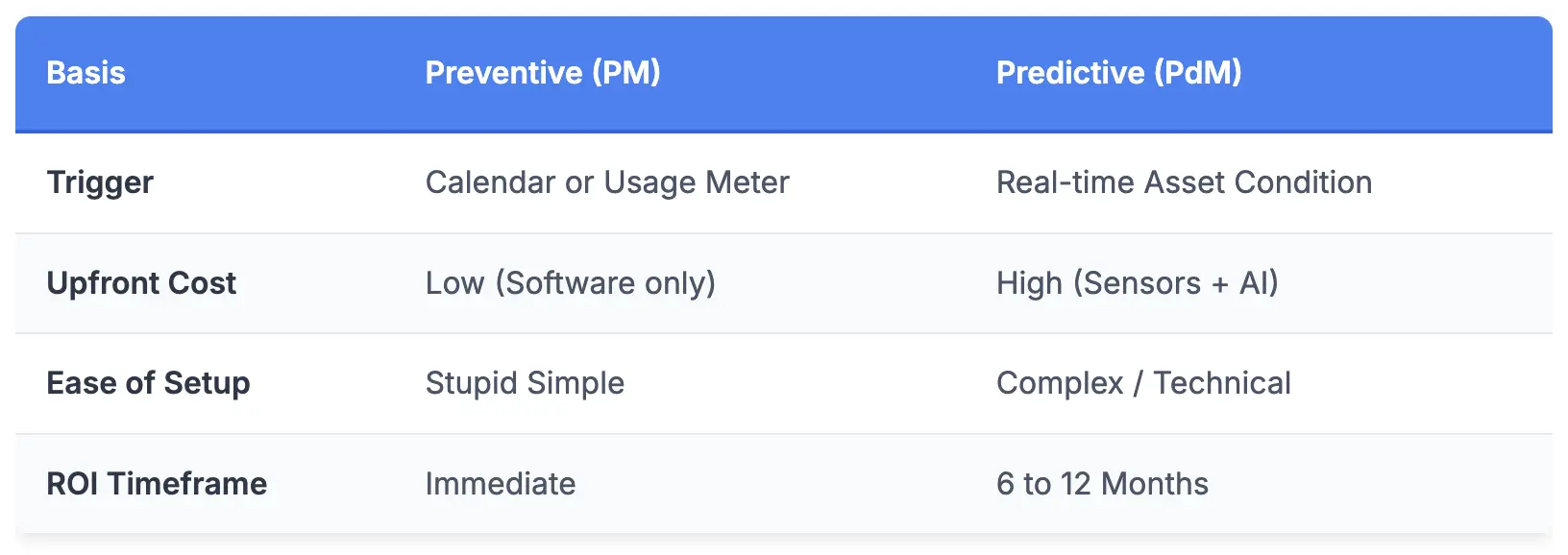
Preventive maintenance is like changing your car's oil every 5,000 miles. You do it because the calendar says so, regardless of how the engine actually sounds. Predictive maintenance is like a smart sensor telling you the oil is dirty and needs a change today.
One is time-based; the other is condition-based.
In 2026, the industry has moved toward a "Hybrid Approach." You don't need sensors on every lightbulb, but you definitely need predictive maintenance software for your critical assets. This strategy balances the high cost of sensors with the reliability your C-suite expects.
PdM requires a higher upfront investment for hardware and software. However, it offers significantly lower long-term labor costs. You stop wasting technician hours on "ghost" PMs that aren't actually necessary.
Insights from NASA's Predictive Maintenance Program prove that condition monitoring can reduce maintenance costs by up to 30%. Before you jump into advanced analytics, you must have a solid preventive maintenance program in place. You can't predict the future if you haven't organized your present.
When to Stick with Preventive Maintenance
Keep it simple for low-cost assets. If a sensor costs $500 but the motor only costs $400, sensor installation is a waste of money. Stick with PMs for non-critical equipment that doesn't halt production if it fails.If your facility is just starting its digital transformation, focus on getting your work orders organized first. You can see how a simple CMMS works to build this foundation before worrying about complex algorithms.
When to Upgrade to Predictive Maintenance
Upgrade when you have "bottleneck" machines where downtime costs thousands per hour. If an asset has unpredictable failure patterns that your time-based PM misses, you need predictive maintenance software to catch the anomalies.High-value equipment is the best candidate for this. Extending the life of a million-dollar asset by even 10% provides a massive return on investment that justifies the initial setup headache.
The Blunt Truth: Why Most PdM Software Fails
Most predictive maintenance software implementations don't fail because the technology is broken. They fail because the humans involved can't use it. We call this the "Complexity Trap." If your dashboard requires a data science degree to interpret, your maintenance team will ignore it. In an industry where 33.2% of the market is driven by manufacturing, the pressure to perform is high.
You don't have time to fight with over-engineered features that only look good in a sales presentation. If the software takes months to learn, it becomes an expensive paperweight rather than a tool for operational order.
Another major hurdle is the "Garbage In, Garbage Out" problem. Predictive algorithms are only as good as the historical data you feed them. If you haven't been tracking asset health or work order history, the AI has nothing to learn from. Many facilities suffer from "Shiny Object Syndrome." They buy a $50,000 AI tool before fixing their basic work order flows.
You cannot predict the future of an asset if you don't even know its past. This lack of foundation is why many companies get hit with a hidden "integration tax" when they try to connect sensors to a disorganized system.
The 'Stupid Simple' Principle in PdM
User adoption is the only metric that truly matters for ROI. If the team doesn't use the software, you won't realize your goals. To succeed, you must reduce "alert fatigue." A system that flags every tiny vibration as a crisis will quickly be muted by frustrated technicians. The goal is to integrate these alerts directly into your cmms software workflow.When the predictive maintenance software spots a critical anomaly, it should automatically trigger a clear, visual work order that anyone can understand.
Integration Headaches and How to Avoid Them
Siloed data is the enemy of efficiency. You don't want your sensor data living in one app and your asset history in another. This separation creates a massive headache for managers trying to see the big picture.Open APIs are non-negotiable for modern maintenance tech because they allow different systems to talk to each other without expensive third-party integrators.
We recommend starting small. Use a "One Asset" pilot program. Pick your most critical machine, get the data right, and prove the ROI before rolling it out to the entire plant. This staged approach keeps things organized and prevents the team from feeling overwhelmed.
How to Implement Predictive Maintenance Without the Headache
Implementing predictive maintenance software shouldn't feel like a second full-time job. Most managers fail because they try to boil the ocean on day one. You don't need a sensor on every conveyor belt and light socket. Instead, you need a lean, tactical roadmap that delivers results without the over-engineered stress.
If you follow these five steps, you'll move from disorganized chaos to operational order in months, not years.
- Step 1: Get your fixed asset management in order. You cannot predict the failure of a machine you haven't even tracked. Clean up your asset list, tag your equipment, and ensure your historical data is accurate before you buy a single sensor.
- Step 2: Identify your "Top 5" critical assets for a pilot study. Focus only on the machines that would halt production if they failed today. These are your bottlenecks where the ROI is easiest to prove.
- Step 3: Choose sensors that match your specific failure modes. Don't buy a thermal camera if your main problem is bearing misalignment. Match the tool to the trouble.
- Step 4: Integrate sensor alerts directly into your mobile maintenance app. An alert that sits in an inbox is useless. It must trigger a visual work order on a technician's phone immediately.
- Step 5: Review, refine, and scale. Run the pilot for 90 days. Look at the data, see what was caught, and then roll the system out to the rest of the facility.
Auditing Your Current Infrastructure
Before you commit, check your connectivity. Do you have reliable Wi-Fi or cellular coverage on the plant floor? With 45.2% of EU enterprises already purchasing cloud services, your facility needs that digital backbone to handle real-time data streams.You should also ask if your team is trained on digital work orders yet. If they're still using paper, a high-tech predictive system will likely fail. Look for "low-hanging fruit" like simple motors or pumps where sensor installation is stupid simple and the wins are quick.
Calculating ROI to Prove it to the C-Suite
The C-suite cares about the bottom line, not the "cool" factor of AI. Use this formula to prove the value: (Hourly Downtime Cost) x (Estimated Hours of Failure Prevented). This gives you a hard number for avoided costs.You should also factor in labor savings from reduced "inspect and find nothing" PMs. Instead of checking a machine every week, you only go when the software tells you to.
Additionally, predictive maintenance software reduces MRO inventory costs by predicting specific parts needs, allowing you to order only what's necessary rather than hoarding expensive spares.
Zoidii: The Simple Foundation for Maintenance Success
High-tech sensors and advanced algorithms are useless if your team can't turn that data into a completed repair. You don't need more noise; you need a system that organizes the chaos. Zoidii acts as the operational backbone for your facility.
We help you move from disorganized spreadsheets to operational order with a setup that takes minutes, not months. We're trusted by maintenance teams worldwide to provide a stupid-simple interface that technicians actually use on the floor. Whether you're managing a pilot study on five critical assets or an entire factory, we provide the reliable backbone you need to succeed in 2026.
We focus on being "stupid simple" because we know that user adoption is the only way you'll ever realize your goals. While the market for predictive maintenance software is projected to hit $15.29 billion in 2026, many of those dollars are wasted on tools that technicians find too frustrating to open.
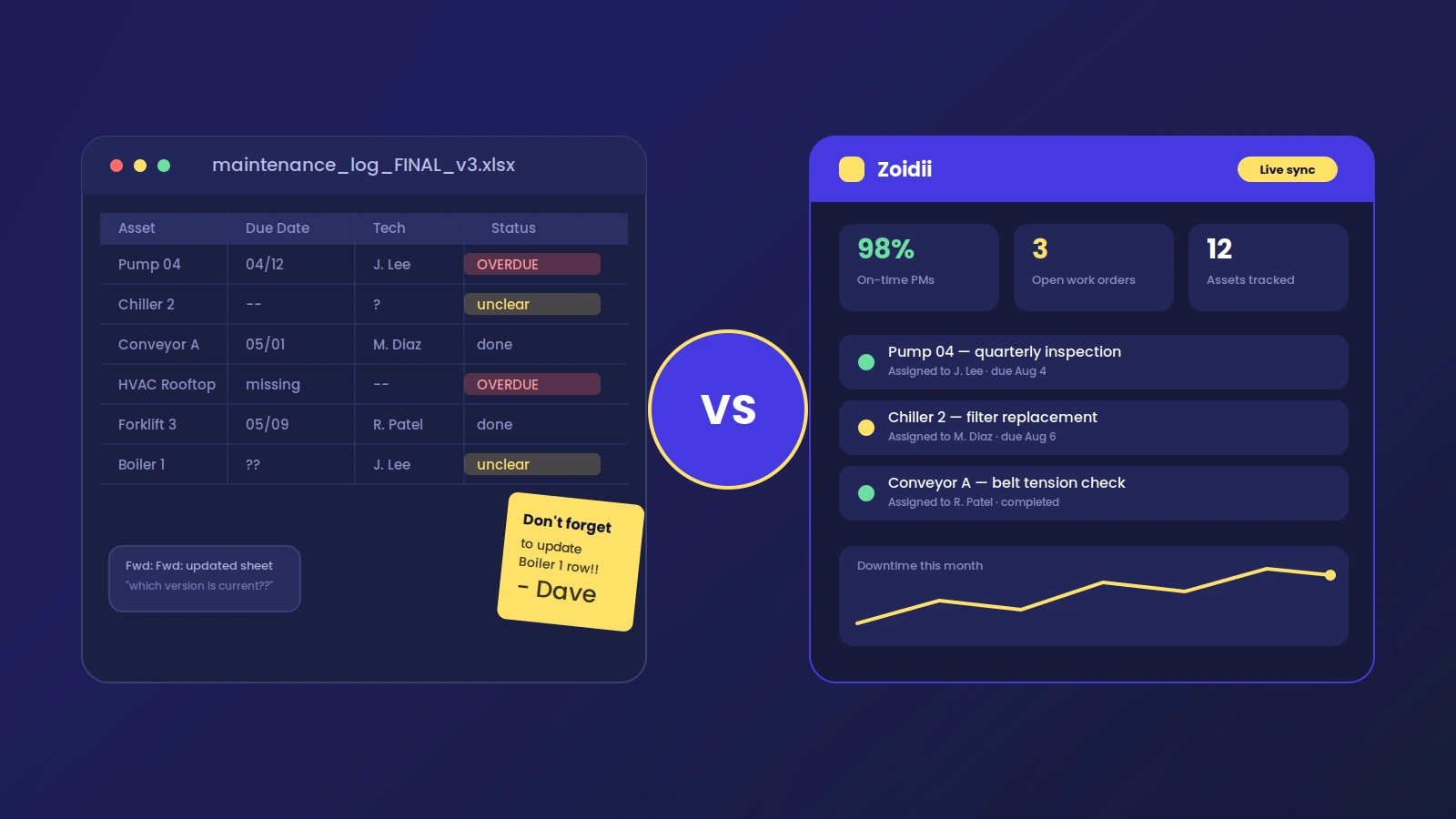
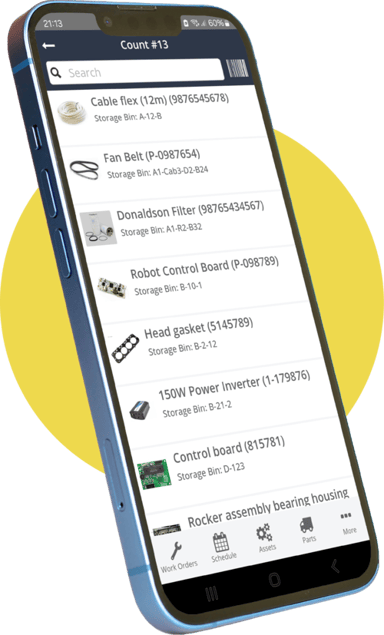
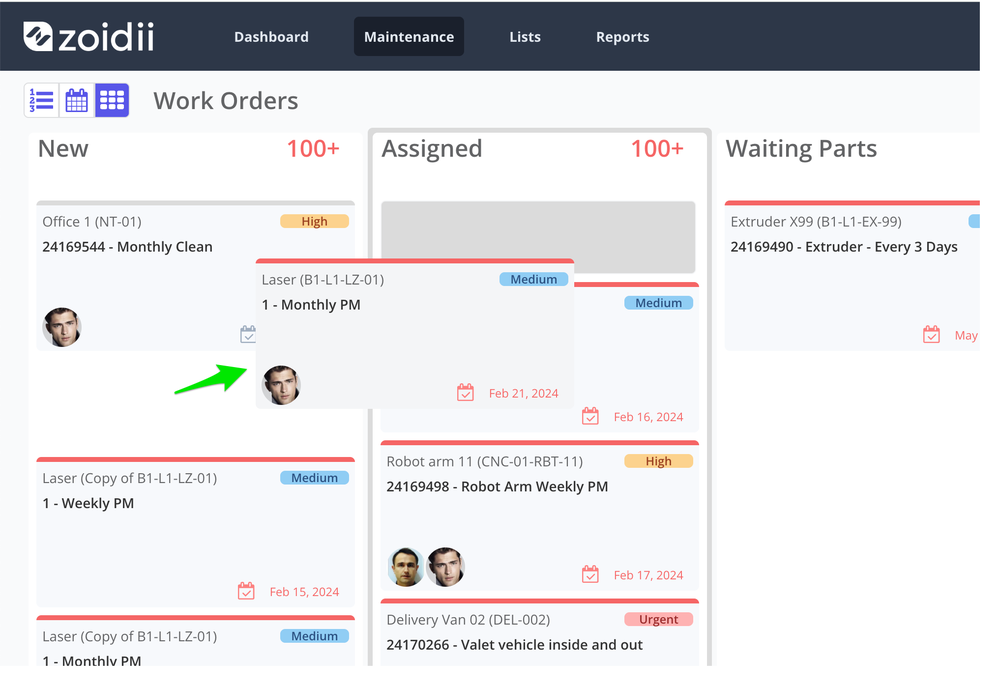
Zoidii is designed to be simple to implement and adopt. We use visual Kanban boards to make alerts actionable. This visual approach eliminates the confusion of traditional lists. If your team is on the move, our mobile-first design ensures they have everything they need in their pocket. They can update work orders, check parts inventory, and upload photos without ever walking back to a desktop computer.
A CMMS That Actually Gets Used
Success in maintenance is about eliminating friction. If it's hard to report a problem, people won't do it. Zoidii uses guest work orders to let anyone in your facility flag an issue in seconds. This feeds your data stream and ensures no "low-hanging fruit" is missed.Our real-time reporting then takes all this activity and turns it into a clear ROI narrative for the C-suite. You can show exactly how many hours of downtime were avoided and how your maintenance shift is saving the company money. It's about moving from a cost center to a value driver.
Ready to Stop Firefighting?
You don't have to spend months in a "complexity trap" to see results. Most of our users organize their assets and see their first wins in minutes, not months. We invite you to book a demo with a product expert.You won't be talking to a sales rep who has never seen a wrench; you'll be talking to someone who understands the pressure of a downed production line.
Chat with a Zoidii expert today and see how easy operational order can be.