
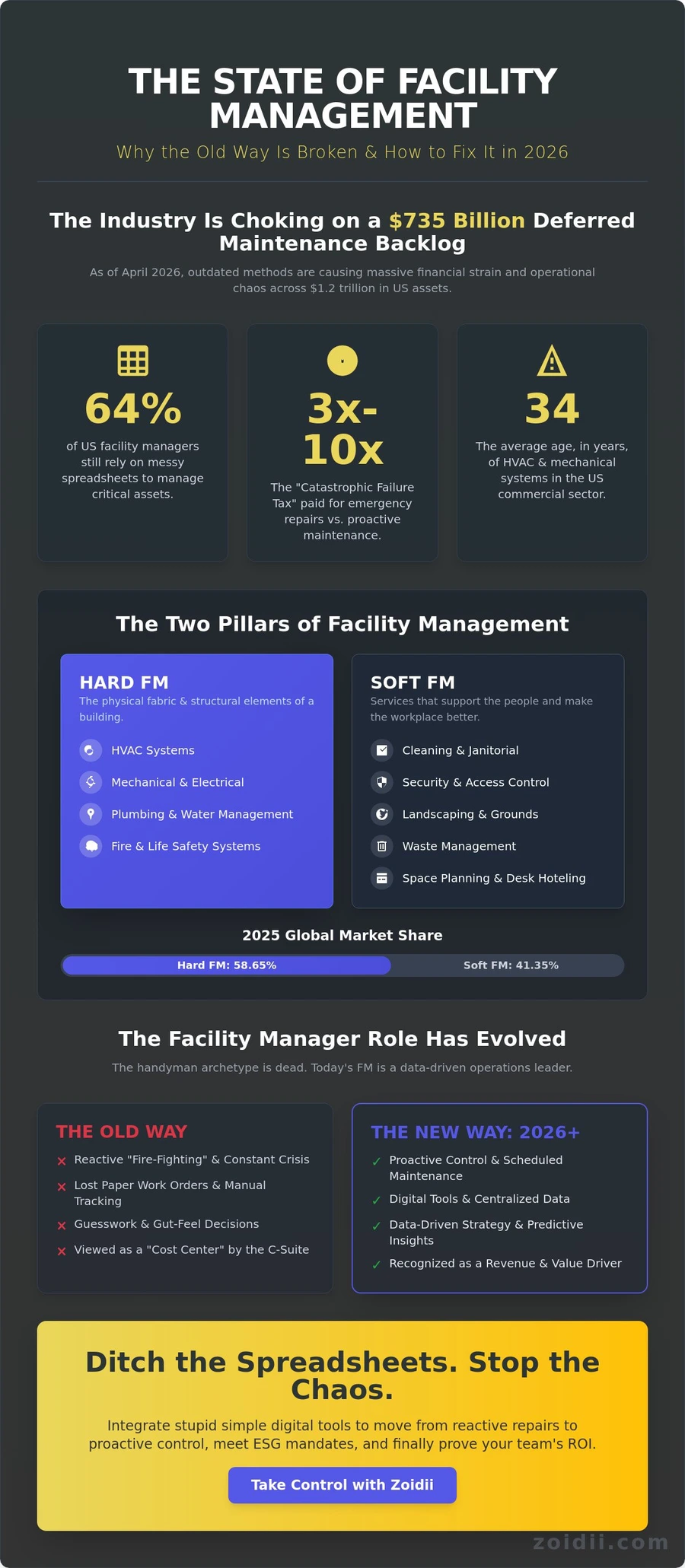
Even in April 2026, 64% of US facility managers are still trying to run $1.2 trillion worth of assets using messy spreadsheets and disconnected work order systems. It's a direct cause of the $735 billion deferred maintenance backlog currently choking the industry. You likely feel the weight of constant fire-fighting and paper work orders that vanish the moment they're printed. It's exhausting to lead facility management when you can't prove ROI to a C-suite obsessed with mandatory ESG reporting and the bottom line.
We agree that the old way of doing things is broken and over-engineered. This guide provides a pragmatic, blunt breakdown of the principles you need to stop the reactive chaos for good. You'll get a clear understanding of the core FM pillars and a roadmap to transition from reactive repairs to proactive control. We're keeping it stupid simple so you can organize your assets and finally realize your operational goals.
Key Takeaways
- Stop treating facility management as a cost center and learn how to coordinate people and assets to drive actual revenue.
- Master the two pillars—Hard and Soft FM—to ensure both your building's physical fabric and occupant services remain functional.
- Identify why "free" spreadsheets are costing you thousands and how to break the reactive cycle of constant fire-fighting.
- Follow a pragmatic roadmap to audit your assets and ditch the manual work orders that get lost in the shuffle.
- Learn how to integrate stupid-simple digital tools to meet 2026 ESG mandates without over-complicating your team's workflow.
What is Facility Management? (The Blunt Truth)
Cut the fluff. Facility management isn't just about changing lightbulbs or unclogging toilets. It's the strategic practice of coordinating your physical workplace with the people and the work of the organization.
In 2026, it's the thin line between a facility that supports revenue and one that consumes your budget through neglect and reactive chaos. If your building isn't functional, your business isn't profitable. It's that simple.
If you want to understand what is facility management at its core, think of it as the guardian of your asset's lifecycle. Your core objective is to ensure safety, functionality, and longevity for every piece of equipment you own. But as of April 2026, the game has changed.
You can no longer just "fix things" when they break. You have to manage data to stop them from breaking in the first place. With the US facility management market reaching a value of $1.2 trillion this year, the stakes for getting this right have never been higher.
The Evolving Role of the Facility Manager
The handyman archetype is dead. Today, you're a data-driven operations leader. You have to balance the immediate needs of tenants with the long-term health of the building. Here's the straight-shooting reality: if you aren't tracking it, you aren't managing it.With the US deferred maintenance backlog exceeding $735 billion in 2026, you can't afford to guess. You need a stupid-simple way to see what's happening across your entire portfolio. You're no longer just a "building guy"; you're a protector of the company's largest physical investments.
Why Facility Management Matters for Your Bottom Line
Good management hits the balance sheet immediately. In 2026, ESG reporting is mandatory for large enterprises in most major economies. This means managing energy consumption isn't just a "nice to have" anymore; it's a core KPI that you must report to the C-suite. Proper facility management extends the life of HVAC and mechanical systems that are, on average, 34 years old in the US commercial sector.By moving away from reactive maintenance, you avoid the "catastrophic failure tax." That's the 3x to 10x cost multiplier you pay when an asset dies because you ignored the PMs.
You realize success by optimizing labor and reducing energy waste, not by working harder during a crisis. When you organize your team and your assets, you stop bleeding cash and start proving your value to the organization.
Hard FM vs. Soft FM: Understanding the Two Pillars
Think of your building as a living organism. Hard FM represents the skeleton and internal organs; it's the physical fabric that keeps the structure standing and functional. Soft FM is the skin and the personality; it's the suite of services that make the environment safe and pleasant for the people inside.
In 2025, Hard Services accounted for 58.65% of the market share, proving that most budgets still lean heavily toward the "bricks and mortar" side of operations.
However, successful facility management requires a perfect balance. If you over-index on one while ignoring the other, you're either managing a beautiful building with broken toilets or a high-tech engine room in a filthy, unsafe workspace.
True operational efficiency lives at the intersection of these two pillars. You can see this balance in action by looking at how municipal leaders define Hard FM vs. Soft FM to keep public infrastructure running. It's about ensuring the physical assets and the human services work in tandem. When they don't, your costs skyrocket, and your team burns out.
Hard Facility Management Services
Hard FM covers the items you can't easily move. This includes Mechanical and Electrical (M&E) systems, plumbing, and HVAC. These are the hearts of your facility. In 2026, fire safety and water management remain non-negotiable compliance areas that require strict adherence to evolving regulations.Because these systems are complex and high-stakes, they demand specialized maintenance scheduling software. You can't track a 30-year-old chiller's health on a post-it note. You need a system that triggers PMs automatically so you don't realize there's a problem only after the system fails.
Soft Facility Management Services
Soft FM focuses on the human element. This includes cleaning, landscaping, security, and waste management. While these might seem secondary, they are the "face" of your facility. With the rise of hybrid work models in 2026, space planning and desk hoteling have become critical soft services. You're no longer just cleaning floors; you're optimizing underutilized space to save on energy and leasing costs.Many managers outsource these niche services to external contractors. The trick is keeping those contractors organized without drowning in emails. If you're ready to stop the chaos, you can get your team organized and start realizing your efficiency goals today.
Why Most Facility Management Strategies Fail
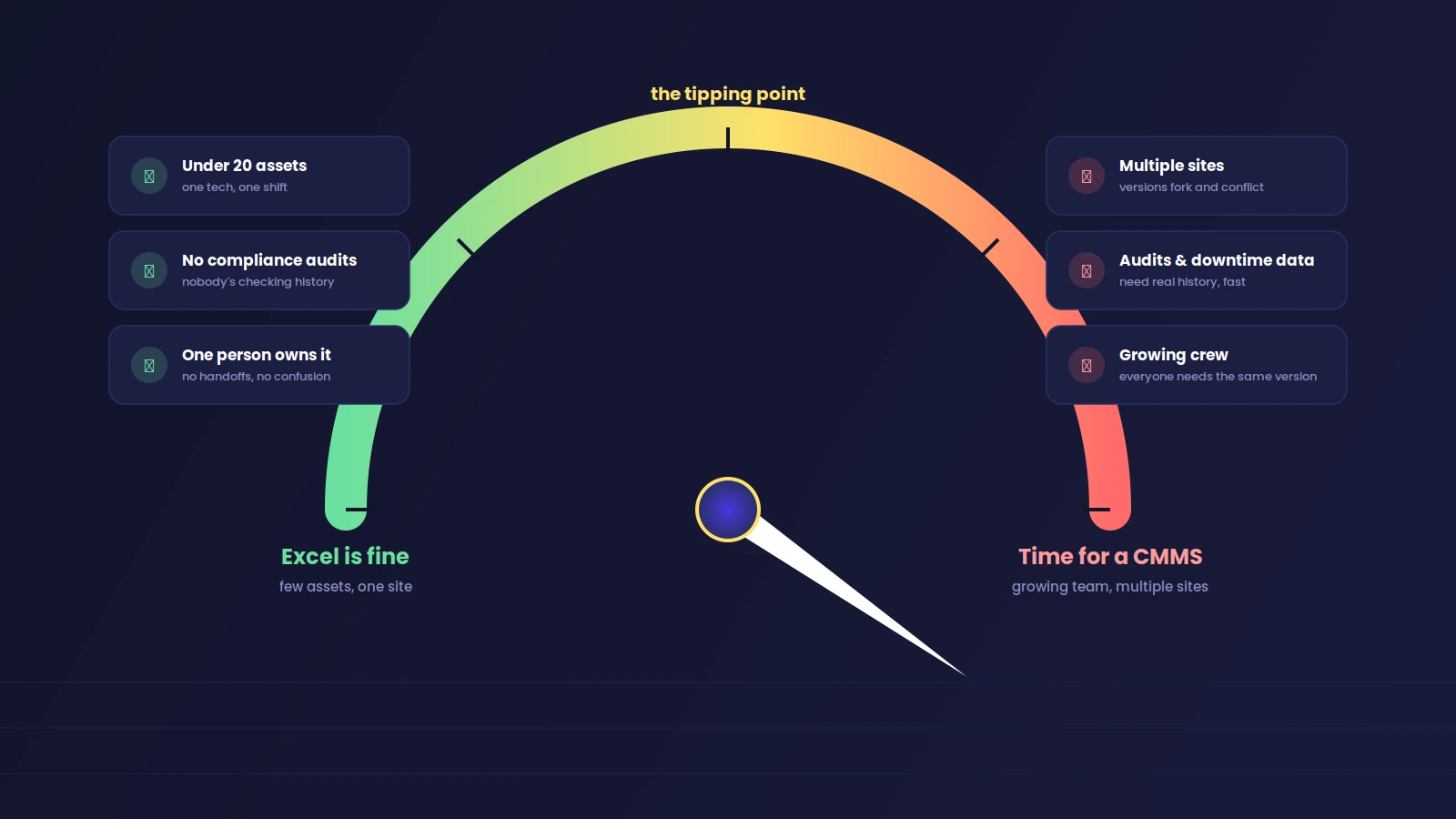
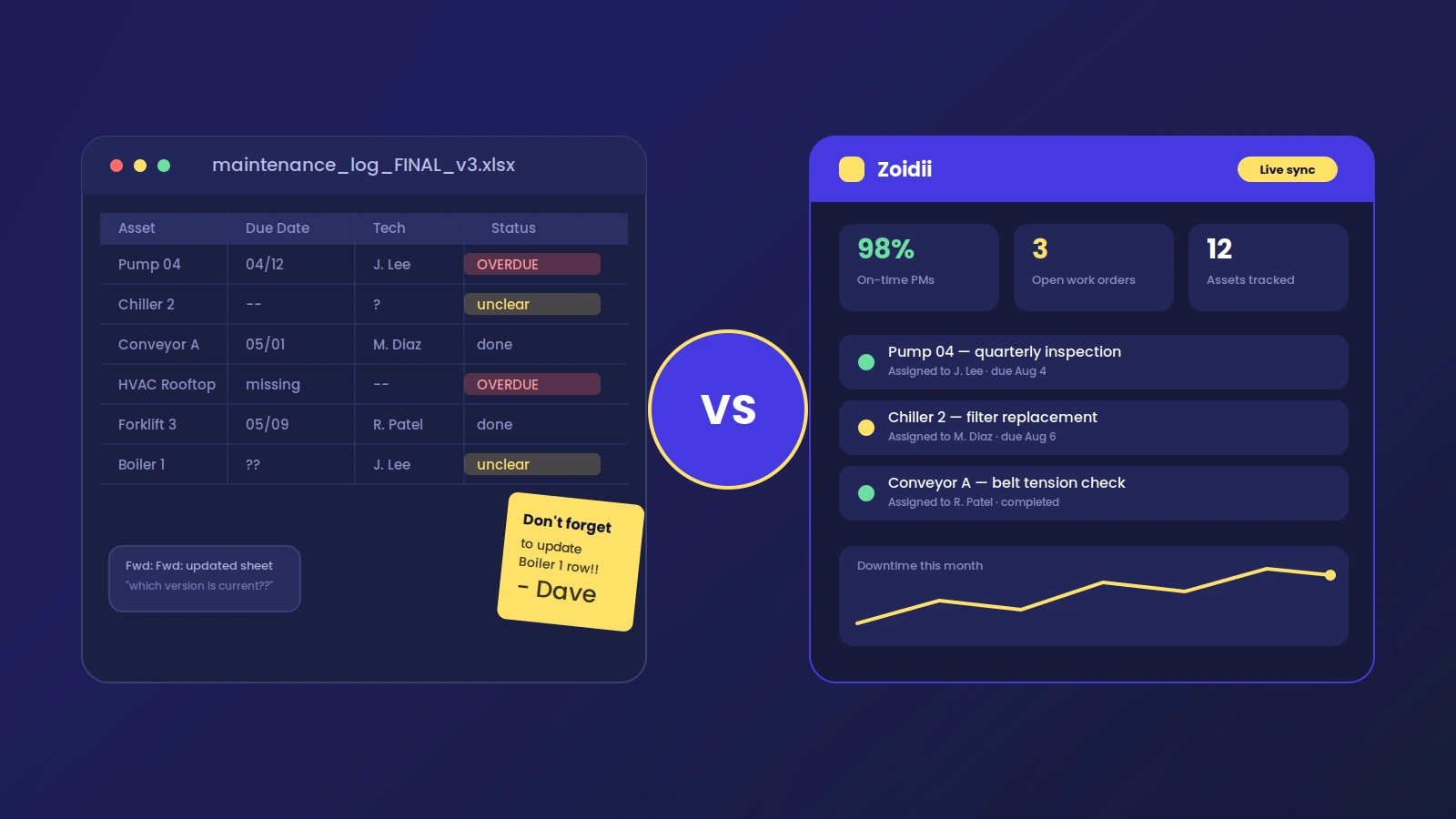
Most managers think they're saving money by sticking to "free" tools like Excel or physical logbooks. They're wrong. These methods are actually a data graveyard where critical information goes to die.
In 2026, 64% of US facility managers are still caught in the spreadsheet trap, leading to a cycle of reactive fire-fighting that burns out even the best technicians. If your facility management strategy relies on memory and manual tracking, you're not managing; you're just waiting for the next disaster.
Reactive mindsets are a recipe for operational failure. Waiting for a chiller to die before looking at it isn't a plan. It's a gamble that usually ends in an expensive emergency. This approach creates massive information silos where the night shift has no clue what the morning shift fixed.
Without a digital record, there's zero accountability. If a work order isn't logged in a centralized system, it didn't happen. You can't prove ROI to the C-suite with a handful of greasy paper notes and a "trust me, we're busy" attitude.
The Hidden Cost of Paper-Based Systems
Manual data entry is a massive productivity killer. Your team should be fixing assets, not filling out forms or "walking the floor" just to give you a status update. There is also a significant compliance risk involved with physical records.If an auditor shows up today, you need to produce fire safety and HVAC certs in seconds, not hours spent digging through filing cabinets. The "paper trail tax" is the loss of 20% of technician productivity due to outdated, manual processes.
Overcoming the 'If It Ain't Broke' Mentality
You have to shift your culture from fire-fighting to preventive planning. It starts by using data to prove that preventive maintenance is significantly cheaper than emergency repairs. Most emergency fixes cost 3x to 10x more than a scheduled PM. Present these blunt truths to your stakeholders to get the buy-in you need.Show them that the "if it ain't broke" mentality is the primary reason the US deferred maintenance backlog has exceeded $735 billion in 2026. Realize that your goal is to move from chaos to control by making your operations stupid simple.
Core Competencies of a 2026 Facility Manager
Modern facility management isn't a job for the tech-averse. In 2026, you don't need to be a programmer, but you must be a master of technology integration. This means building a tech stack that's stupid simple to ensure your team actually uses it. If a technician has to jump through hoops to log a PM, they'll just stop doing it.
You realize success when your tools fade into the background and let your people focus on asset reliability. You need to know the exact lifecycle stage of every pump, motor, and roof in your portfolio to prevent the deferred maintenance backlog from claiming your building.
Sustainability has moved from the marketing department to your desk. With ESG reporting mandates now active across major economies as of 2025, managing energy consumption is a core KPI.
You're the one who has to prove your HVAC isn't bleeding carbon or wasting the company's budget. Whether you're meeting local building performance standards in Toronto or strict fire code regulations in Dublin, compliance mastery is non-negotiable. You need a digital paper trail that's ready for an audit at any second. If you're still digging through folders, you're already behind.
Data Literacy and Reporting
The C-suite doesn't care that you were "busy." They care about the bottom line. You have to move beyond the "we did the work" narrative and start talking about Mean Time to Repair (MTTR) and Planned Maintenance Percentage (PMP).If your PMP is below 80%, you're still stuck in the reactive chaos we discussed earlier. Using service work order software allows you to automate these reports. It turns your daily grind into a clear story of ROI that any executive can understand without needing a translator.
Emergency Preparedness and Risk Management
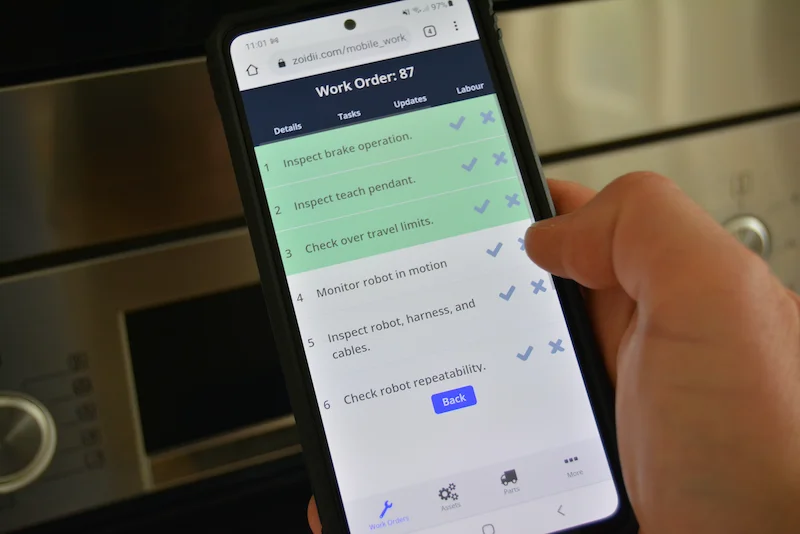
When a critical system fails at 3 AM, panic is your biggest expense. You need stupid-simple SOPs for equipment failure that every team member can access on their phone while they're standing in front of the asset. A CMMS isn't just a database; it's your single source of truth during an emergency. It tells your team which valves to turn and which contractors to call without you needing to play middleman.This level of organization reduces risk and keeps your operations functional when things go sideways. If you're ready to stop the fire-fighting and start leadng, chat with a product expert to see how we get your team organized.
Moving from Reactive Chaos to Proactive Control
Breaking the cycle of reactive chaos requires a deliberate shift in how you handle facility management. You can't just wish for fewer breakdowns; you have to build a system that prevents them. This transition isn't a luxury in 2026. It's a survival requirement for any manager trying to chip away at that $735 billion deferred maintenance backlog. If you're ready to stop fire-fighting and start leading, follow these four steps to regain control of your operations.- Step 1: Audit your assets. You can't manage what you don't track. Every pump, chiller, and fire panel needs a digital identity. If it has a serial number or requires a PM, it belongs in your database.
- Step 2: Ditch the manual tools. Spreadsheets are where data goes to die. They're the primary reason 64% of managers are still struggling with disorganized workflows. Delete the "free" files that are costing you thousands in lost productivity.
- Step 3: Implement a cloud-based CMMS. You need a system that technicians actually want to use. If it's too complex, your team will ignore it, and you'll be right back where you started.
- Step 4: Automate your PM schedules. Stop relying on memory or calendar alerts. Set your preventive maintenance to trigger automatically based on dates or meter readings.
Why Cloud-Based CMMS is the Only Choice
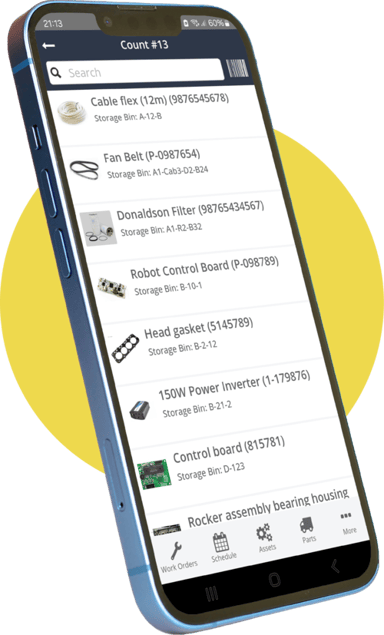
On-premise software is a relic of the past. In 2026, you need real-time updates from the field via mobile apps. Your technicians shouldn't have to walk back to a desk to close a work order. Cloud systems eliminate installation headaches and offer accessibility from anywhere.With SSO integration, you get enterprise-grade security without the friction that slows your team down. It's the only way to maintain a single source of truth for your facility.
How Zoidii Simplifies Facility Management
We built Zoidii to be stupid simple. We know that if the software is over-engineered, your team won't use it. Our platform uses Kanban boards that make visualizing your facility's health effortless.You can see exactly what's open, what's in progress, and what's overdue at a glance. We also included guest work orders, allowing tenants to report issues without needing a login.
This removes the barrier to communication and ensures you hear about problems before they become catastrophes. You realize your goals when your team is organized and your assets are protected.
Ready to stop the chaos? Chat with a Zoidii product expert today.
Stop the Fire-Fighting and Start Realizing Your Goals
You've seen the data. In 2026, relying on spreadsheets is a liability that contributes to the $735 billion deferred maintenance backlog. Effective facility management requires you to ditch the paper trails and embrace a single source of truth.
By auditing your assets and automating your PM schedules, you transition from reactive chaos to proactive control. It's the only way to meet mandatory ESG reporting and prove your worth to the C-suite.
Zoidii is the #1 rated cloud-based CMMS for ease of use. We help teams in Dublin, Toronto, and across the globe get organized without the typical enterprise software headaches.
Our zero-friction setup and guest work order features ensure you catch issues before they turn into expensive disasters. Book a demo to see how Zoidii makes FM stupid simple. You have the roadmap; now it's time to act. Let's get your facility back on track.