
Unplanned equipment downtime now costs manufacturers an average of $260,000 per hour — and that figure keeps climbing. In response, organizations across every asset-intensive industry are turning to reliability engineers to protect uptime, extend asset life, and build data-driven maintenance programs backed by modern CMMS (Computerized Maintenance Management System) software. But what exactly does a reliability engineer do? And how do they use tools like a CMMS to deliver measurable results? This guide breaks down everything you need to know — including the latest 2026 industry data.
What Is a Reliability Engineer?
A reliability engineer is a cross-functional maintenance and operations professional whose primary mission is to identify and manage asset reliability risks that could disrupt production or harm business performance. Unlike maintenance technicians who respond to failures after the fact, reliability engineers take a proactive, data-driven approach — designing systems, analyzing failure patterns, and implementing strategies that prevent problems before they occur. Their work sits at the intersection of engineering, operations, and data analysis, making them one of the most strategically valuable roles in any facility today.Why Reliability Engineering Matters More Than Ever in 2026
The stakes have never been higher. Consider the current landscape:
- Unplanned downtime costs an average of $260,000 per hour (Aberdeen Group, 2025)
- Plants lose an average of 27 hours per month to unplanned downtime — down from 39 hours in 2019, thanks to better predictive tools (Siemens, 2024)
- 80% of facilities still struggle with reactive repair cultures (Plant Engineering, 2024)
- 69% of maintenance professionals are 50 years or older (Plant Engineering), creating an urgent need to capture institutional knowledge
The 3 Core Roles of a Reliability Engineer
Reliability engineering responsibilities can be organized into three foundational areas. Understanding these helps clarify how the role interacts with a CMMS and broader maintenance strategy.
1. Loss Elimination
One of the most impactful responsibilities of a reliability engineer is tracking production losses and high-cost maintenance assets, then systematically reducing or eliminating them. Loss elimination involves:
- Prioritizing assets and processes where failures have the greatest financial or operational impact
- Conducting Root Cause Analysis (RCA) to identify the underlying drivers of recurring failures
- Partnering with operations teams to develop and implement corrective action plans
- Documenting findings and resolutions in a CMMS to build a searchable asset history
2. Risk Management
Reliability engineers take a quantitative approach to evaluating operational risk. They work with leadership, maintenance teams, and operations personnel to:
- Conduct Failure Mode and Effects Analysis (FMEA) to identify weak points before they fail
- Assess risks related to environmental health and safety, asset capability, quality, and regulatory compliance
- Recommend and implement maintenance strategies — including Reliability-Centered Maintenance (RCM), condition-based maintenance (CBM), and Total Productive Maintenance (TPM)
- Ensure that critical assets receive appropriate attention before issues escalate
3. Life Cycle Asset Management (LCAM)
Reliability engineers think beyond the next work order. They plan for the full life cycle of every asset — from commissioning and installation through operation, maintenance, and eventual replacement. LCAM includes:
- Collaborating with engineering teams on production design and new equipment specifications
- Planning MRO (Maintenance, Repair, and Operations) inventory to ensure parts are available when needed
- Evaluating repair-vs.-replace decisions using value analysis
- Setting inspection schedules and testing protocols tied to asset criticality
Key Responsibilities: What Does a Reliability Engineer Do Day-to-Day?
Beyond the three core focus areas, reliability engineers carry a broad set of daily and ongoing responsibilities:
Predictive Maintenance & Condition Monitoring: Reliability engineers implement and oversee condition monitoring programs — using vibration analysis, thermography, oil analysis, and ultrasonic testing — to catch early warning signs of equipment degradation. When integrated with a CMMS, sensor alerts automatically generate work orders, closing the loop from detection to repair.
FMEA and RCM Analysis: These structured analytical tools help identify the most likely failure modes for critical assets, assess their consequences, and select the most cost-effective maintenance tasks to mitigate them.
Work Order Analysis & CMMS Utilization: Reliability engineers regularly review work order data in the CMMS to identify recurring failures, measure Mean Time Between Failures (MTBF) and Mean Time To Repair (MTTR), and use those KPIs to drive continuous improvement.
Knowledge Capture and Team Development: With nearly 70% of maintenance professionals nearing retirement age, capturing institutional knowledge is critical. In 2026, the top reported benefit of AI in maintenance is knowledge capture and sharing — ahead of even failure reduction. Reliability engineers play a key role in standardizing job plans and procedures within the CMMS so that knowledge is preserved and accessible to newer technicians. Cross-Functional Collaboration: Reliability engineers serve as a bridge between production, engineering, maintenance, and management — translating technical findings into business outcomes and aligning maintenance strategy with organizational goals.
The Reliability Engineer's Toolkit: Methods and Frameworks
Reliability engineers draw on a well-established set of methodologies, often supported by CMMS software:
How CMMS Software Empowers Reliability Engineers
A CMMS is the operational backbone of a reliability engineering program. It transforms raw maintenance activity into structured, searchable data that reliability engineers can use to make better decisions — faster.
Here's how a CMMS directly supports each area of reliability engineering:
Centralizing Asset History: Every work order, inspection, failure event, and repair record is logged in one place. A full asset history gives reliability engineers a complete picture of asset health over time — essential for FMEA, RCA, and life cycle planning.
Automating Preventive Maintenance Schedules: Rather than relying on spreadsheets or tribal knowledge, a CMMS automatically triggers PMs based on time, usage, or condition thresholds — ensuring nothing falls through the cracks.
Enabling Predictive Maintenance: When integrated with IoT sensors and condition monitoring tools, a CMMS receives real-time asset data and triggers work orders the moment an anomaly is detected. This is the foundation of moving from reactive to predictive maintenance.
Tracking Reliability KPIs: A CMMS makes it easy to monitor MTBF, MTTR, unplanned downtime percentage, PM compliance, and maintenance cost per production hour — giving reliability engineers the data they need to prove ROI and guide strategy.
Supporting the Skilled Labor Transition: As experienced technicians retire, a CMMS becomes the repository for the knowledge they carry. Standardized job plans, troubleshooting steps, and repair procedures stored in the CMMS ensure that expertise is never lost when someone walks out the door.
The numbers reinforce this: organizations that prioritize CMMS data quality see unplanned maintenance rates 20 percentage points lower than those with poor data discipline — a direct impact on costs, safety, and production output.
Reliability Engineer vs. Maintenance Engineer: What's the Difference?
These roles are often confused — but they serve distinct functions:
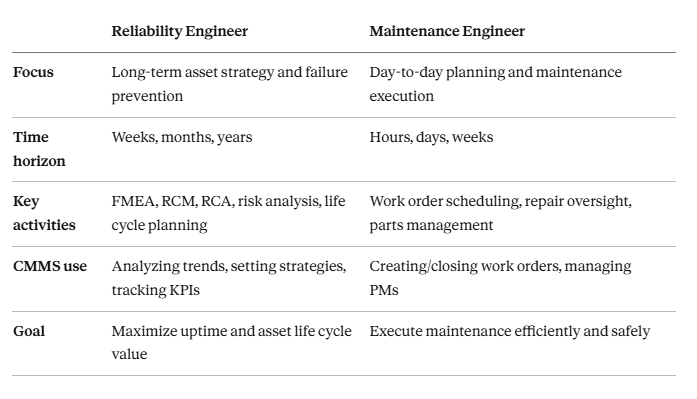
In many facilities, reliability and maintenance engineering work hand in hand. The reliability engineer sets the strategy; the maintenance team executes it — and the CMMS connects both.
Industries That Rely on Reliability Engineers
Reliability engineers are critical in any sector where equipment downtime carries high costs or safety risks:
- Manufacturing — Reducing unplanned stoppages that cost thousands per minute
- Oil & Gas — Managing complex, high-risk infrastructure with extended asset lifecycles
- Utilities & Energy — Ensuring continuous power generation and grid stability
- Pharmaceuticals — Maintaining FDA compliance and contamination-free production
- Mining — Keeping heavy equipment operational in demanding environments
- Facilities Management — Optimizing building systems across commercial and institutional properties
Essential Skills for a Reliability Engineer in 2026
The modern reliability engineer needs a blend of technical expertise and analytical capabilities:
Technical Skills
- Deep knowledge of mechanical and electrical systems
- Proficiency in FMEA, RCM, and RCA methodologies
- Experience with condition monitoring technologies (vibration, thermography, oil analysis)
- CMMS administration and data analysis
- Familiarity with IoT, SCADA, and industrial sensors
- Statistical analysis and reliability modeling (Weibull analysis, MTBF/MTTR calculations)
- KPI development and performance benchmarking
- Root cause investigation and problem-solving
- Cross-functional collaboration and communication
- Change management and influencing without authority
- Documentation and knowledge-sharing
- Certified Reliability Engineer (CRE) — American Society for Quality
- Certified Maintenance and Reliability Professional (CMRP) — SMRPCO
- RCM certifications from recognized industry bodies
The Future of Reliability Engineering: AI, Predictive Maintenance, and CMMS Integration
Looking ahead, the reliability engineer's role is evolving rapidly. In 2026 and beyond, several trends are reshaping the profession:
AI-Powered Maintenance: With 32% of maintenance teams having already implemented AI solutions — and 65% planning to adopt AI within the next year — reliability engineers are increasingly working with machine learning tools that predict failures, optimize PM schedules, and surface troubleshooting steps automatically.
Deeper CMMS-IoT Integration: As sensor costs fall and connectivity improves, real-time condition data flows directly into CMMS platforms, enabling truly predictive — not just preventive — maintenance programs. Reliability engineers who can configure and interpret these integrations will be in high demand.
Knowledge Management as a Core Function: The skills gap created by an aging workforce makes documentation and knowledge capture a strategic priority. Reliability engineers are increasingly responsible for ensuring that asset knowledge lives in the CMMS — not just in the heads of experienced technicians.
Digital Twins: Forward-looking facilities are beginning to use virtual replicas of physical assets to simulate failure scenarios, test maintenance strategies, and optimize performance before changes are made in the real world.
How Zoidii CMMS Supports Your Reliability Program
A reliability engineering program is only as strong as the data and tools that support it. Zoidii CMMS gives reliability engineers and maintenance teams the visibility, automation, and analytics they need to move from reactive firefighting to proactive asset management.
With Zoidii, you can:
- Centralize all asset data, maintenance history, and work orders in one place
- Automate preventive maintenance scheduling and never miss a critical PM
- Integrate with condition monitoring tools to enable predictive maintenance
- Track MTBF, MTTR, downtime, and maintenance costs in real time
- Capture and preserve institutional knowledge across your team
Frequently Asked Questions
What is the primary role of a reliability engineer? The primary role is to identify and manage asset reliability risks that could harm plant or business operations through loss elimination, risk management, and life cycle asset management.
How does a CMMS help reliability engineers? A CMMS centralizes asset history, automates PM scheduling, tracks reliability KPIs, and integrates with IoT sensors to enable predictive maintenance — giving reliability engineers the data they need to make better decisions.
What is the difference between a reliability engineer and a maintenance engineer? Reliability engineers focus on long-term strategy — FMEA, RCM, risk analysis, and asset life cycle planning. Maintenance engineers focus on the day-to-day execution of work orders and PM schedules. Both roles depend on a CMMS to work effectively.
What qualifications does a reliability engineer need? Most reliability engineers hold a degree in mechanical, electrical, or industrial engineering, with certifications such as the CRE (Certified Reliability Engineer) or CMRP (Certified Maintenance and Reliability Professional). What does unplanned downtime cost in 2026? According to Aberdeen Group (2025), unplanned equipment downtime costs manufacturers an average of $260,000 per hour — making reliability engineering one of the highest-ROI investments a facility can make.